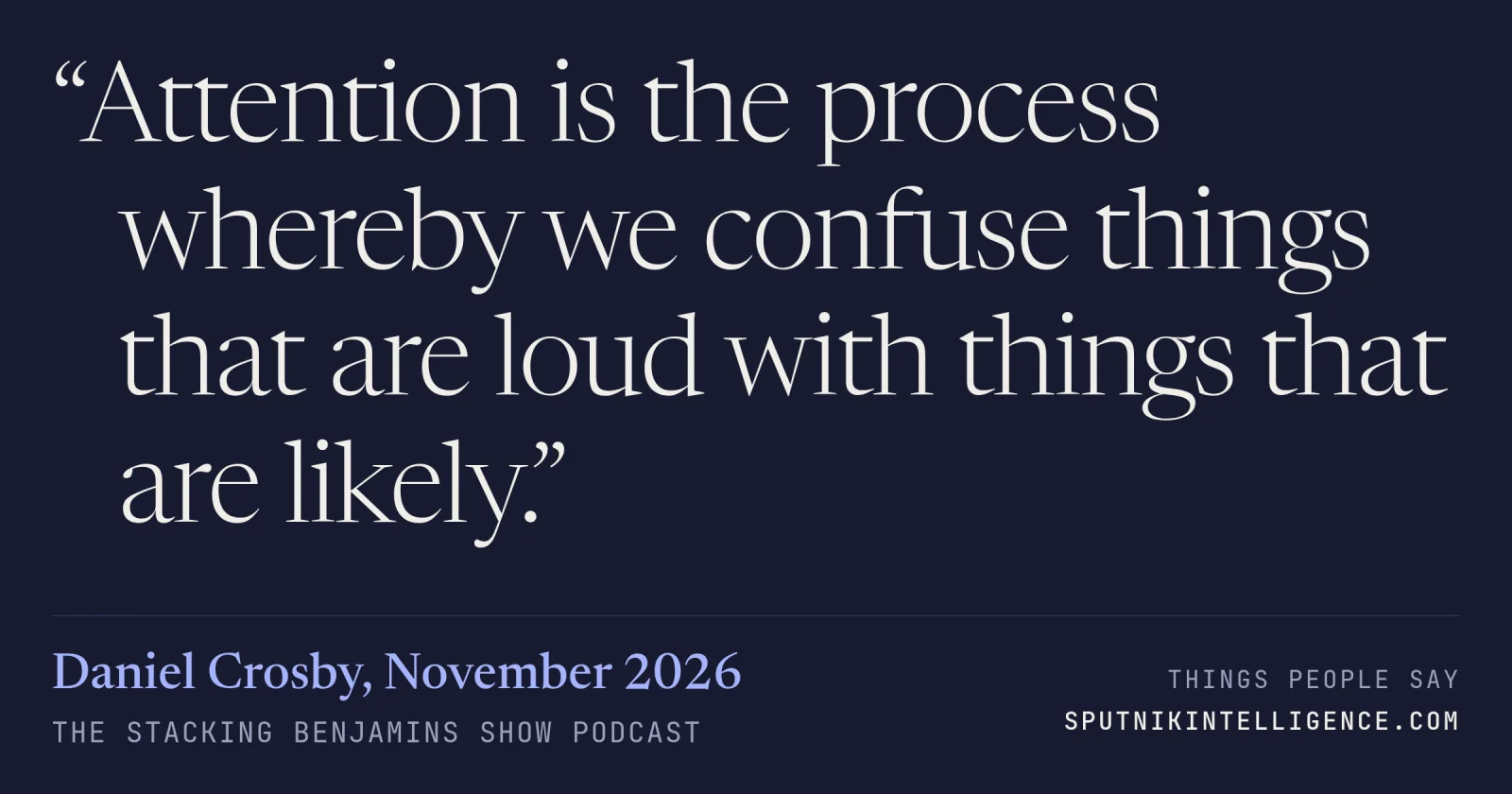
Asked how attention gets investors into trouble, the third of his four behavioral 'troublemakers', the psychologist gives this one-line definition of why headline-driven investing goes wrong.
…watching your portfolio drop 10 or 15%, it's identical. I mean, all the same stuff happens physiologically. That's what leads us to, you know, play it too safe, not take adequate risk, not account for inflation, keep it all under the mattress, that sort of conservatism and its evolutionary roots.
It's also then, I would think, staying alive today versus thinking about staying alive 30 years from now, which is something that, you know, in the time when fewer and fewer people have pensions, we have to pay attention to.
Yeah, absolutely. And again, talk about things we, the things we weren't wired for. My youngest child is 10. And when she was born, I remember the doctor saying to us, like, hey, there's about a 40% chance that she'll live to be 100. I mean, this is a new, this is a new phenomenon that we would have potentially a 40-year working life and then a 40-year retirement. I mean, to say that that has not been the precedent in human history is putting it very mildly. So things have shifted quite a bit, but our capacity to understand them hasn't necessarily.
It is interesting how quickly things are moving. As I got this surgery on my ankle, I was telling Cheryl, I'm like, even if this were the 1850s, in the big scheme of things, not that long ago, this ankle problem, I would have been screwed. I mean, for life, if I had anything that I had to do, and…
Attention is the process whereby we confuse things that are loud with things that are likely. There's lots of people. Oh, in the age
of social media, that never happens. Right. Don't ever have anything loud.