RM

Ricky Mulvey

Things Ricky Says on Podcasts

Where to Find Them

Ricky Mulvey hosts The Indicator (Planet Money) and hosts Planet Money .

Recently: “Can Anthropic make enough money to justify its value?” on The Indicator (Planet Money) (November 2026); “Corporate tax cheats, recession deal eats and costly Halloween treats!” on The Indicator (Planet Money) (October 2026); “Can Montana end Citizens United?” on The Indicator (Planet Money) (October 2026); “Why Meta is giving you Muse for free” on The Indicator (Planet Money) (October 2026); “CoreWeave woes, Pokémon foes, and maple syrup lows” on The Indicator (Planet Money) (October 2026); “The case for sharing your salary” on The Indicator (Planet Money) (October 2026).

What They Said

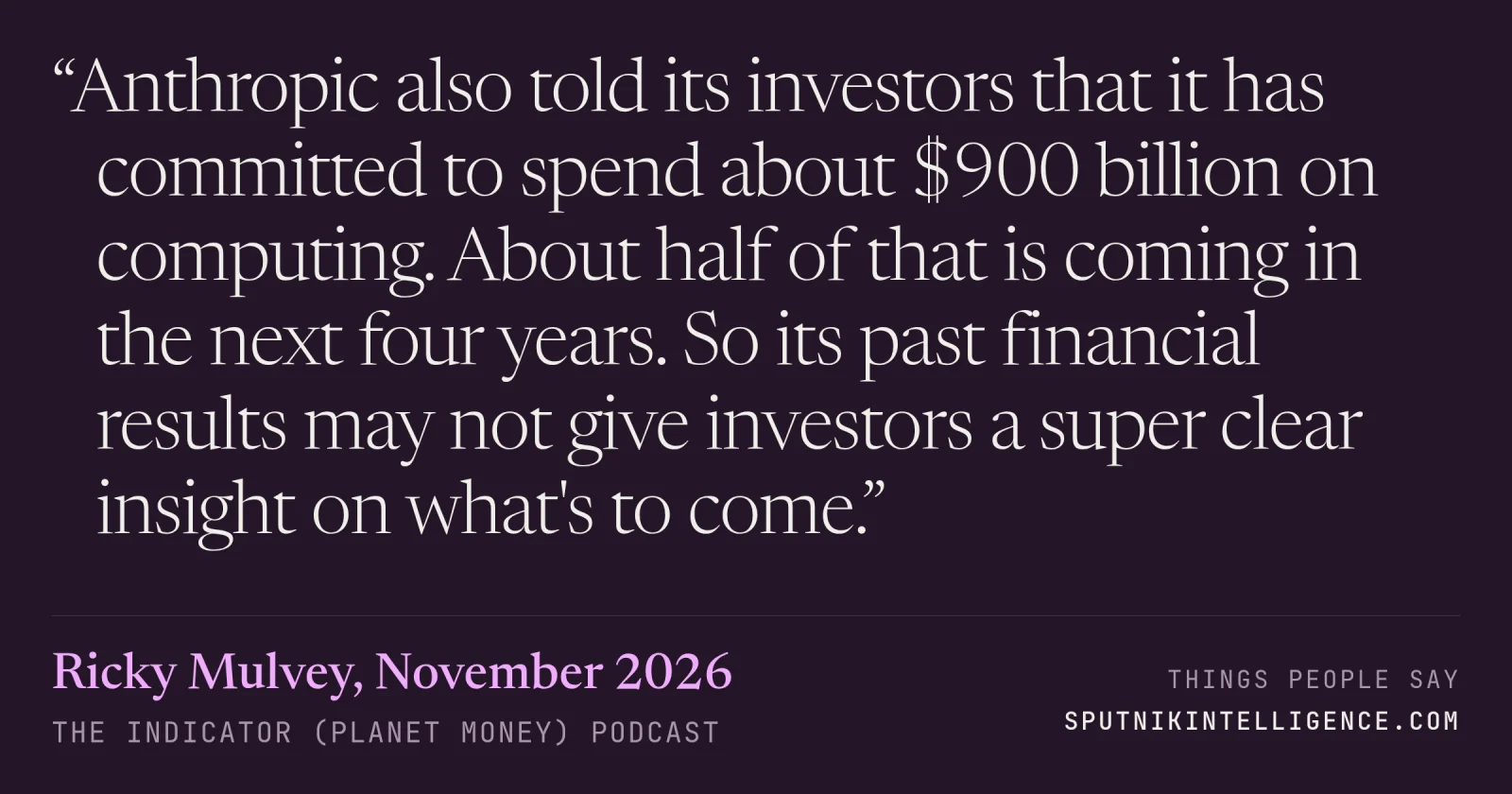
“Anthropic also told its investors that it has committed to spend about $900 billion on computing. About half of that is coming in the next four years. So its past financial results may not give investors a super clear insight on what's to come.” — Ricky Mulvey, The Indicator (Planet Money)

The hosts had just praised Anthropic's lean balance sheet and low capital spending. Ricky Mulvey points to the footnotes of its IPO filing, which show a huge future compute commitment.

The Indicator (Planet Money) · 2026-11-05 Permalink → Listen →
The Indicator (Planet Money) Around 06:14 into the episode
Speaker 1

Financial statements alone can't tell us the full story of a business. We have to use the context provided in the footnotes.

Speaker 2

PB says that you've got to do your homework.

Speaker 3

Anthropic also told its investors that it has committed to spend about $900 billion on computing. About half of that is coming in the next four years. So its past financial results may not give investors a super clear insight on what's to come.

Speaker 4

Anthropic has already changed so much that like 2024 and 2025 feel like ancient history.

Speaker 2

And it's a business that carries a different kind of risk, not just for its investors, but also for you.

Speaker 3

Yeah, companies have to disclose their potential risks when they release their stock to public markets. One of Anthropic's risks is that its AI systems, quote, pose catastrophic or existential risks to humanity.
Speaker names come from our own diarization. The position is estimated from where the line sits in the episode.
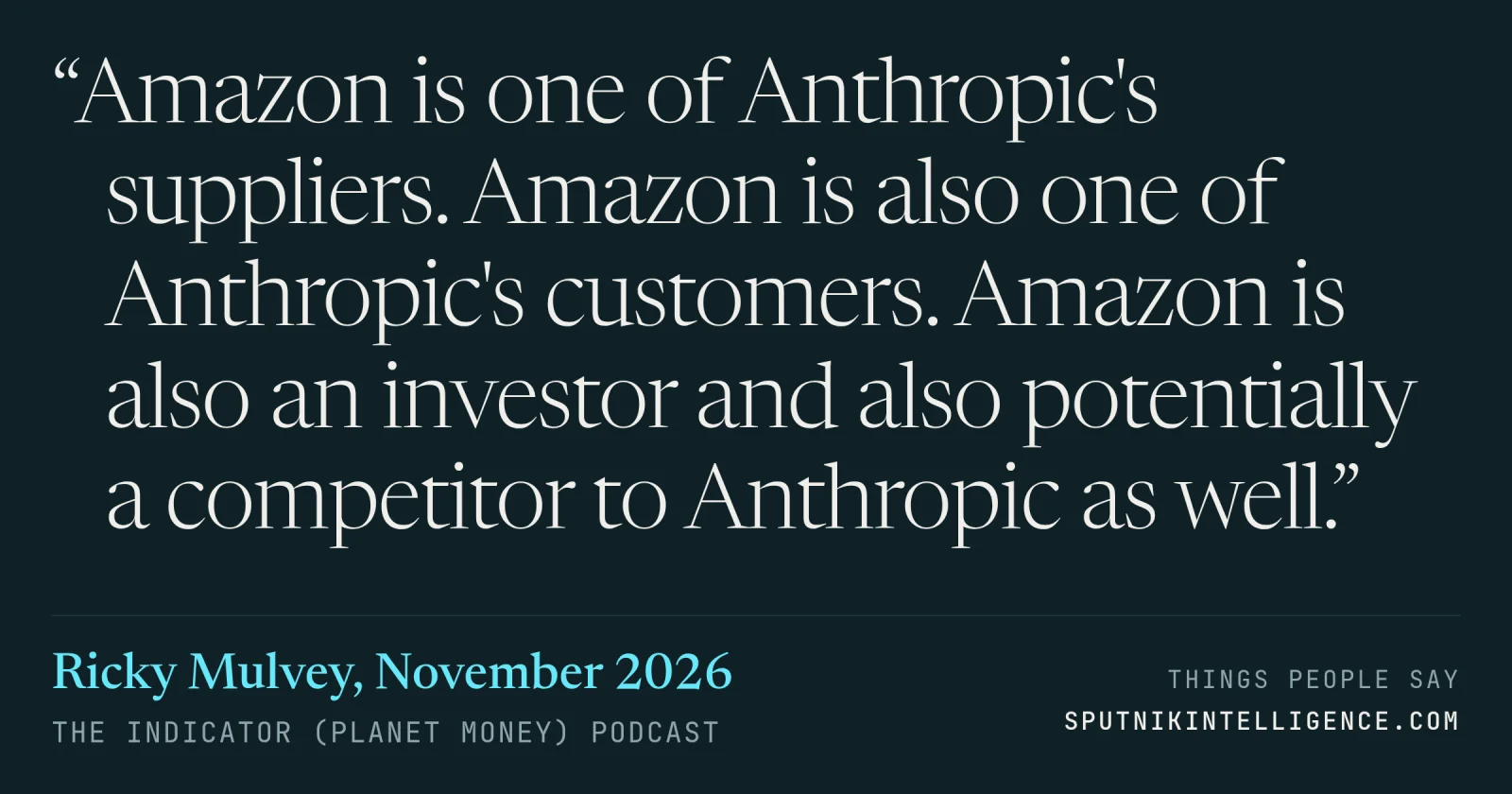
“Amazon is one of Anthropic's suppliers. Amazon is also one of Anthropic's customers. Amazon is also an investor and also potentially a competitor to Anthropic as well.” — Ricky Mulvey, The Indicator (Planet Money)

The hosts were discussing the circular deals of the AI economy, after noting how much Anthropic has committed to spend with Amazon on computing. Ricky Mulvey lays out why this is not a normal company relationship.

The Indicator (Planet Money) · 2026-11-05 Permalink → Listen →
The Indicator (Planet Money) Around 07:27 into the episode
Speaker 3

No matter what, you protect the shareholders, Wayland. So this company has some big questions moving forward. One, can Anthropic keep growing its sales to pay for all of the servers, chips, and cooling systems that it plans on using?

Speaker 2

And how does the AI circular economy fit into all of this? For example, Anthropic owes Amazon $110 billion over the next 10 years because it is buying computing power from it.

Speaker 3

But it's not a normal company relationship here. Amazon is one of Anthropic's suppliers. Amazon is also one of Anthropic's customers. Amazon is also an investor and also potentially a competitor to Anthropic as well.

Speaker 1

Where does it begin? When does it end? No evidence of wrongdoing here, but a unique, very unique arrangement. And so it's like there's a host of companies where like there's multiple relationships with Anthropic.

Speaker 2

And the biggest question for Anthropic's supporters and really society is: can this company create artificial general intelligence? Or in this case, AI models that are able to improve all by themselves without much human involvement?

Speaker 3

Kevin with Machine Gods says that reaching this level is possible and would fundamentally change the economy.

Speaker names come from our own diarization. The position is estimated from where the line sits in the episode.

Collections They Appear In