 Ethan Mollick
I am a professor at the Wharton School of the University of Pennsylvania.
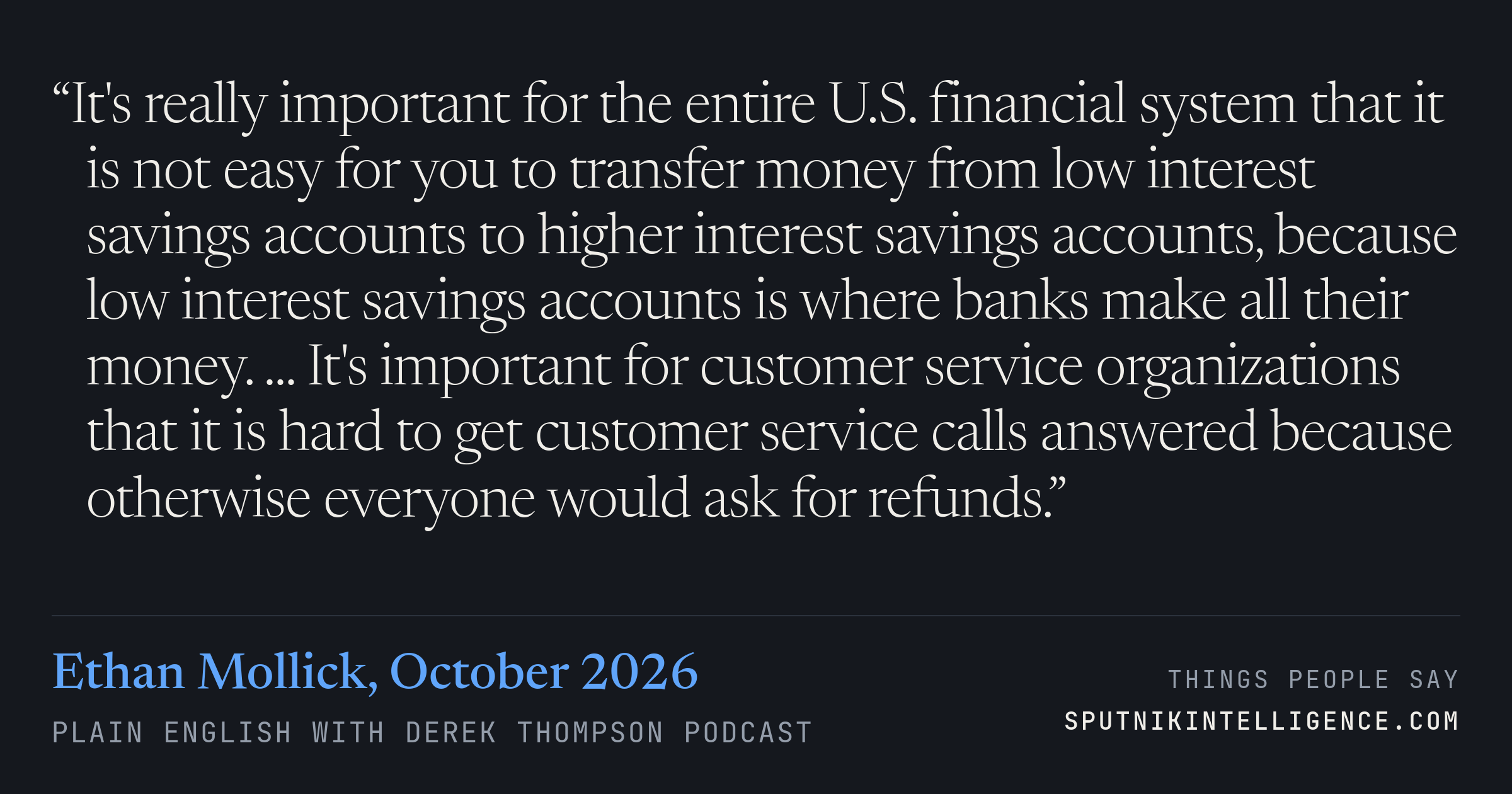
“It's really important for the entire U.S. financial system that it is not easy for you to transfer money from low interest savings accounts to higher interest savings accounts, because low interest savings accounts is where banks make all their money. ... It's important for customer service organizations that it is hard to get customer service calls answered because otherwise everyone would ask for refunds.”
Plain English with Derek Thompson · US Politics · October 2026
Mollick was explaining why personal AI agents like Meta's Muse caught on: they proactively work through the everyday friction in people's lives. His point is that a lot of that friction was never accidental. Companies depend on it, and agents that tear through it threaten those business models.
Transcript
…every LinkedIn post sounds the same right now, but they're much better than they used to be at explaining things. So I don't know. I wonder if we are, we're, you know, I feel the same thing you do, but I kind of wonder if we're making the usual thing, which is, ah, but not us, you know, as well.
…news. I think the most important thing that's happened in the last few weeks has been the release of and the success of Muse, the meta agent. I want you to tell me what you think Muse is teaching us about this moment in AI use and AI technology and what makes this a different kind of technology.
…that were really important for companies that that friction was there, right? It was really important. It's really important for the entire U.S. financial system that it is not easy for you to transfer money from low interest savings accounts to higher interest savings accounts because low interest savings accounts is where banks make all their money, right? And it's too much friction to do. It's important for customer service organizations that it is hard to get customer service calls answered because otherwise everyone would ask for refunds. So Muse breaks that friction down and just does stuff for you in a way that doesn't require imagination. And I think makes the personal AI real.
Is there any kind of financial moat that a company has over these kind of agents? Or is this the kind of thing where like Meta has Muse and OpenAI has DOT and it's they're all like offering what is essentially the same technology, which means that no company can charge ordinary users any kind of…
Well, I mean, there's a few things there. One is, I think this is where the companies that have frontier models and, you know, and Muse is near Frontier, but there is a, they have their own model underlying it, right? DOT is obviously run by Astra and other models. I think not having a frontier…
So Where’s two ways to think about the introduction of these new kinds of agents. One, you can think about it from the user side, which is, you know, how are people going to become comfortable with giving lots of private information over to an agent that is essentially spying in a friendly way on…
More from Plain English with Derek Thompson