 Ethan Mollick
I am a professor at the Wharton School of the University of Pennsylvania.
“Letters of recommendation are valuable because they're setting time on fire as a recommendation for somebody. And the quality of the letter often matters less than the fact that the person agreed to write it.”
Plain English with Derek Thompson · US Politics · October 2026
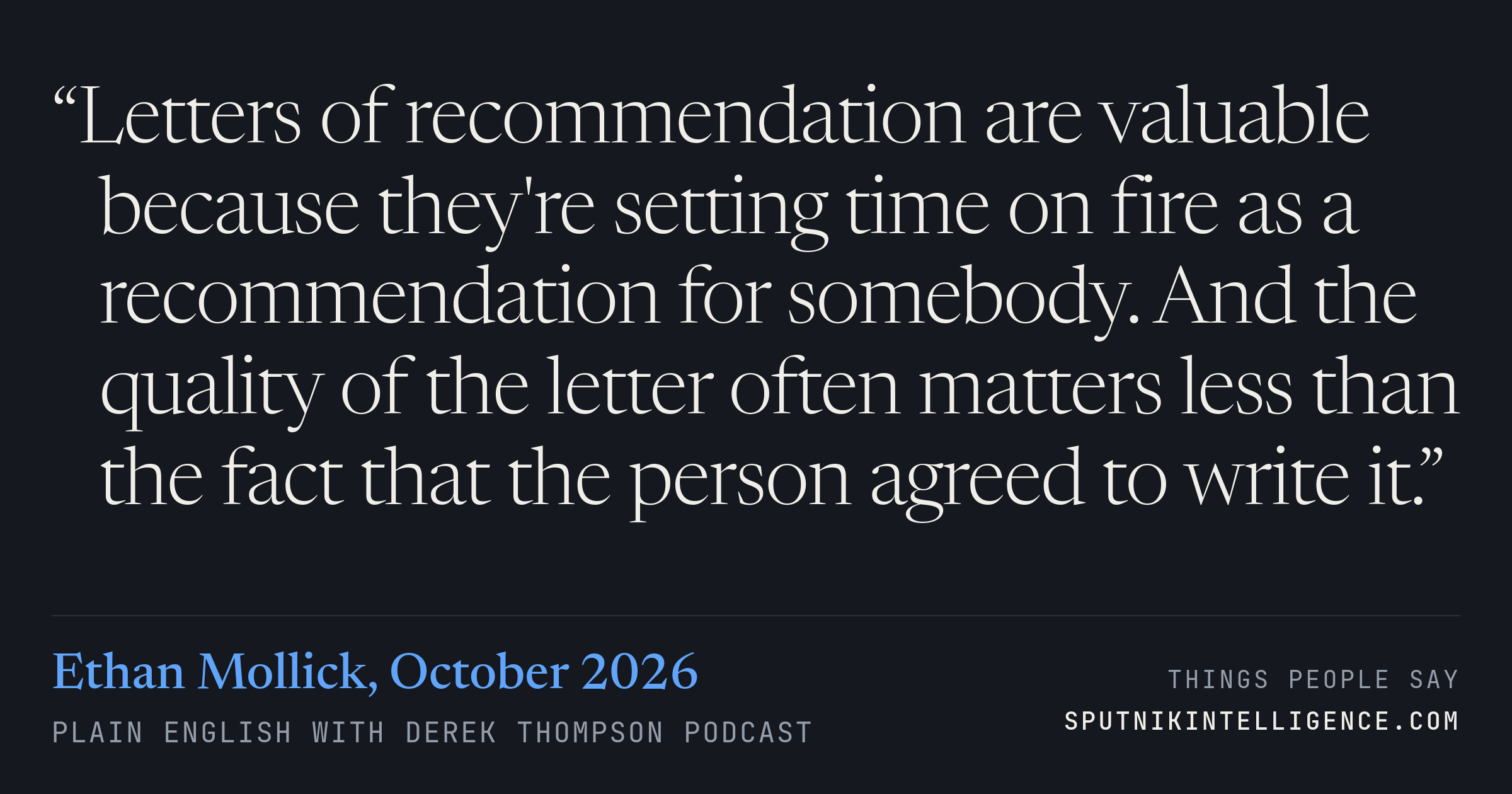
Asked when human effort is essential, Mollick said people first handed AI the most personal writing, like wedding vows and obituaries. He then described asking his students whether they'd rather have a 45-minute letter he wrote himself or a better two-minute AI letter. Every one of them picked the AI letter.
Transcript
…already know how to trade. You've done it your whole life. And TD Easy Trade taps into that instinct so you can build something real. No minimums, no monthly fees, 24-hour support. No investor personality required. Because you are made to trade. And TD Easy Trade is made to help. Download it now.
…can't take three minutes to write an obituary with your own human fingers. And on the other hand, I mean, if the words work for the mother who lost her child, who the fuck am I to tell that mother that the words don't work for her? It's her child. It's her obituary. When is human work essential?
…the question is: is the effort worth it? Is the effort of sitting down and agonizing over this? You know, is that what you want to do? Or do you want to summarize a life? You know, wedding vows, people have copied wedding vows forever from, you know, books of wedding vows or adapted them. Like, I think we're getting fronting where does human effort matter? And the more much more banal side, letters of recommendation are valuable because they're setting time on fire as a recommendation for somebody. And the quality of the letter often matters less than the fact that the person agreed to write it. And I asked my students at one point, like, would you rather I spend my normal 45 minutes writing a letter that's only an okay letter? Because I could only write so much in 45 minutes, but I will read all your stuff. think about it. Or would you rather me do in two minutes with AI if no one can detect it's AI, but it's better written and better for your job that you're applying for. Everyone…
the whole letter. That way you.
People do that actually, too, right? Like that's another thing you see people do is give letter. So like the question is, what was the value of that human work? And by the way, leaving aside obituaries, we're also seeing this breakdown because court filings used to be hard to do. So that was a…
Last question on your book. You say that there are four human advantages. Deep knowledge, wide knowledge, taste, and agency. Can you briefly define each of these human advantages and tell me which one of the four you think will become more important even as AI gets better and better?
More from Plain English with Derek Thompson