 Robert Leshner
CEO and co-founder of Superstate, an asset management firm that builds infrastructure for investment funds, and an investor at Robot Ventures.
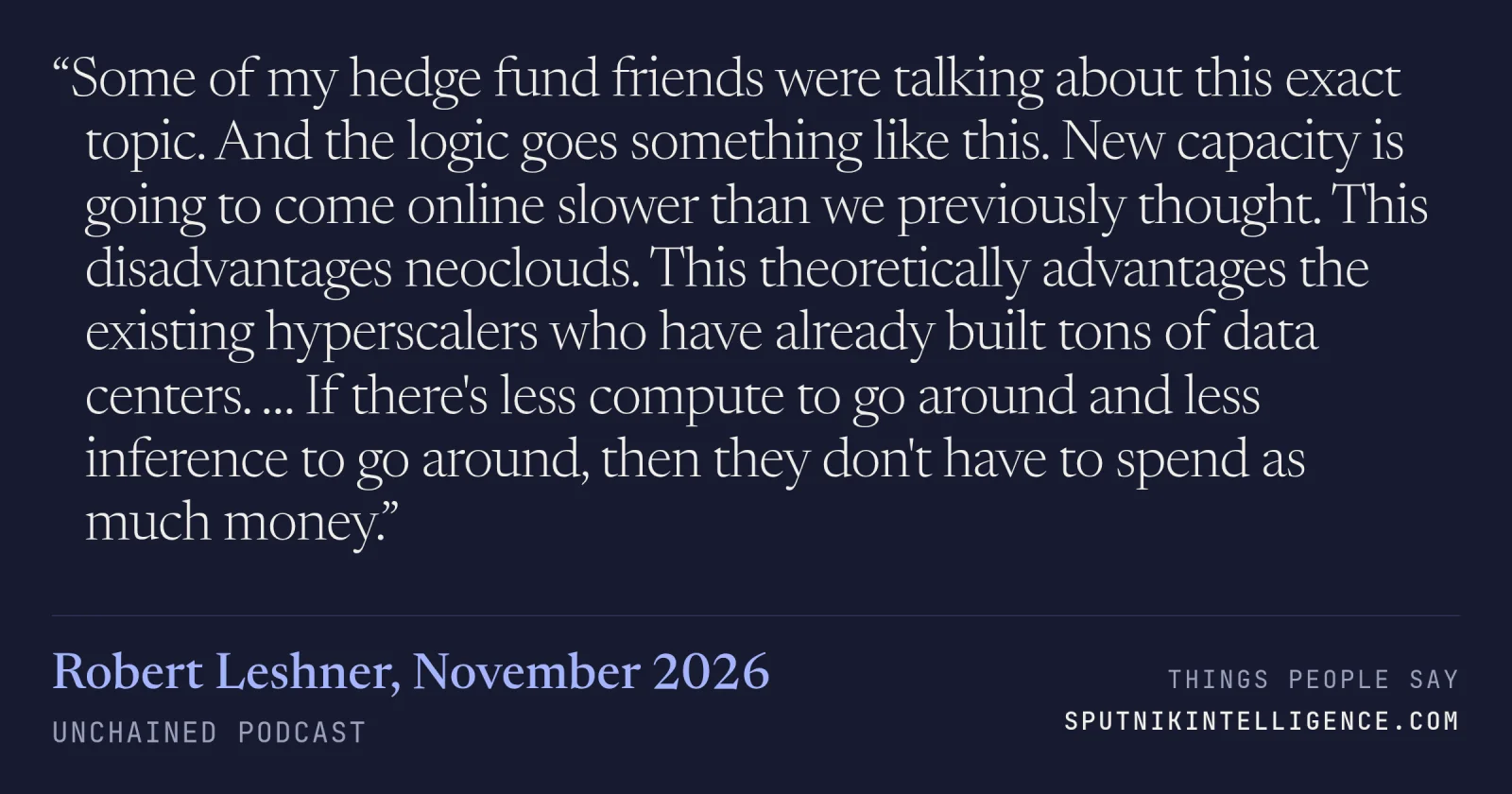
“Some of my hedge fund friends were talking about this exact topic. And the logic goes something like this. New capacity is going to come online slower than we previously thought. This disadvantages neoclouds. This theoretically advantages the existing hyperscalers who have already built tons of data centers. … If there's less compute to go around and less inference to go around, then they don't have to spend as much money.”
Unchained · Crypto & Web3 · November 2026
Context
A co-host noted that Anthropic-linked markets rose after the midterms even though several data-center states flipped. Leshner explains why some hedge funds think slower data-center buildout helps the companies that already have compute.
Transcript
getting regulated or whatever, right?
…now. Yes, that's right. I mean, you know, with this blue wave, it's interesting to me that like you see in the Anthropic perps, Anthropic's clearly up over the last 24 hours. Surprising because so many of the states that ended up flipping were like the data center states and they went blue.
This is actually why. So some of my hedge fund friends were talking about this exact topic. And the logic that they were using goes something like this. New capacity is going to come online slower than we previously thought, right? This disadvantages neoclouds. This theoretically advantages the existing hyperscalers who have already built tons of data centers, whether they fully retrofit that for new AI use cases or not. In some ways, it directly benefits the competitive dynamic of the frontier companies in the aggregate. Because if there's less compute to go around and less inference to go around, then they don't have to spend as much money. Their commitments are lower. If it affects everybody equally, it's a good thing. It's almost like the pacing that they were asking for, but in a fair, more uniformly distributed way. And so theoretically, it like reduces their like CapEx burden and it allows them to like continue delivering their models, but without having to spend the bajillion dollars that they've committed.
Right. But a lot of their spending commitments are locked in, but it means largely they can't. But if they're if that
compute's not delivered to them, they don't have to spend for it.
Yeah, I think, I think Robert's point is more that like, you know, competitors, you know, are now sort of suffocated off from new compute. It's like they bought all the chickens and so you can't start a new restaurant. And even if the chickens don't ever end up happening, you're still not going to…
More from Unchained