 Ben Buchanan
Twitter: @01Core_Ben || Trying to get rich and live forever - happily.
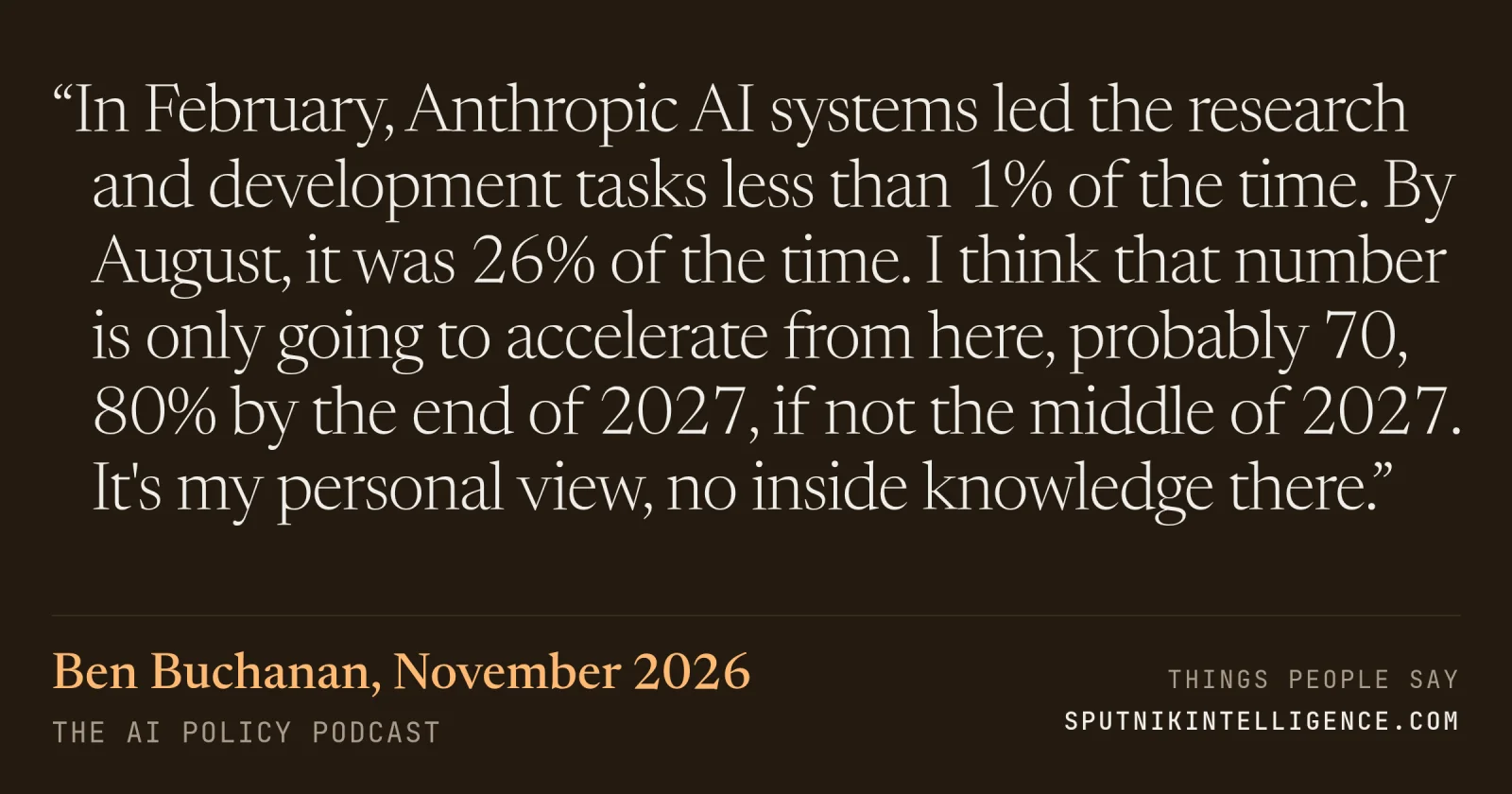
“In February, Anthropic AI systems led the research and development tasks less than 1% of the time. By August, it was 26% of the time. I think that number is only going to accelerate from here, probably 70, 80% by the end of 2027, if not the middle of 2027. It's my personal view, no inside knowledge there.”
The AI Policy Podcast · Geopolitics & World Affairs · November 2026
Context
Asked at the end if he wanted to flag anything, he says AI is moving faster than he expected, pointing to AI systems helping build their own successors. His conclusion: policymakers do not have much time.
Transcript
…to some people in 2021, 2022. So I think I'm very proud of that. And I think that that is less a personal accomplishment, though we had a role in it, and more an accomplishment of a lot of people on both sides of the aisle who have recognized the technology, where it's going, and what's at stake.
…I mean, we've talked about a lot of things. Is there anything major that you wanted to flag, either from your book, from your time at the White House, from the work you've been doing since you left the White House that you think that is important that we haven't had a chance to talk about yet?
One thing we haven't talked about, and this has been a very great conversation in terms of a lot of detail on important national security matters, we haven't spent as much time on the technology itself. And I think I want to. Leave listeners with this point, which is we had a conviction this technology would move fast. And probably the two people in the government who were the most, to use the Silicon Valley phrase, AGI pilled, were Tantim and myself. And we spent four years going through the government saying, this is coming. We got to be ready. It's going to matter for national security. We have to act. And people, Jake Sullivan, Bruce Reed, ultimately the president, gave us a lot of leeway and other folks who worked with us a lot of leeway in getting the policies we wanted. I, of course, wanted probably 30% more than we got, but we got a lot. In some sense, for all of our conviction about how much this technology mattered and how fast it was going, it's going even faster than we thought. And due to things like the continued scaling of computing power, the dawn of recursive…
Well, I think, and I would encourage the audience to take a look at this book, The Bitter Struggle. I think, you know, we've talked about some of the things that stood out to me, but like overall, I think what I took away from it is that it provides insight into how decisions are made in a…
them. I don't think NVIDIA loved them. But it's worth pointing out when we put the chip controls in place, NVIDIA was worth $350 billion and now they're worth like $4 or $5 trillion. So if NVIDIA was the biggest loser of our policies, their stocks got up 15x and they've done pretty well.
So this was the period when the federal government was making decisions right after the release of ChatGPT. We entered the LLM era. And so the book really walks through how some of those decisions were made and why they were made and some of the convictions and ideology driving that. And I think…
More from The AI Policy Podcast