 Anna Lembke
Professor of Psychiatry and Behavioral Sciences at Stanford University School of Medicine, chief of the Stanford Addiction Medicine Dual Diagnosis Clinic and pr...
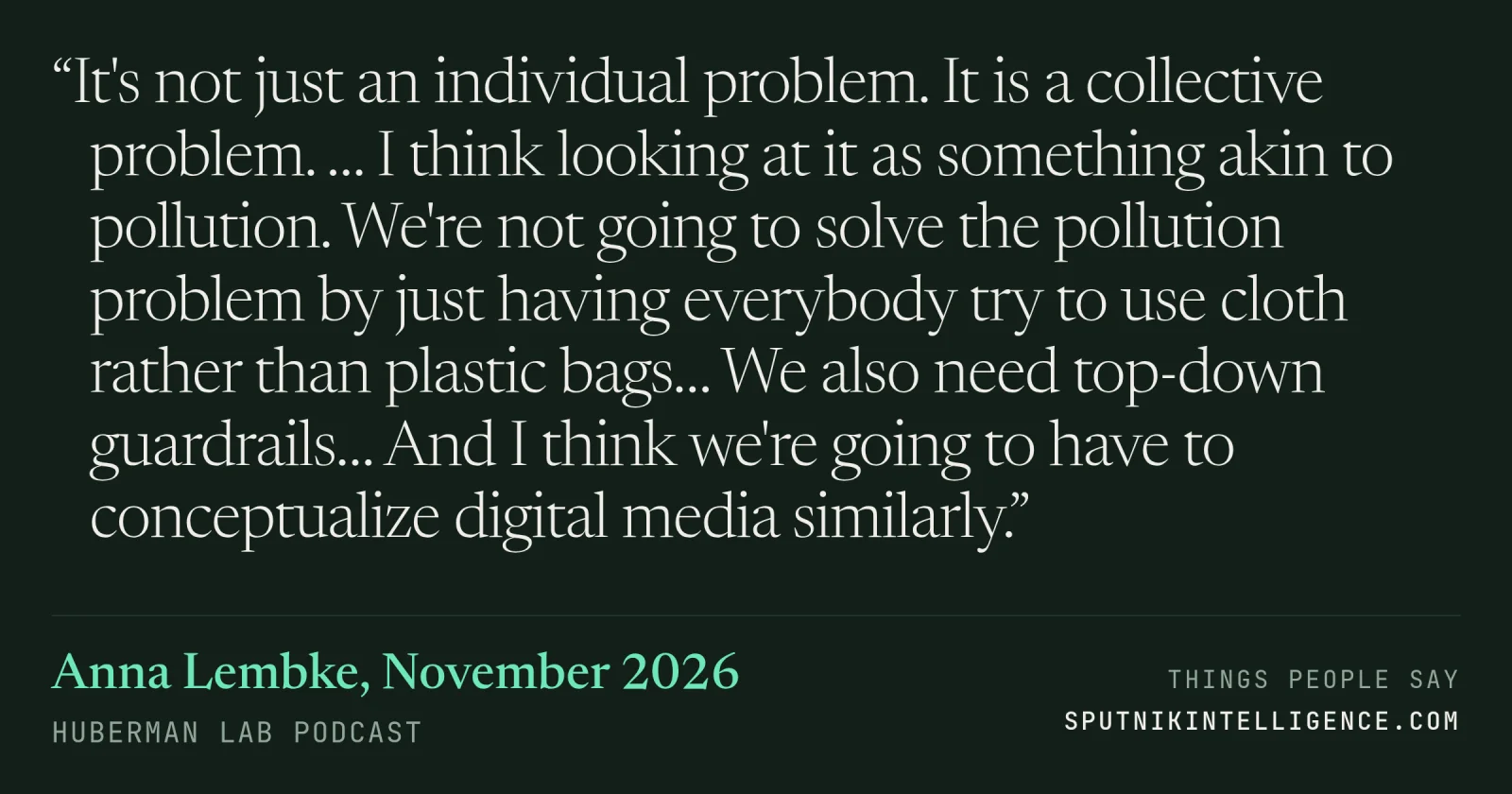
“It's not just an individual problem. It is a collective problem. … I think looking at it as something akin to pollution. We're not going to solve the pollution problem by just having everybody try to use cloth rather than plastic bags… We also need top-down guardrails… And I think we're going to have to conceptualize digital media similarly.”
Huberman Lab · Health & Longevity · November 2026
Context
Huberman said that opting out of social media is hard because it is tied to work and friendships. Lembke answered that this is a shared problem, comparing digital media to pollution that needs rules from governments and companies, not just individual willpower.
Transcript
Yes.
…to a party and not drink and get some of the experience, but not all the experience. Now that's different with fewer people drinking. Yes. But with digital addictions, it's almost like the opt-out can seem or perhaps it's pretty bleak to people. Like who else, who are you going to talk to and how?
…looking at it as something akin to, let's say, pollution, right? We're not going to solve the pollution problem by just having everybody try to use cloth rather than plastic bags, although we could try to do that and that would be a good thing. We also need top-down guardrails like controlling the amount of waste that people can dump into rivers and oceans and into the air and all of that stuff. And I think we're going to have to conceptualize digital media similarly. Like we as individuals have agency and need to exercise that agency, but we also need governments, schools, corporations that make and profit from these digital devices to really come to the table and help us help ourselves as we recognize the inshittification, and you've probably heard that term of technology where first the product adds value, but as time goes on, it's engineered to actually…
Take us back to the circuitry, the brain circuitry that underlies these and all forms of addiction. You could tell us about dopamine and the circuitry and what's involved in resetting the circuitry.
So dopamine is a neurotransmitter. Neurotransmitters are molecules that we make in our brains that allow for fine-tuned control of the electrical circuits. Our brain is basically a bundle of wires. Those are the neurons, but they don't actually connect end-to-end. There's a gap or space between…
And even though the data you just cited are from rodents, can we assume that parallel kind of scaling of dopamine with different behaviors and substances is also occurring in humans?
More from Huberman Lab