 Ben Buchanan
Twitter: @01Core_Ben || Trying to get rich and live forever - happily.
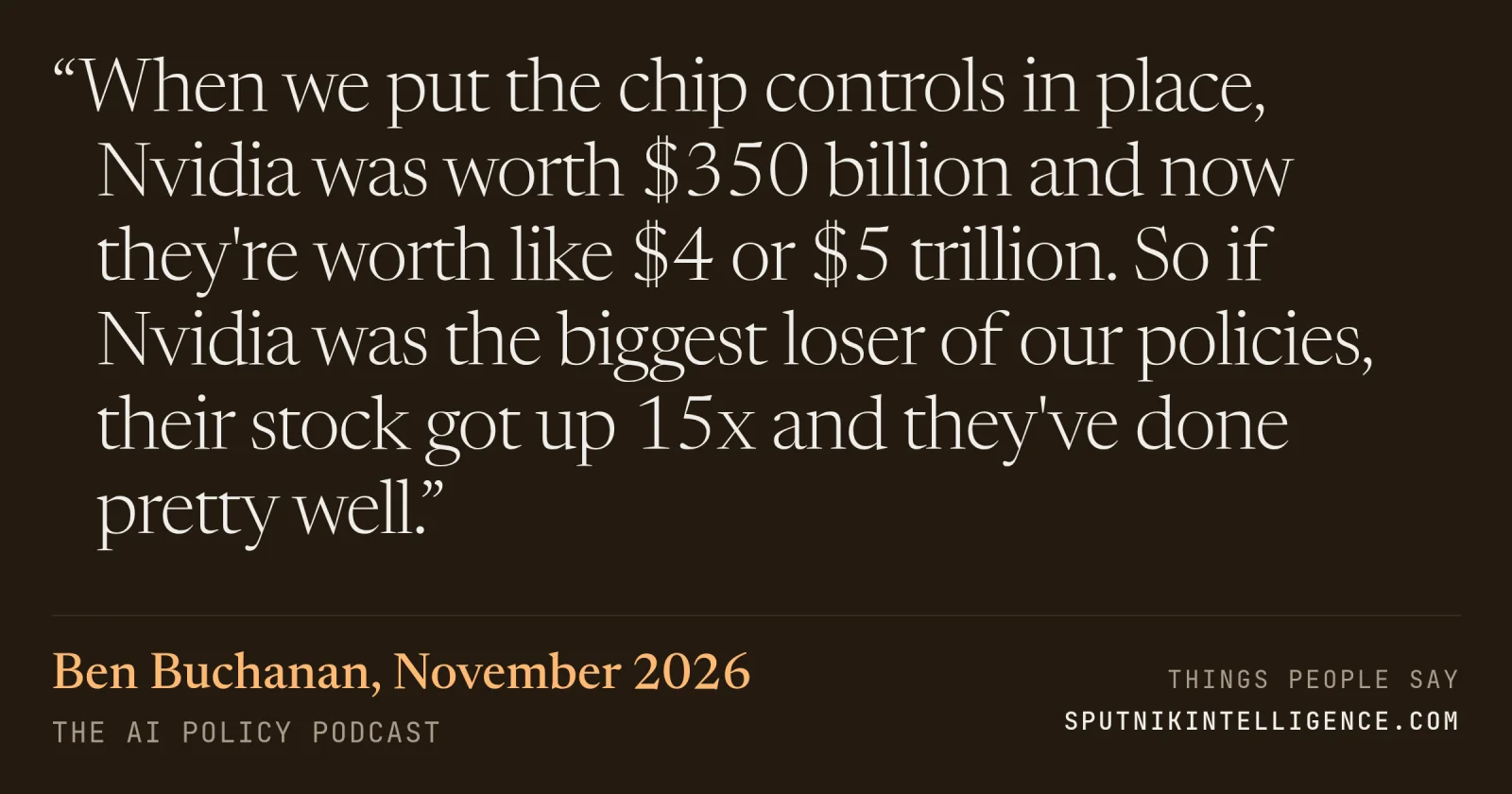
“When we put the chip controls in place, Nvidia was worth $350 billion and now they're worth like $4 or $5 trillion. So if Nvidia was the biggest loser of our policies, their stock got up 15x and they've done pretty well.”
The AI Policy Podcast · Geopolitics & World Affairs · November 2026
Context
The host noted Nvidia never liked the chip export controls the former White House adviser helped put in place. This is his reply.
Transcript
…middle of 2027. So what that means is just an extraordinary amount of technological force that's coming on the game board here that the U.S. government is going to have to manage. And that means the policymakers do not have a lot of time. So they're going to have to act whether they like it or not.
…that stakeholders have. And so, and so like a lot of the decisions that you arrived at were the results of sort of messy compromises that maybe made no one happy, but also ideally made no one especially unhappy either. Maybe that's too idealistic. But anyway, you know, I don't think NVIDIA loved
them. I don't think NVIDIA loved them. But it's worth pointing out when we put the chip controls in place, NVIDIA was worth $350 billion and now they're worth like $4 or $5 trillion. So if NVIDIA was the biggest loser of our policies, their stocks got up 15x and they've done pretty well.
So this was the period when the federal government was making decisions right after the release of ChatGPT. We entered the LLM era. And so the book really walks through how some of those decisions were made and why they were made and some of the convictions and ideology driving that. And I think…
Thanks so much for having me. We wrote this book because we wanted to do exactly what you said that we wanted to describe what we were thinking when we made these decisions, what happened in the Biden administration. We also wanted to describe what we think is coming next. And again, I think…
I think it also is, I think, bold and risky to write a book-length manuscript on AI, given how fast AI is evolving. And so I appreciate you also doing the work to put that down, knowing that maybe in some ways, a significant part of what you wrote might be outdated by the time the book actually got…
More from The AI Policy Podcast