 Justin Wolfers
Professor of economics and public policy at the University of Michigan, a non-resident senior fellow at the Brookings Institution, and author of a widely used i...
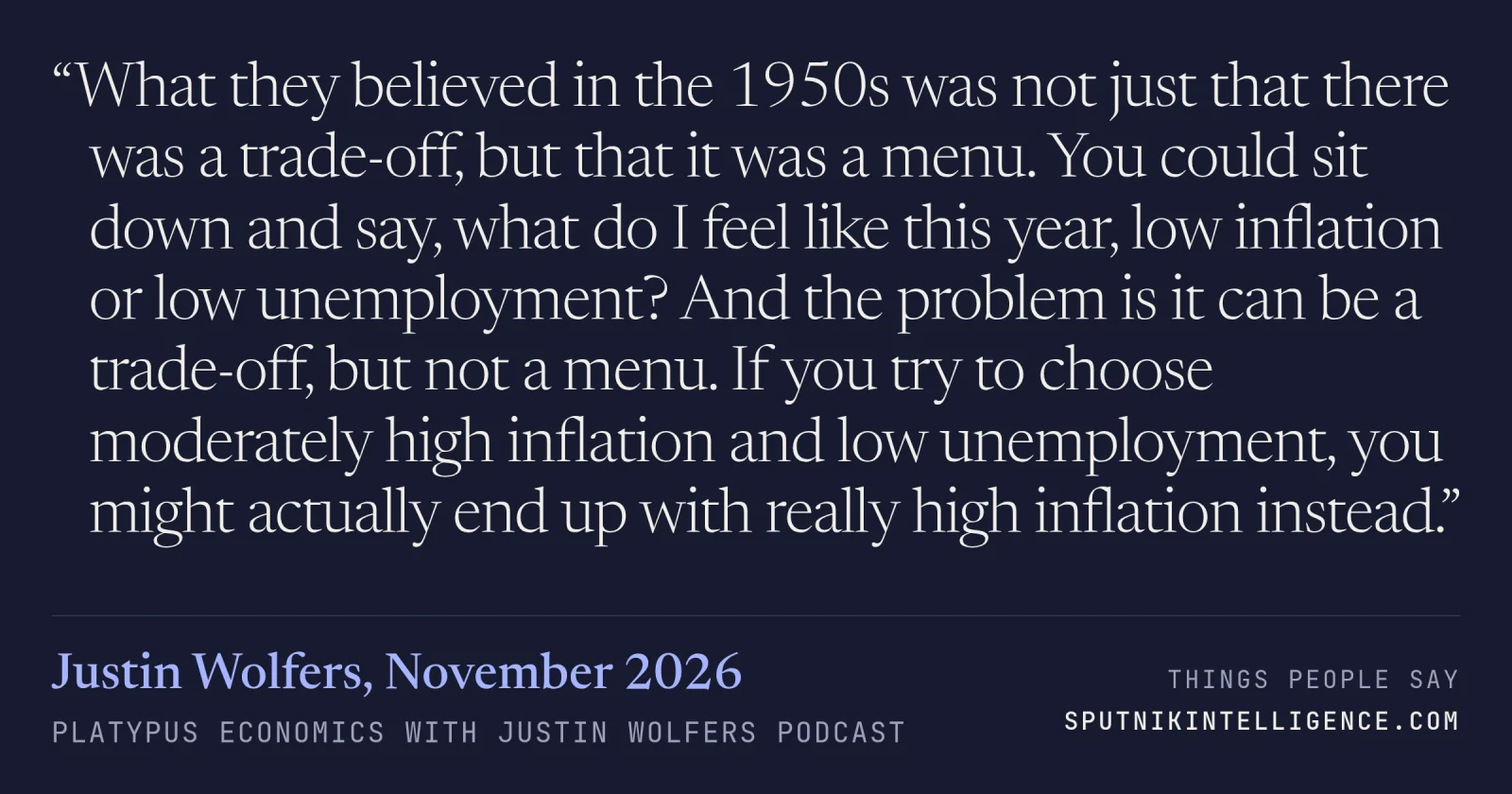
“What they believed in the 1950s was not just that there was a trade-off, but that it was a menu. You could sit down and say, what do I feel like this year, low inflation or low unemployment? And the problem is it can be a trade-off, but not a menu. If you try to choose moderately high inflation and low unemployment, you might actually end up with really high inflation instead.”
Platypus Economics with Justin Wolfers · Money & Markets · November 2026
Context
Continuing his Phillips curve lesson, Wolfers describes the mistake of mid-century policymakers who thought they could pick a point on the curve, and why expected inflation breaks that idea.
Transcript
…for America, then you've just discovered the Phillips curve. Now, what they believed in the 1950s was not just that there was a trade-off, but that was a menu. You could sit down and you say yourself, oh, what do I feel like this year? Low inflation or low unemployment? I'm just going to choose.
Oh.
And the problem is it can be a trade-off, but not a menu, because you might start thinking to yourself, oh, you know what? I would really like some of that delicious low unemployment. We know low unemployment comes with high inflation. But if people expect high inflation, that in itself creates inflation. And then you have the queue out the front of the Outback Steakhouse that creates more inflation. So when you try to choose the moderate inflation, you know, moderately high inflation, low unemployment, you might actually end up with really high inflation instead. And so that trade-off is not a menu. And that was one of the important lessons we learned through the 50s and 60s. I should also say the intellectual history of central banks is littered with crazy ideas that sometimes lasted a week and a half. That's the truth.
Like what?
When I was a young bloke in Australia, it's crystal clear the Reserve Bank of Australia was targeting the current account deficit. That people became really obsessed with Australia's imports relative to their exports in a way that is very hard to understand. And they never said it out loud, but…
Okay, so we had somebody ask, which I think is actually a very sensible question and something I've wondered about for a long time. Why does the Fed move in these quarter point steps? Would it not make more sense to move it like smaller and faster? So you have more frequent meetings where you do…
More from Platypus Economics with Justin Wolfers