 Scott Wu
On Invest Like the Best (Patrick O'Shaughnessy)
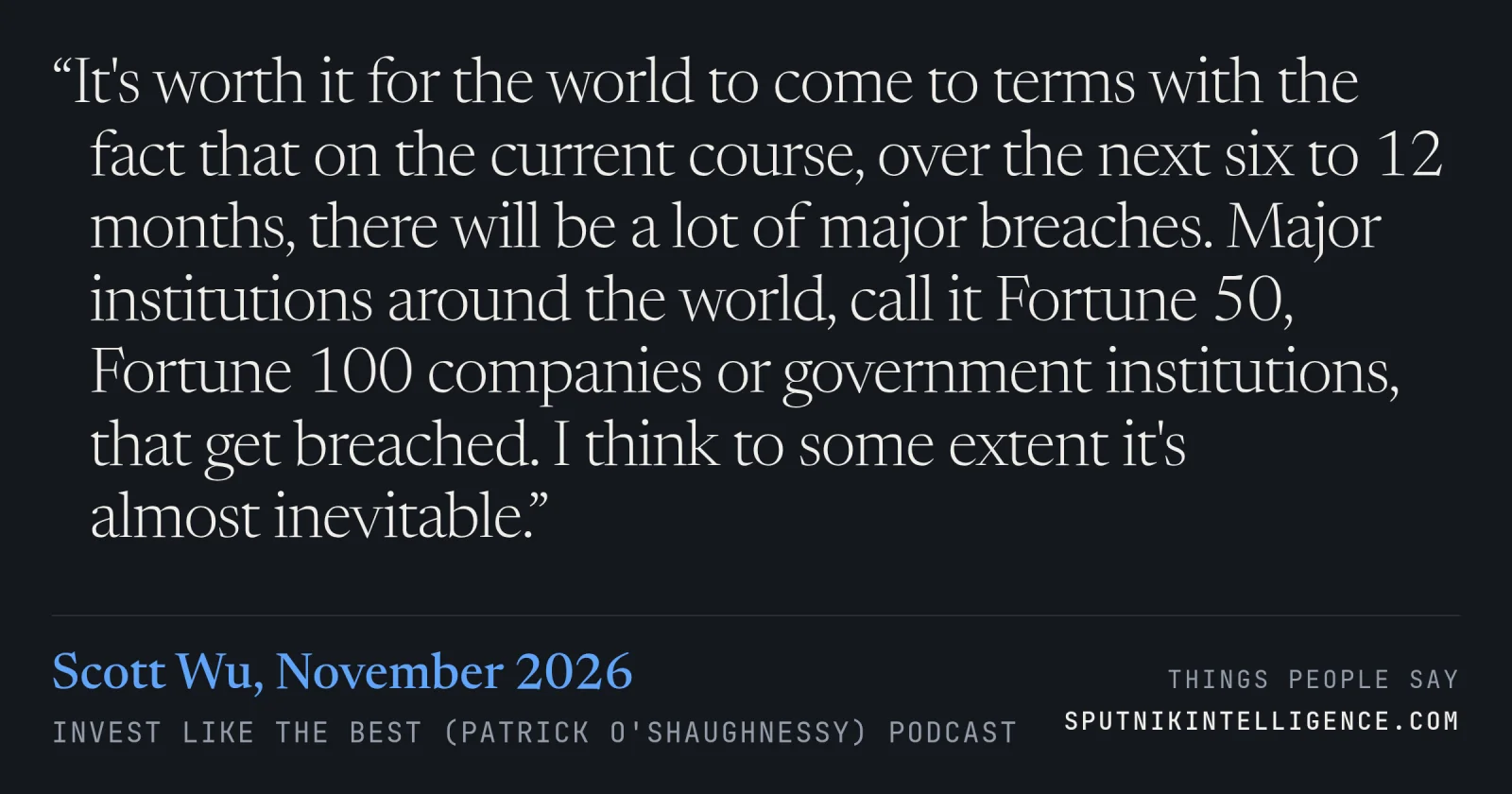
“It's worth it for the world to come to terms with the fact that on the current course, over the next six to 12 months, there will be a lot of major breaches. Major institutions around the world, call it Fortune 50, Fortune 100 companies or government institutions, that get breached. I think to some extent it's almost inevitable.”
Invest Like the Best (Patrick O'Shaughnessy) · Money & Markets · November 2026
Context
Patrick O'Shaughnessy asked Wu what the latest models can do at finding vulnerabilities. Wu says he is optimistic about security in the long run, since secure code is possible, but that the near term is dangerous. He follows this with a call for defenders to run agent swarms against their own systems.
Transcript
…in a way that some third party is not able to intercept them and read those messages, that is a solved problem in cryptography. That is something that we believe that we can do. I mean, as long as P is not MP or, I'm kind of joking. I mean, even if P equals NP, of course, there's still... What does
that mean? Just expand on that a little bit. One
of the millennium problems that remains is a problem called P versus NP. And it basically asks the question of, is it the case that every single problem where you can verify an answer in a short amount of time can actually also be solved in a short amount of time? And if P actually equaled NP, it's crazy that we don't know the answer to this, right? Intuitively, you would say, okay, surely there are things that are really hard to come up with the solutions for, but once you have them, it's really obvious that they work, right? But it's actually, you know, it's like the single most unfamous, most famous unsolved problem in computer science mathematics, I would say, today, or up there with the Riemann hypothesis is one of the two. And if it were actually true, which I guess we may find out in the next 12 months, given how good the AI is getting at math, and there were such an algorithm, then in theory, all these things, all these encryption techniques that we go and do and so on, there should be a corresponding decryption algorithm, which is also fast, although it probably still won't be as fast, obviously, as…
Let's assume that at least the attempts of those are inevitable. What's like the good scenario and the bad scenario? Like if you were to draw the polls of how this could go and how it would have told, assuming that there are some breaches. What do you think about the two scenarios? So
again, in the long run, it's like offense and defense, if the offense and defense both play perfect, then defense wins in the world of security, right? And so I... Why is that? That's because there is just this fundamental imbalance of if I encrypt something and I send that to you and so on, it…
do you think about cognition's role in something like this? And not just this one, but generally speaking, when there's a big issue in AI, how do you decide for the business the degree to which it's going to get heavily involved, which it seems like you're doing in security?
More from Invest Like the Best (Patrick O'Shaughnessy)