 Ben Buchanan
Twitter: @01Core_Ben || Trying to get rich and live forever - happily.
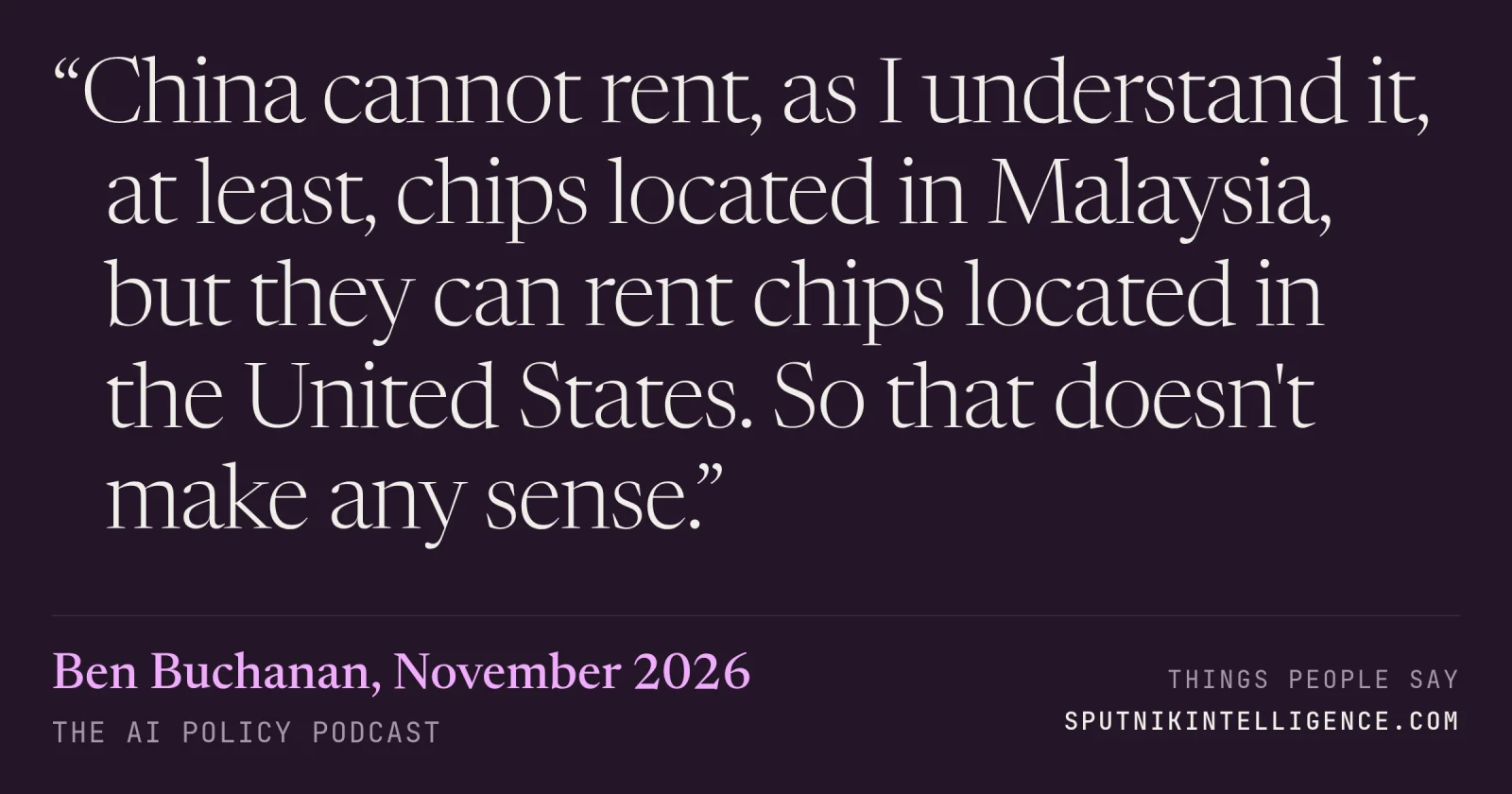
“China cannot rent, as I understand it, at least, chips located in Malaysia, but they can rent chips located in the United States. So that doesn't make any sense.”
The AI Policy Podcast · Geopolitics & World Affairs · November 2026
Context
A former White House AI adviser, asked whether a new rule limiting remote access to compute will widen the gap between US and Chinese AI. He says it will if enforced, then names the loopholes.
Transcript
…about spies or sex. It's about Chinese access through places like Malaysia and Singapore to advanced chip technology. And I worry greatly about this. And I think his decision to not enforce what we call the diffusion rule was a mistake and enabled China to keep close, keep closer, I should say.
…been happening. Would you say that your estimation is that things are going to get harder for Chinese companies going forward? Will we see the gap between U.S. companies and Chinese companies increase as a result of these actions? And I know a lot of it is dependent on how it's enforced, obviously.
Provided President Trump enforces the rule, yes. There are still some loopholes in the rule that he put out last week, which is real progress from where he was before. He's now going back to some of the Biden-era policies. There's a couple of loopholes. It doesn't cover smuggling routes outside of Southeast Asia. So that's not great. They should fix that. And it doesn't cover data centers in the United States. So China cannot rent, as I understand it, at least, China cannot rent chips located in Malaysia, but they can rent chips located in the United States. So that doesn't make any sense. So provided they close those loopholes and provide they do the enforcement, yes, I think this rule could enable an even larger advantage for the United States.
So I think up to this point, we've talked a lot about sort of the first pillar of your argument, which is sort of establishing this advantage. I wanted to shift now a little to sort of the idea of leveraging that advantage, spending it or using it in some way to address some of the other parts in…
Exactly. And our belief as far back as 2021 was we had to have a big lead so that we could spend the lead on safety. And there would be no appetite to slow down or regulate in the United States if we were neck and neck with China. And we could have a debate about what the right thing to do in that…
And so this sort of intersects with something we've seen in AI Policy. It was at least a minor contributor, maybe more than a minor contributor to the outcome of the midterm elections. And that is that this public opportunity. Opposition to AI. So we see it with data centers where the public is…
More from The AI Policy Podcast