 Ben Buchanan
Twitter: @01Core_Ben || Trying to get rich and live forever - happily.
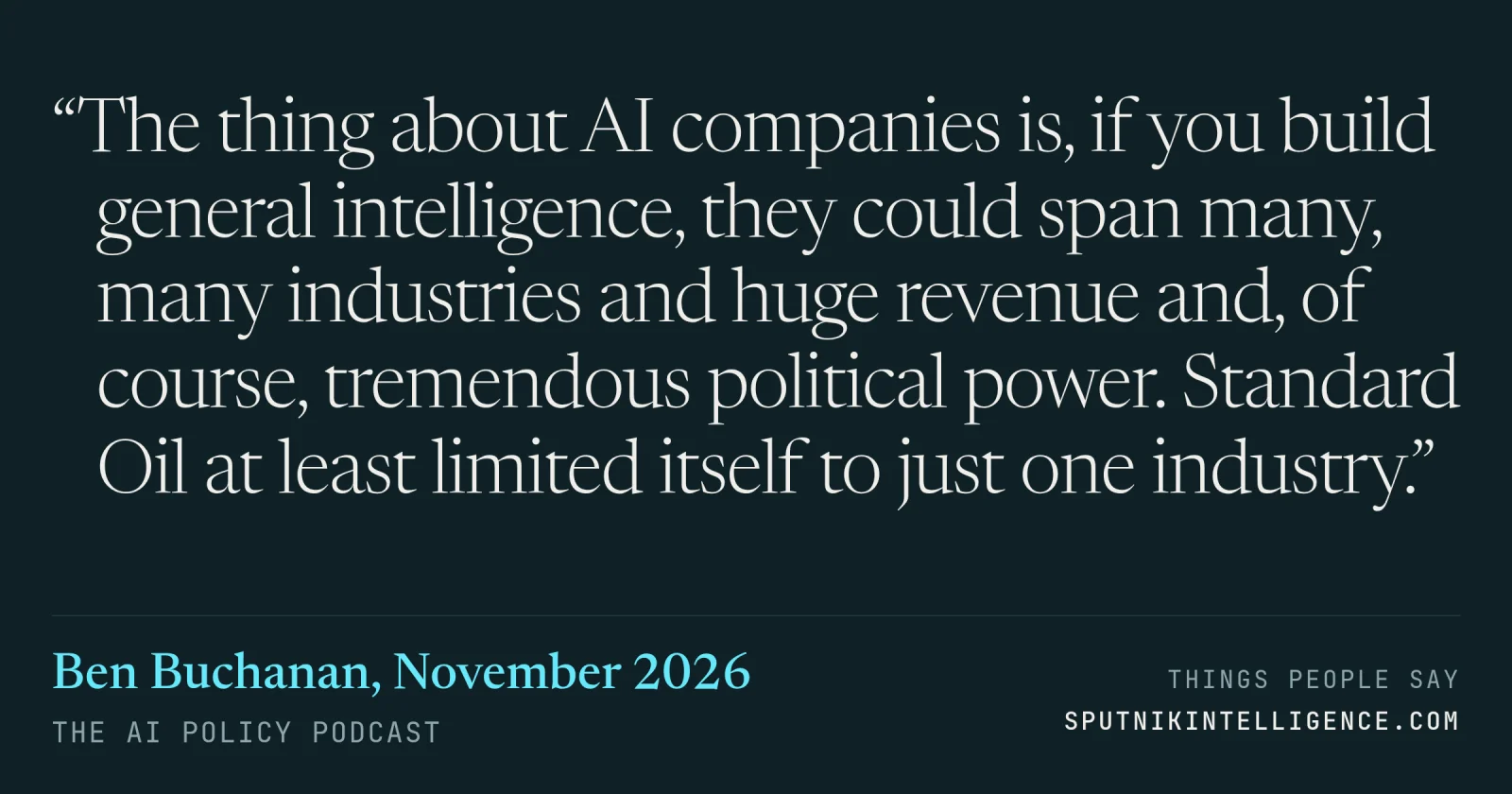
“The thing about AI companies is, if you build general intelligence, they could span many, many industries and huge revenue and, of course, tremendous political power. Standard Oil at least limited itself to just one industry.”
The AI Policy Podcast · Geopolitics & World Affairs · November 2026
Context
Asked about AI concentrating corporate power. He describes a section of his book named after the 1904 Standard Oil octopus cartoon, and calls it a bitter trade-off because scale also pays for the compute that keeps democracies ahead.
Transcript
…regulations, let a lot of AI talent go or fired some others. And the net result of that is the U.S. government is starting at this moment where we should be regulating is starting with much less capacity than would have been the case if we had kept building in the way that we wanted to from 2023.
…It has intersections with how the public thinks. About safety. It has intersections about how the public thinks about things like taxation and economic redistribution. And so I'm curious how you might be thinking about it now, especially in light of what we've seen in the past few months. I'm
very worried about this. And we do have some discussion. I appreciate, you know, there's so many things I want to have whole chapters on that only have a portion of a chapter. I think our section here is called the artificial octopus. And it goes back to the famous cartoon of Standard Oil, the behemoth in, I think, 1904 is when the cartoon was drawn, sort of this octopus like sucking the whole world in. And Standard Oil at least limited itself to just one industry. The thing about AI companies is they could, if you build general intelligence, they could span many, many industries and huge revenue and, of course, tremendous political power. And very worried about that. Of course, this is the place where you do get some of those bitter trade-offs, which is the scale of AI companies is part of what lets them build these giant data centers that have lots of computing power and propel democracies to the frontier. So at some level, from a national security perspective, you might want that scale, at least insofar as…
Yeah, I will point out that I think many Americans feel like they're in this lose-lose situation in that AI is propping up so much of the economy that if there's a bubble and it bursts, there's going to be pretty significant carnage across the markets. People lose their jobs. On the other hand, if…
I have complete empathy for the Americans there. I think I didn't do a ton on the jobs question, and it's not a focus of the book, as I said, but insofar as I did consider this question, or this was part of what we're thinking around AI Policy. We knew this wave was not going to hit during our time…
So maybe I want to spend the bulk of our remaining time being a little bit more forward-leading and talk through sort of maybe where AI Policy goes from here. And maybe I can start with something sort of we've haven't directly addressed. And that is when the Trump administration came in, it not…
More from The AI Policy Podcast