RG

Robert Greene

Things Robert Says on Podcasts

Where to Find Them

Robert Greene writes The Beat with Ari Melber . They have also been a guest on Barry Kibrick - Between the Lines (7 times) , Young and Profiting with Hala Taha (Entrepreneurship, Sales, Marketing) (5 times) , The Daily Stoic (4 times) , The Learning Leader Show With Ryan Hawk (4 times) , The Game Changing Attorney Podcast with Michael Mogill (3 times) , BigDeal (2 times) , Huberman Lab (2 times) , My First Million (2 times) , The Prof G Pod with Scott Galloway , Open Book with Anthony Scaramucci , Behind the Book Cover , Dropping Bombs , The Knowledge Project (Shane Parrish) , The Pomp Podcast , Two Percent with Michael Easter , Within Reason , David Perell's How I Write , BiggerPockets Real Estate Podcast , Invest Like the Best (Patrick O'Shaughnessy) and A Bit of Optimism .

Recently: “Robert Greene almost died. Here’s what it taught him about living” on My First Million (November 2026); “#62: Life Is Awesome. We Just Need to Realize It | Robert Greene” on Two Percent with Michael Easter (November 2026); “Robert Greene: 99% of People Are Sleepwalking Through Life. Here's How to Wake Up.” on The Daily Stoic (November 2026); “Power, Seduction and War: How To Win In The Age of AI | Robert Greene” on BigDeal (November 2026); “Access the Sublime & Live Your Best Life | Robert Greene” on Huberman Lab (November 2026); “Robert Greene & Ryan Holiday: The Secret To A Great Apprenticeship” on The Daily Stoic (October 2026).

What They Said

Shaan Puri said the most charismatic people Greene studied often seem broken, driven by a need for outside validation. Greene agrees that greatness often comes with difficult personalities, and argues we should stop expecting the people who get things done to also be saintly.

My First Million · 2026-11-11 Permalink → Listen →
My First Million Around 1:10:12 into the episode
Robert Greene

…camera, was from kind of creating this neediness in the camera that she wants and is drawing your attention and drawing your love is a quality that a lot of actors can have. And it's something that some have learned. But in her case, once again, it was a function of really of where she came from.

Shaan Puri

…with this idea that like, I guess I do seek some of that. I get high highs when it's validated and low lows when I'm not seeing that special. That is true about me. So I guess in that way, it's true. Can you, I guess, is what I said, like, does that resonate with your research and what you believe?

Robert Greene

First, I mean, you know, when the attention leaves you, when the camera isn't following you, when you're not in power, you're not fighting a Hitler, you know, you can get very, very depressed. And obviously, Marilyn Monroe committed suicide. Churchill had these, I forget what his name is, Black something or others that he would kind of fall into where he just was deeply, deeply depressed. Kennedy, you know, he had a lot of physical ailments. I don't really know because he died. He was assassinated when he was quite young. But so the idea is you become addicted to the attention and to the need to have a public all the time. And that can be debilitating. But, you know, a lot of very great people aren't necessarily the nicest people on the planet. And that's, and they're maybe not necessarily the happiest, but they create great things. One of my icons in sports was Kobe Bryant because that guy had set levels of determination. And persistence, channeling a lot of anger that he had from probably from his childhood. And, you know, he was just so fierce on the court. And he was probably a difficult person in many…

Sam Parr

That's awesome. Is there someone who you look up to where they've checked all the boxes or many of the boxes where you think that they are a great person and also ethical? And I admire them for how they treated their family, things like that, because we have a lot of great people on here. And there…

Shaan Puri

Who do you admire the whole of, or who is the outlier that accomplished the greatness, but was a great being as well?

Robert Greene

Well, I mean, it's kind of personal, but my former mentee, Ryan Holliday, I very much admire him because he's incredibly successful. He's built this empire. He's a very decent, good person. He's raising a family. He's a great father. And I used, I got him to be my researcher because I saw that he…

Speaker names come from our own diarization. The position is estimated from where the line sits in the episode.
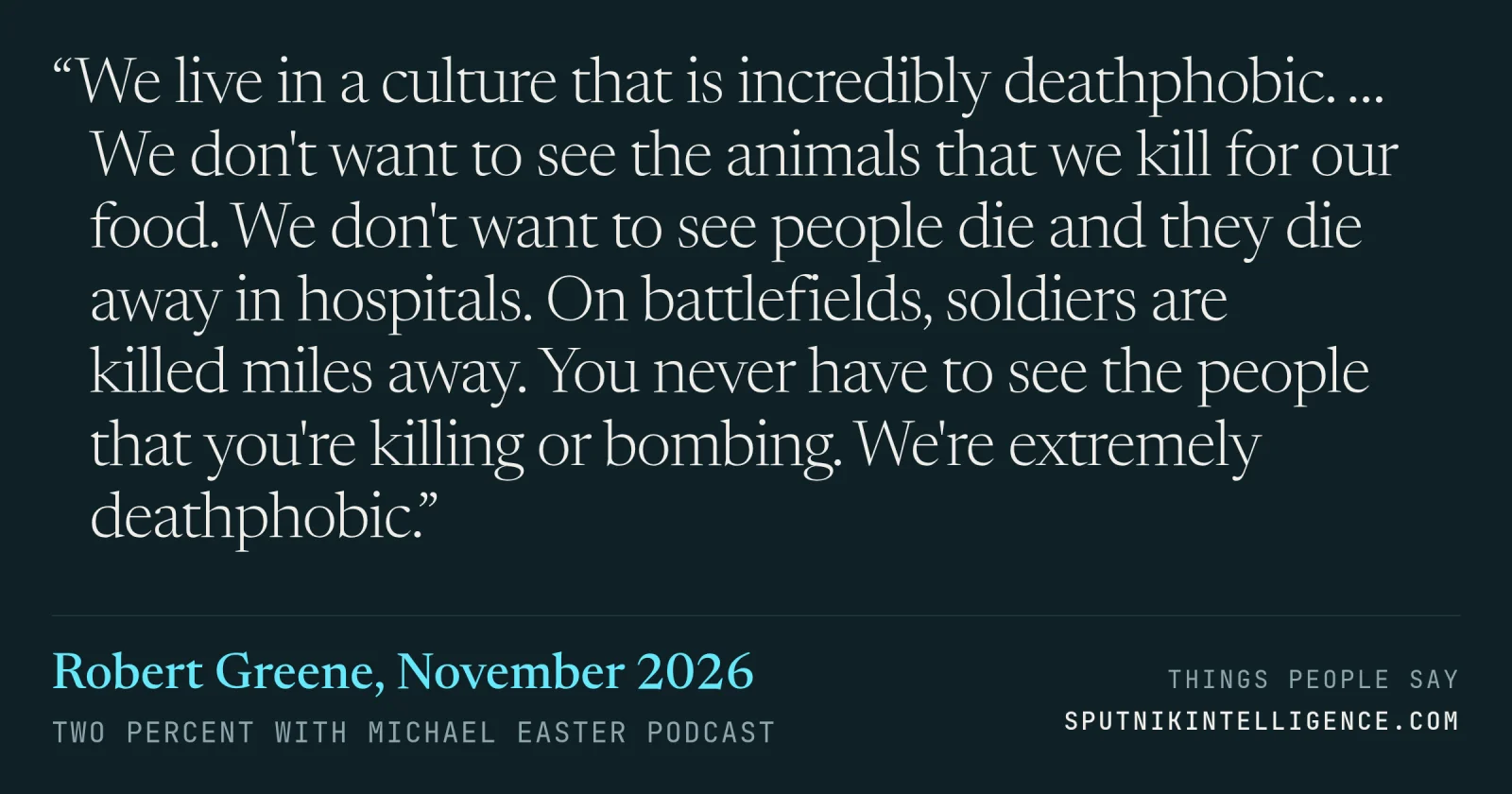
“We live in a culture that is incredibly deathphobic. … We don't want to see the animals that we kill for our food. We don't want to see people die and they die away in hospitals. On battlefields, soldiers are killed miles away. You never have to see the people that you're killing or bombing. We're extremely deathphobic.” — Robert Greene, Two Percent with Michael Easter

Asked what ordinary people can take from his near-death experience after a 2018 stroke, Greene argues modern life walls death off from everyday awareness, a theme of his book on the sublime.

Two Percent with Michael Easter · 2026-11-10 Permalink → Listen →
Two Percent with Michael Easter Around 05:16 into the episode
Robert Greene

…don't make any sense. It was mostly that I was just, it was just this sort of weird excitement that I had come so close to death. And now everything kind of felt different and everything felt kind of light and buoyant and exciting to me. That was sort of the initial moments after the stroke.

Michael Easter

What do you think the average person can draw from that? The fact that you came to the Edge, pull back, and then you're laughing, elated.

Robert Greene

…like a feeling, a sensation that you can't even explain, you can't even control. I think it's like this physiological response because if you look at the way humans are in their day-to-day lives, they completely separate death from life. They have no conception of it. We live in a culture that is incredibly deathphobic. I think that's like the dominant strain. We don't want to see anything like we don't want to see the animals that we kill for our food. We don't want to see people die and they die away in hospitals. On battlefields, soldiers are killed miles away. You never have to see the people that you're killing or bombing. We're extremely deathphobic. But death is like this incredible reality. It's actually part of your body as you are right now. It's inside of you. So that feeling of death inside of you kind of alters your physiology. It alters neurology and it shakes you up. The other effect that I don't know if it's quite pertaining to my particular stroke, but I think it does in some way, is that when the brain kind of starts to die…

Michael Easter

Yeah, that makes sense. So on the ambulance ride home, you're deciding now's the time to write this book. Book is out November 10th, Law of the Sublime. But you had had this idea for this book since the early 2000s. So I'm curious to know where the idea for the book first germinated.

Robert Greene

Well, one thing that I can say about my mental life is I'm always craving different ways of looking at the world, different thought processes, different cultures. That's why I took a lot of drugs when I was 18, 19, 20 years old. I wanted to experience the world from a different side, a different…

Michael Easter

So readers understand the topic. When you say sublime, how do you define that? And how do we sort of understand that in a practical sense?

Speaker names come from our own diarization. The position is estimated from where the line sits in the episode.
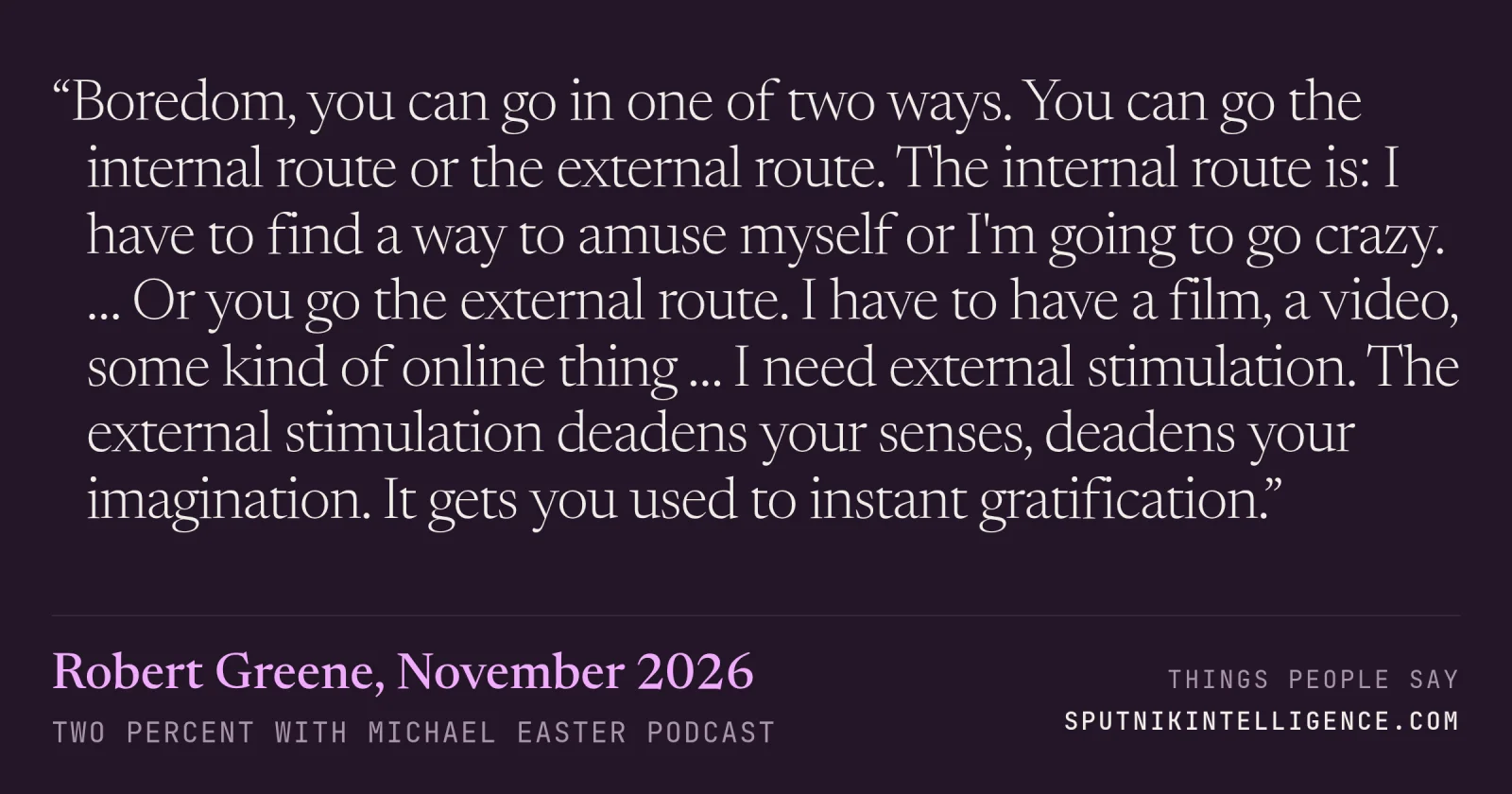
“Boredom, you can go in one of two ways. You can go the internal route or the external route. The internal route is: I have to find a way to amuse myself or I'm going to go crazy. … Or you go the external route. I have to have a film, a video, some kind of online thing … I need external stimulation. The external stimulation deadens your senses, deadens your imagination. It gets you used to instant gratification.” — Robert Greene, Two Percent with Michael Easter

Michael Easter read Greene's line that boredom signals an inability to connect meaningfully with the world. Greene, who had just described inventing war games in his childhood backyard, draws a line between boredom that builds imagination and boredom handed off to screens.

Two Percent with Michael Easter · 2026-11-10 Permalink → Listen →
Two Percent with Michael Easter Around 47:22 into the episode
Robert Greene

…also into sports and I invented my own game, my own version of football where I had all these teams that I created. And in my backyard, my parents thought I was crazy and I would play the entire game in my mind using dice to sort of show what the play was. Boredom was a spur to like my imagination.

Michael Easter

Yeah.

Robert Greene

I had to think, I had to create things in my brain, in my head, that would make me feel excited and alive and get rid of this boredom. And in some ways, it spurred my imagination and it led to how I write books where I have to constantly imagine things. I have to imagine the life of this person that I'm trying to describe or the dinosaurs on the verge of becoming extinct. And so boredom, you can go in one of two ways. You can go the internal route or the external route. The internal route is: I have to find a way to amuse myself or I'm going to go crazy. I have to start playing the piano and getting to hear music on my own. It's going to amuse me. I'm going to have to invent a game. Or you go the external route. I have to have a film, a video, some kind of online thing, and whatever it is. I need external stimulation. The external stimulation deadens your senses, deadens your imagination. It gets you used to instant gratification. Everything has…

Michael Easter

It's a more active use of boredom rather than passive. You're having to figure it out yourself rather than scrolling or pushing plate. What I think is interesting too is that I've noticed in my own work, cell phones take a lot of heat, screen time. And so when people will take, say, two hours off…

Robert Greene

Yeah. Yeah.

Michael Easter

So what is I think that adults are probably, as you just said, you sort of learn these patterns as a kid. So probably the older you are, the better set up you are to have more interesting ways to manage boredom. But what would your advice be for adults? I mean, I'm almost 40. So we had video games…

Speaker names come from our own diarization. The position is estimated from where the line sits in the episode.
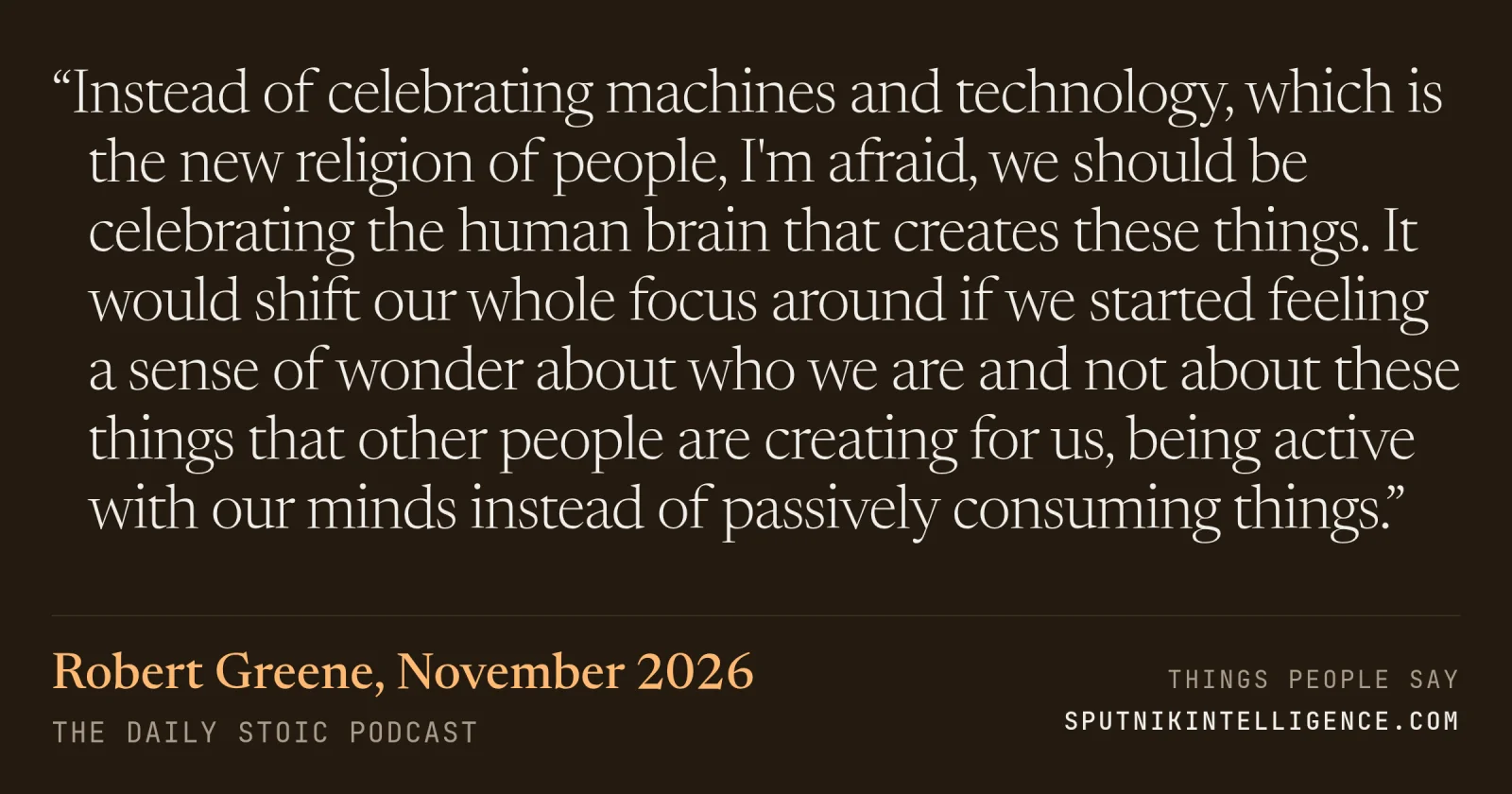
“Instead of celebrating machines and technology, which is the new religion of people, I'm afraid, we should be celebrating the human brain that creates these things. It would shift our whole focus around if we started feeling a sense of wonder about who we are and not about these things that other people are creating for us, being active with our minds instead of passively consuming things.” — Robert Greene, The Daily Stoic

Greene had said it is easy to feel gloomy about humanity right now, with AI and fears that we may destroy ourselves. He pushes back on treating technology as the thing to marvel at, rather than the minds that built it.

The Daily Stoic · 2026-11-09 Permalink → Listen →
The Daily Stoic Around 57:12 into the episode
Robert Greene

Well, you know, sometimes you can get kind of depressed about humanity, particularly now.

Ryan Holiday

Sure.

Robert Greene

…in the oceans, multicellular organs, the first multicellular organs. We are an incredible species, what we have done. We are absolutely, our conscious is absolutely miraculous. What we can accomplish when we think like this and we go through these processes and we analyze and then we recreate worlds through footprints or whatever. We should be in awe of ourselves and what the human brain is. So instead of celebrating machines and technology, which is the new religion of people, I'm afraid, we should be celebrating the human brain that creates these things. It would shift our whole focus around if we started feeling a sense of wonder about who we are and not about these things that other people are creating for us, being active with our minds instead of passively consuming things. That's

Ryan Holiday

to me kind of a meta level of sublime that you can get to when you contemplate how much work went into the science understanding and communicating and capturing this small scientific fact we have. Where I think about, like, I know, how long did you work on Law of the Sublime? Seven years. So, do…

Robert Greene

Yeah, yeah. What I think of is like, is like the internet. So when I wrote about the internet as being this kind of infinite space, and I think we can all remember if we're old enough, the early 2000s where there was this sense of excitement about the internet. It was this vast, it was like the far…

Ryan Holiday

favorite part of the book was the stuff on the pagan sublime: the woman going to the temple, being inducted into the mysteries. Yeah, and just because I think, like even watching this new movie, this new version of the Odyssey, the main gripe I would have with Christopher Nolan is that like…

Speaker names come from our own diarization. The position is estimated from where the line sits in the episode.

Collections They Appear In