HL

Hélène Landemore

Things Hélène Says on Podcasts

Where to Find Them

Hélène Landemore has been a guest on Foreign Policy Live , The Ezra Klein Show , Capitalisn't , Worklife with Molly Graham , Scaling Laws and Freakonomics Radio .

Recently: “694. Does Democracy Really Need Elections?” on Freakonomics Radio (November 2026); “Hélène Landemore on Public Participation in AI Governance” on Scaling Laws (October 2026); “How to Have Politics Without Politicians” on Foreign Policy Live (March 2026); “ReThinking: Taking politicians out of politics with Hélène Landemore” on Worklife with Molly Graham (February 2026); “Reinventing Democracy, With Hélène Landemore” on Capitalisn't (June 2023); “A Radical Proposal for True Democracy” on The Ezra Klein Show (February 2021).

What They Said

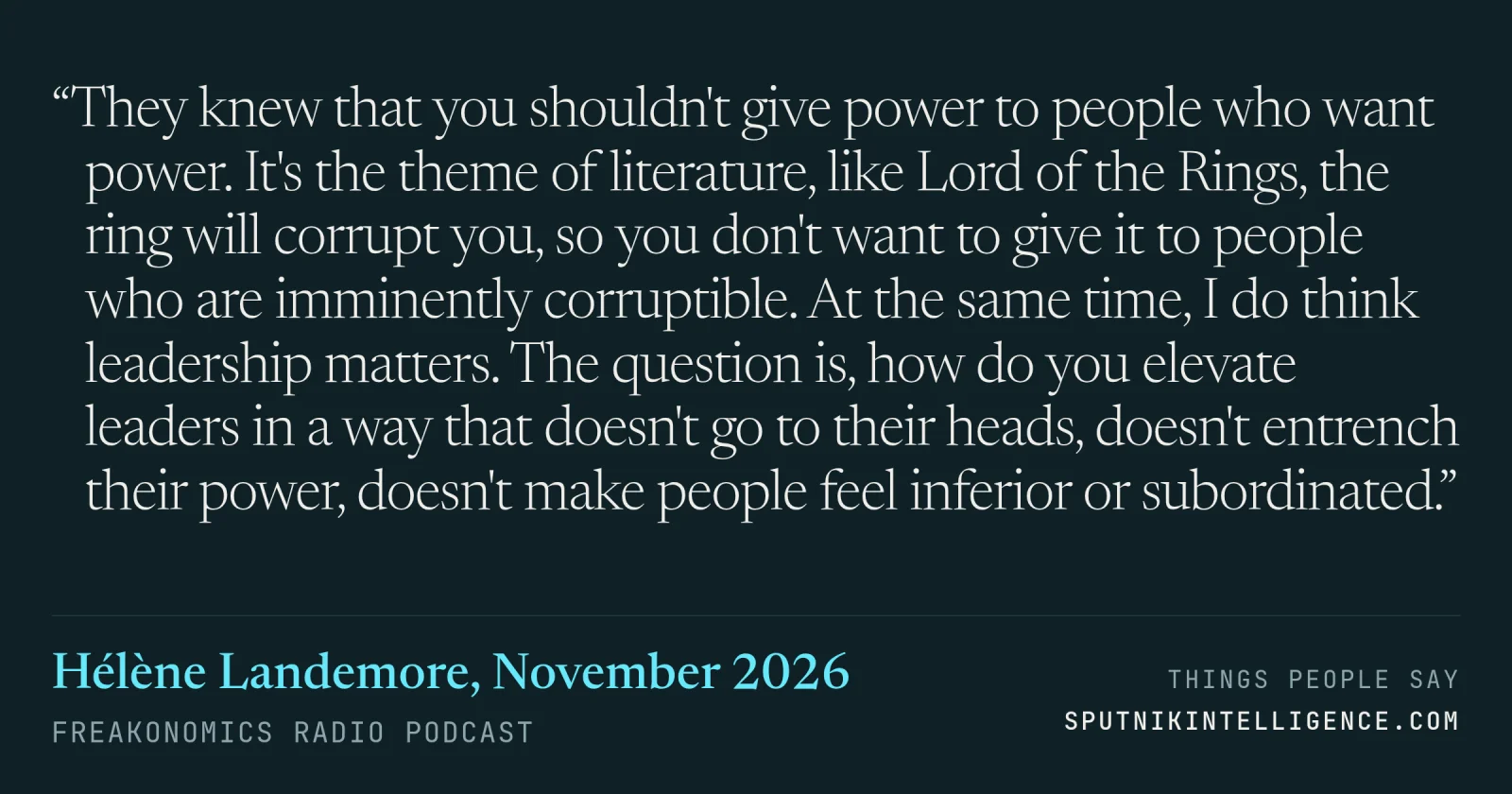
“They knew that you shouldn't give power to people who want power. It's the theme of literature, like Lord of the Rings, the ring will corrupt you, so you don't want to give it to people who are imminently corruptible. At the same time, I do think leadership matters. The question is, how do you elevate leaders in a way that doesn't go to their heads, doesn't entrench their power, doesn't make people feel inferior or subordinated.” — Hélène Landemore, Freakonomics Radio

Stephen Dubner returned to the ancient Athenian practice of choosing officials by lot. Landemore, a political theorist, explains the logic behind it while conceding that leadership still matters.

Freakonomics Radio · 2026-11-06 Permalink → Listen →
Freakonomics Radio Around 26:15 into the episode
Terry Bouricius

…ones that were adopting all new laws, all those bodies were selected by lottery. The General Assembly, the huge open body, they could declare war, they could pass resolutions, they could give tributes, but they couldn't adopt laws. They themselves transferred power to adopt laws to a jury process.

Stephen Dubner

Elen Landemore of Yale also thinks the Greeks had it right.

Hélène Landemore

They knew that you shouldn't give power to people who want power. It's the theme of literature, like from Lord of the Rings, the ring will corrupt you, so you don't want to give it to people who are imminently corruptible. At the same time, I do think leadership matters. The question is, how do you elevate leaders in a way that doesn't go to their heads, doesn't entrench their power, doesn't make people feel inferior or subordinated.

Stephen Dubner

You like the idea of sortition going back to ancient Athens, yes. If this is such a good idea, and if it was or could be such a good system more broadly, why did it vanish, essentially?

Hélène Landemore

That's a big puzzle. In the 18th century, 19th century, the practice of drawing lots to select public officials completely disappeared. Bernard Manon, who's an important political theorist in France, blames it on a confluence of things. One is the fact that social contract theory was the dominant…

Stephen Dubner

So Elaine Landemore thinks that politicians may be exposed to the wrong kind of people. Terry Bouricius thinks that politicians themselves are the wrong kind of people.
Speaker names come from our own diarization. The position is estimated from where the line sits in the episode.
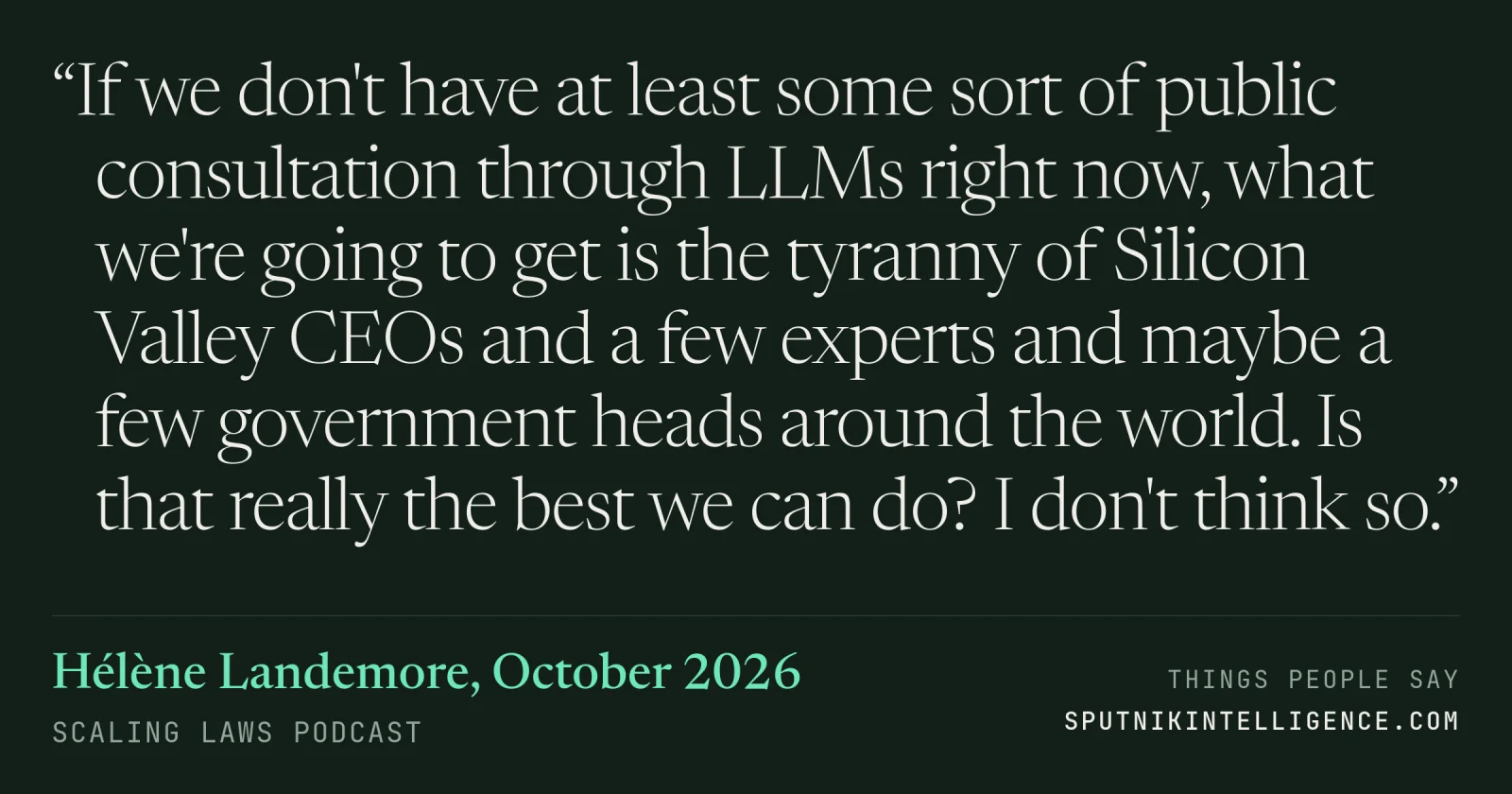
“If we don't have at least some sort of public consultation through LLMs right now, what we're going to get is the tyranny of Silicon Valley CEOs and a few experts and maybe a few government heads around the world. Is that really the best we can do? I don't think so.” — Hélène Landemore, Scaling Laws

Landemore has proposed using the AI labs' own chatbots, which reach huge numbers of people directly, to consult the public on how AI should be governed. She was answering the objection that the scheme has flaws and hands the labs too much power. Her reply is that it should be judged against the status quo and not against an ideal world.

Scaling Laws · 2026-10-06 Permalink → Listen →
Scaling Laws Around 43:09 into the episode
Speaker 4

…of like maximizing their wages. But it's different from being involved at the level of the corporation where you're an actor and not just an input in the production chain, right? So for me, this conversation also needs to be connected. And it's like it's an agenda for the next 50 years. I mean,

Speaker 3

…some of these critical decisions. And I'm not saying that board meetings should be broadcast via Zoom or YouTube or something like that. But there needs to be an opportunity such that there's friction in how and when some of the most consequential decisions are going to be made by these companies.

Speaker 4

…about when I'm saying we should even rethink capitalism broadly, but it would be a beginning of something, it would be better than a status quo. And to go back to the beginning of our conversation, when you rightly pointed out, okay, your scheme has flaws, but at least compared to the status quo, it's something. I think that's the point. You can always compare any proposal to an ideal world. But if we don't have at least some sort of public consultation through LLMs right now, what we're going to get is the tyranny of Silicon Valley CEOs and a few experts and maybe a few government heads around the world. Is that really the best we can do? I don't think so.

Speaker 3

Yeah, and I think, too, there's so much to remembering first principles in these conversations. Again, I'm sure some listeners are at this point ready to throw their phone into the ocean. We've questioned capitalism. We've questioned Congress. They're just, wow, this is a radical episode. But if we…

Speaker 4

Well, yes, I think we've seen some attacks on like Sansa Maltman. It's looking like a sort of populist rebellion in the making. But I would say, even if we don't see that violence, I hate when we have to wait for violence to do anything. In France, too, we had to have the yellow vest movement and…

Speaker 3

Yeah, what a fascinating provocation because I was just reading before this some scholarship from Jillian Hadfield looking at how important it is for society and for cooperative action to have sanction and to have clear penalties. And it's compliance with those penalties and enforcement of those…

Speaker names come from our own diarization. The position is estimated from where the line sits in the episode.

Collections They Appear In