TY

Tian Yang

Things Tian Says on Podcasts

Where to Find Them

Tian Yang hosts The Variant Perception Blog . They have also been a guest on Macro Voices (6 times) , Monetary Matters with Jack Farley (4 times) , Excess Returns (3 times) , The Grant Williams Podcast (2 times) , Financial Sense Newshour (2 times) , Forward Guidance (2 times) and Odd Lots .

Recently: “The Impossible Trilemma That Hangs Over the Nvidia Crisis” on Odd Lots (November 2026); “What We Got Right & Wrong” on The Variant Perception Blog (November 2026); “Top 10 Surprises 2026 Reviewed” on The Variant Perception Blog (November 2026); “Tian Yang: The Sovereign AI Race Is Changing the Rules of This Bubble” on Financial Sense Newshour (October 2026); “Inflation Well Above Target. A Market All In on AI. What Does the Market Top Checklist Say Now?” on Excess Returns (August 2026); “Full Transcript: Tian Yang on Leading Indicators and the Macro Setup” on Excess Returns (August 2026).

What They Said

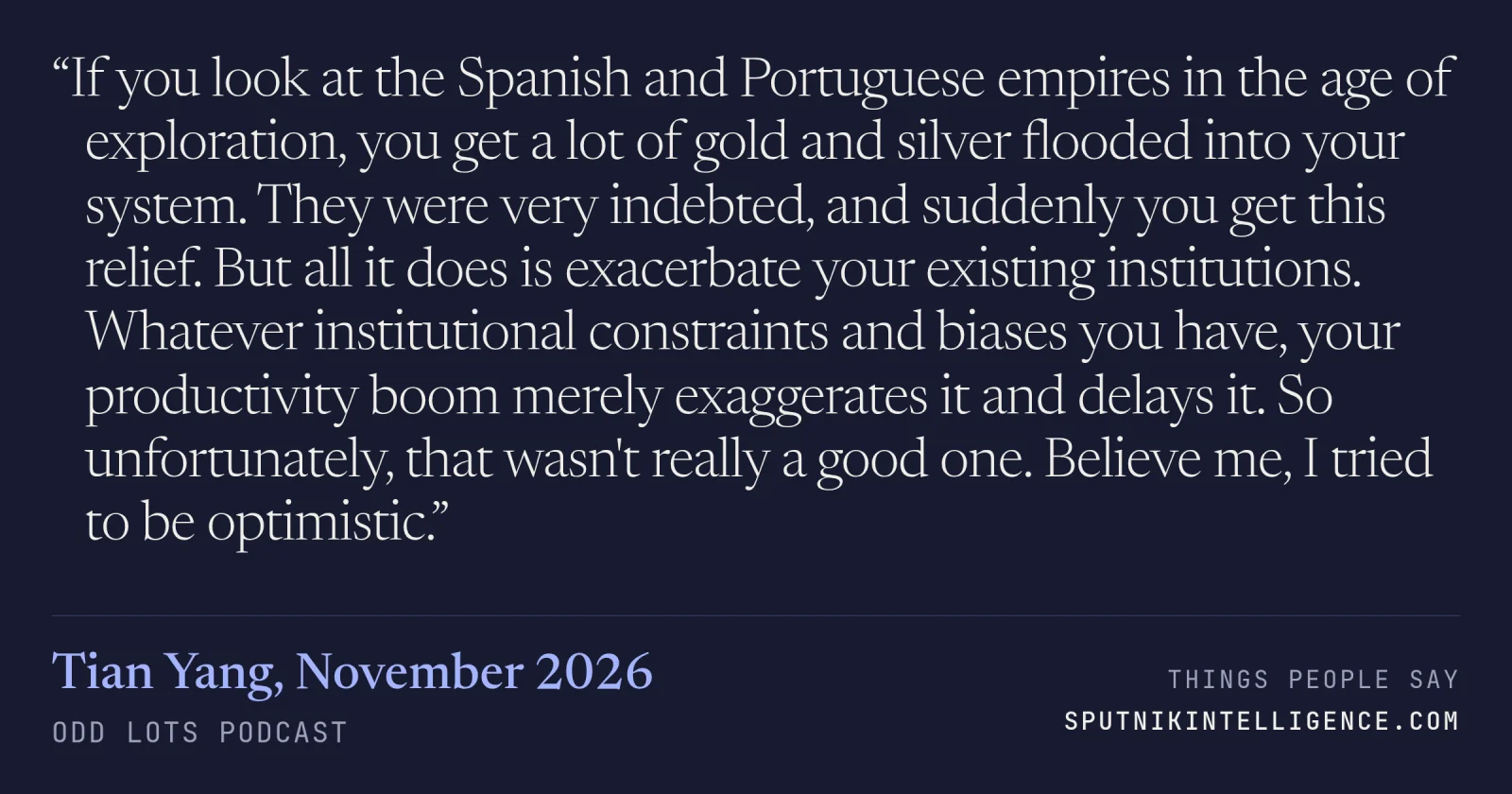
“If you look at the Spanish and Portuguese empires in the age of exploration, you get a lot of gold and silver flooded into your system. They were very indebted, and suddenly you get this relief. But all it does is exacerbate your existing institutions. Whatever institutional constraints and biases you have, your productivity boom merely exaggerates it and delays it. So unfortunately, that wasn't really a good one. Believe me, I tried to be optimistic.” — Tian Yang, Odd Lots

Tracy Alloway raised an AI productivity boom as the way out of the West's guns, butter and sound money squeeze. Yang answers from history that a windfall postpones reform instead of forcing it.

Odd Lots · 2026-11-16 Permalink → Listen →
Odd Lots Around 35:59 into the episode
Joe Weisenthal

Or we get the big data center revolt and the domestic population says we don't want the AI anymore. Like that has to be at least considered as a possibility. Or

Tracy Alloway

a productivity boom, which everyone seems to like, that's the wild card that everyone is sort of resting their hopes on, right?

Speaker 2

Yeah, so this is very interesting. I looked at other historical analogs and it's obviously hard to measure productivity, but there's things like, for example, if you look at the Spanish and Portuguese empires in the age of exploration, you get a lot of gold and silver just get flooded into your system, right? So they were, again, very indebted. Suddenly you get this relief. But the problem is, all it does is exacerbate your existing institution. So if you go back to, this is the work of, you know, Daron A. Samoglu originally, right? Whatever institutional constraints and biases you have, your productivity boom merely exaggerates it and delays it, right? So unfortunately, that wasn't really a good one. Believe me, I tried to be optimistic and look.

Joe Weisenthal

First of all, also, another headline.

Tracy Alloway

Oh, God.

Joe Weisenthal

This is what you guys were like. The network of companies said that Alice Wong recently invested in Chinese AI company DeepSeek. So her company were like DeepSeek. Oh, this is all getting very interesting. Wait, say more about the downside of a productivity boom. This is a very counterintuitive…

Speaker names come from our own diarization. The position is estimated from where the line sits in the episode.
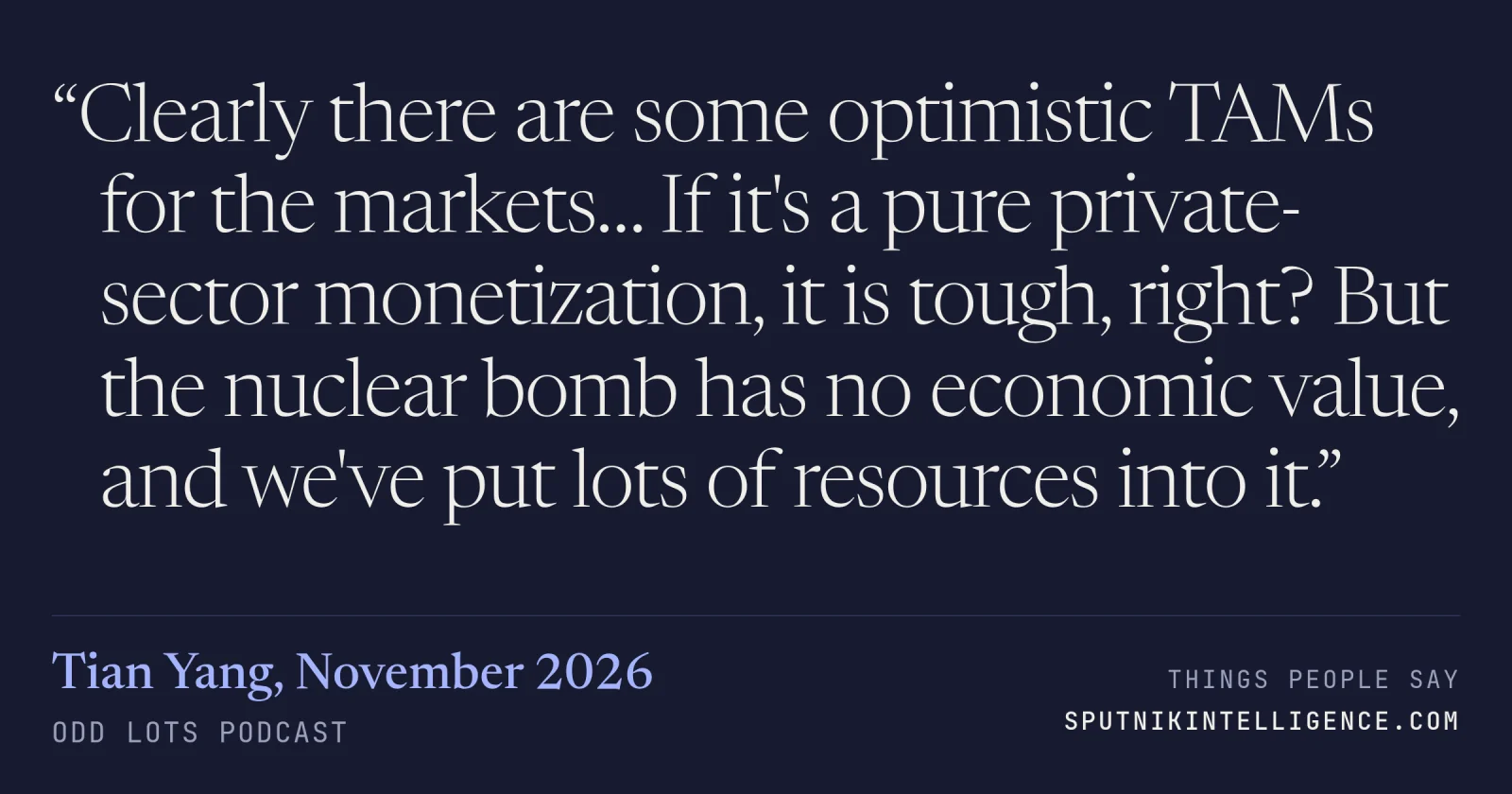
“Clearly there are some optimistic TAMs for the markets… If it's a pure private-sector monetization, it is tough, right? But the nuclear bomb has no economic value, and we've put lots of resources into it.” — Tian Yang, Odd Lots

Weisenthal asked whether Yang sees weakness in the commercial case for AI. Yang separates the commercial case from the national-security case. He compares AI to the bomb, which was funded for security, not profit.

Odd Lots · 2026-11-16 Permalink → Listen →
Odd Lots Around 25:40 into the episode
Speaker 2

…in the non-AI stuff, right? Like, you know, the fast cycle race growth slows down. But AI has been the secular thing. What connects them now is this financing need. And the financing need is sort of a function of the macro interest rates and where we are. And that's what's connecting them now.

Joe Weisenthal

…this company. People are going to want to pay for it. That companies will like, oh, I'm getting value from my AI spending. Maybe consumers were like, maybe pay for like an assistant bot. Like some of these theses that people have, like, do you not see at this point any weaknesses in these stories?

Speaker 2

Oh, yeah. I think clearly there's some optimistic TAMs for the markets. But I would say, again, if you put a sovereign. Lands on, there's a lot of assumptions about which of the markets and where things are going to leak, right? So, let's say we move to a world where governments have to get involved because we're strong to finance. There's going to be a lot of conditions attached to that government financing. The government might mandate everything you buy comes from the U.S. locally. So, then you inject a lot of similarities into the system. It's all kept here. So, asset prices here might be okay. But if you're a foreign supplier, you have other things that goes away, right? I think that's more likely the way we're going. That sure, if it's a pure private sector, you know, kind of monetization, it is tough, right? But as we said, if you're trying to, the nuclear bomb has no economic value, but we've put lots of resources into it. So, you have a nuclear bomb today, plus the steel use…

Joe Weisenthal

Yeah.

Speaker 2

I would say that's an open question. The evidence so far is still yes.

Joe Weisenthal

Yeah.

Speaker names come from our own diarization. The position is estimated from where the line sits in the episode.
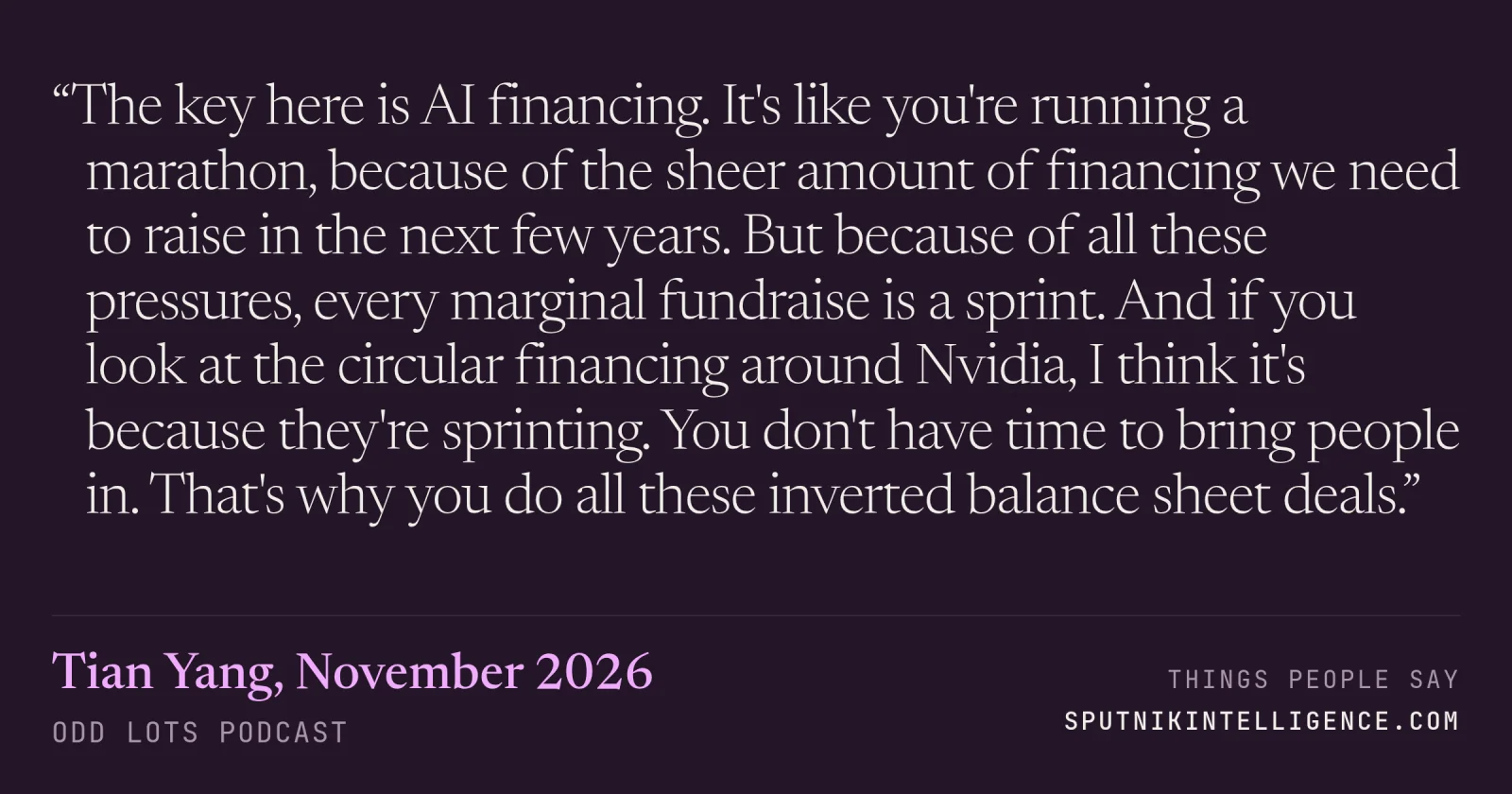
“The key here is AI financing. It's like you're running a marathon, because of the sheer amount of financing we need to raise in the next few years. But because of all these pressures, every marginal fundraise is a sprint. And if you look at the circular financing around Nvidia, I think it's because they're sprinting. You don't have time to bring people in. That's why you do all these inverted balance sheet deals.” — Tian Yang, Odd Lots

Joe Weisenthal asked why Nvidia fell 14% on Jensen Huang's exit while the S&P 500 barely moved. Yang answers with the scale of financing the AI buildout needs. He says that is why Nvidia ended up funding its own customers.

Odd Lots · 2026-11-16 Permalink → Listen →
Odd Lots Around 21:26 into the episode
Speaker 2

Yeah, sure.

Joe Weisenthal

…14% and the S ⁇ P 500 being down 0.17%? This is the, we're describing this company for a long time as the beating heart of the most important industry of the market, maybe world history. And its future has never been more uncertain. And the stock market is down like not even a quarter of a percent.

Speaker 2

Yeah, so I think you guys alluded to this a bit earlier, but the key here is AI financing, right? So in my mind, this is almost like you're running a marathon because just the sheer amount of financing we need to raise in the next few years. But because of all these pressures, every Marginal fundraise is like a sprint. And in a way, if you look at the circular financing around Nvidia Crisis think it's because they're sprinting. You don't have time to bring people in. That's why you do all these inverted balance sheet times. Explain it.

Joe Weisenthal

What do you mean they don't have time to bring people in? Explain what this means.

Speaker 2

So normally, if you want to raise financing, you can go to everyone, get everyone to do their analysis. It's time to wait, right? But the way the AI financing is, we have to raise so much money so quickly to keep the game going that every sprint is kind of this rush. Okay, what can we do? Just…

Joe Weisenthal

I get that, but explain, what does that have to do with NVIDIA being at the center of it all? So I get all they're all sprinting, but what does that have to do with NVIDIA?

Speaker names come from our own diarization. The position is estimated from where the line sits in the episode.

Collections They Appear In