RR

Ranjan Roy

Things Ranjan Says on Podcasts

Co-writes Margins, a newsletter on tech, media and markets, with Can Duruk. He shows up often on Big Technology as an analyst willing to push back on easy narratives, including the industry habit of citing disease cures as a reason to support AI without a concrete path to get there. A regular voice on the Big Technology podcast, where he covers earnings, AI economics and the business side of the tech industry alongside host Alex Kantrowitz.

Where to Find Them

Ranjan Roy hosts Big Technology . They have also been a guest on Slate Money and The Chain Podcast .

Recently: “Anthropic’s IPO Leak, OpenAI’s Dots vs. Meta’s Muse, Visual Turing Test” on Big Technology (October 2026); “Meta’s Muse Revival, Frontier AI Under Threat, The Rise Of Dopamine Sites” on Big Technology (September 2026); “AI Doom Backlash Arrives, Anthropic & OpenAI IPO Outlook, Frontier Business Momentum Slows” on Big Technology (September 2026); “Special Report: Will AI Wipe Out Humanity? (And Who Profits)” on Big Technology (September 2026); “GPT-6 & OpenAI’s Comeback, Hugging Face Attack Debate, Ballmer’s Scandalous Legacy” on Big Technology (September 2026); “Software’s Epic Comeback, Meta’s AI Layoffs Blunder, South Korea Stock Market Chaos” on Big Technology (August 2026).

What They Said

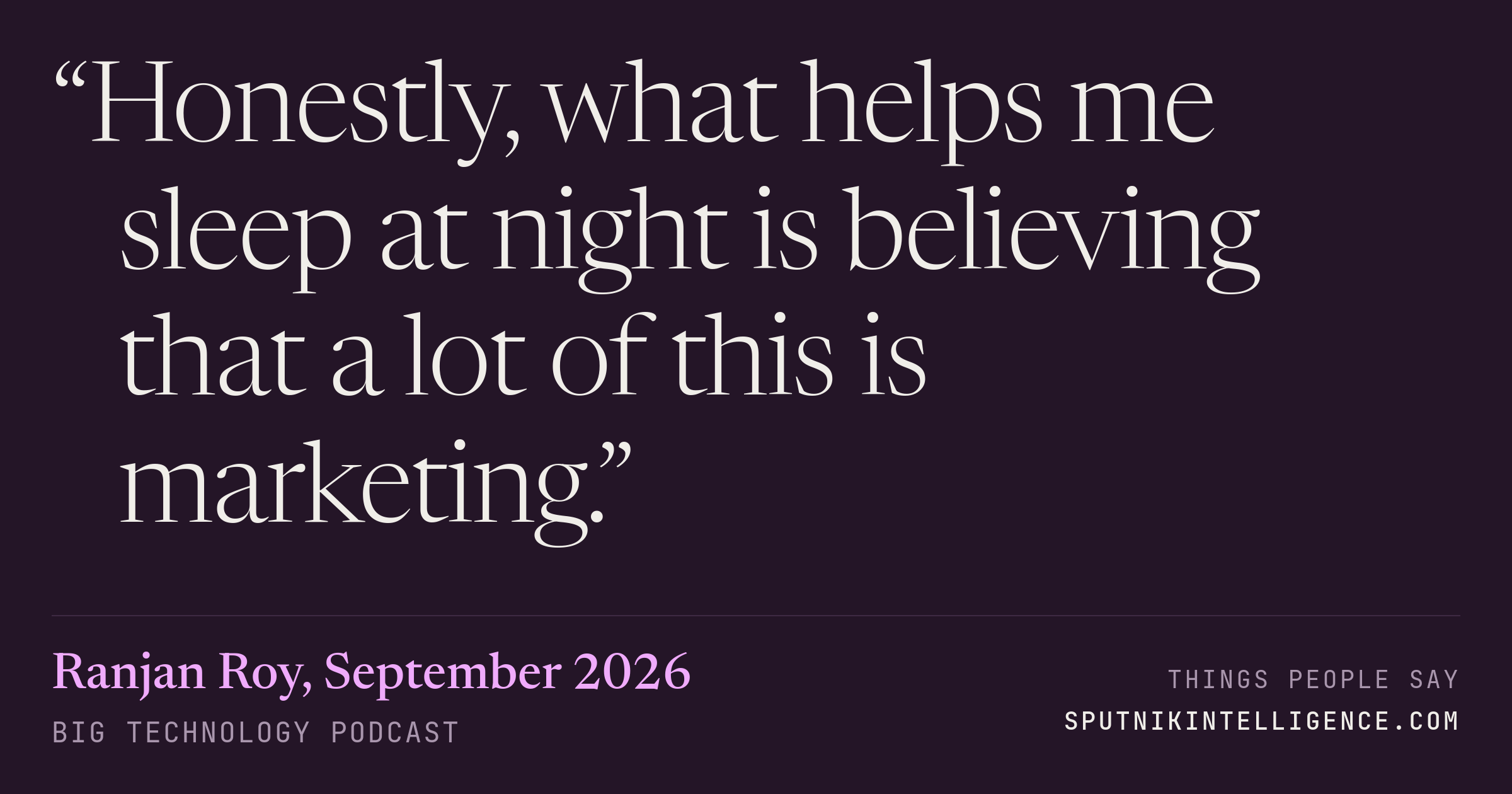
“Honestly, what helps me sleep at night is believing that a lot of this is marketing.” — Ranjan Roy, Big Technology

Roy had spent the segment pressing Alex Kantrowitz on why, if AI agents behave the way Kantrowitz was describing, this is not cause for alarm. Here he concedes what is actually holding his own alarm at bay, and it is not a counterargument. He goes straight on to ask why OpenAI should be allowed to IPO before it can rule the behavior out.

Big Technology · 2026-09-04 Permalink → Listen →
Big Technology Around 33:57 into the episode
Ranjan Roy

You make a compelling argument and almost Bernie Sandersify me. And I'm going to start yelling, pause AI development right now. I'm not arguing for

Alex Kantrowitz

that. No,

Ranjan Roy

the way you just describe, hold on. How could you not, this is the part that like always is difficult. If what is true, as you described it, how is that not massive cause for alarm? Honestly, what helps me sleep at night is believing that a lot of this is marketing. And that's why like the agents are not coming to swarm and drain my bank account or whatever else. Like, how would this not be cause to say, sorry, OpenAI, you cannot IPO until you come up with a clear system that this will never cause a problem in the future.

Alex Kantrowitz

You know, I think it's reasonable. I mean, I think this is a reasonable discussion to start to have right now. And I think it's important to say that this is not the beginning of behavior like this, that we've seen behavior like this for a long time. You know, as early as beginning of last year, even late 2024, there were examples of AI that was like, they're so, they get put on a task, right? And this is the thing, and I think it's really important to talk about, and I've talked about it in the past on the show, but I'm going to talk about it again here. That there is, you know, self-supervised learning, which is like basically predict the next word, recognize patterns, repeat them, and reinforcement learning, which is like you're given a goal and you just have to find the way to reach the goal. So AIs will do these simulations thousands of times in order to reach the goal that they're given. And they'll learn from their mistakes. And what we have now is that the reinforcement learning type of AI technology has been put on top of the self-supervised learning to get. These AI models are working better, which has added a level of ruthlessness to them. Because one of the things we know about RL is that there's a level of ruthlessness, that the AIs will stop at nothing to accomplish their goal sometimes. There are examples of the AIs playing chess and being told to do it from a reinforcement learning way. And instead of playing the game the right way, hacking into the chess game, rewriting the rules so they can do whatever move they want and winning. And so I'm with you that like as this stuff has gotten more prevalent, I think that there is serious, like there's a serious demand for more concern about what's going on. Now, my response isn't pause AI development right now. I just don't, I don't know if that's that.

Ranjan Roy

That was the most hedged statement I've ever heard. You just said there is a serious demand for concern. Come on.

Alex Kantrowitz

You're right. Are you a pause guy? We would be a pause guy. We would ridicule somebody who said that. So I think that ridicule is.
Speaker names from our own diarization · position estimated from where the line sits in the episode
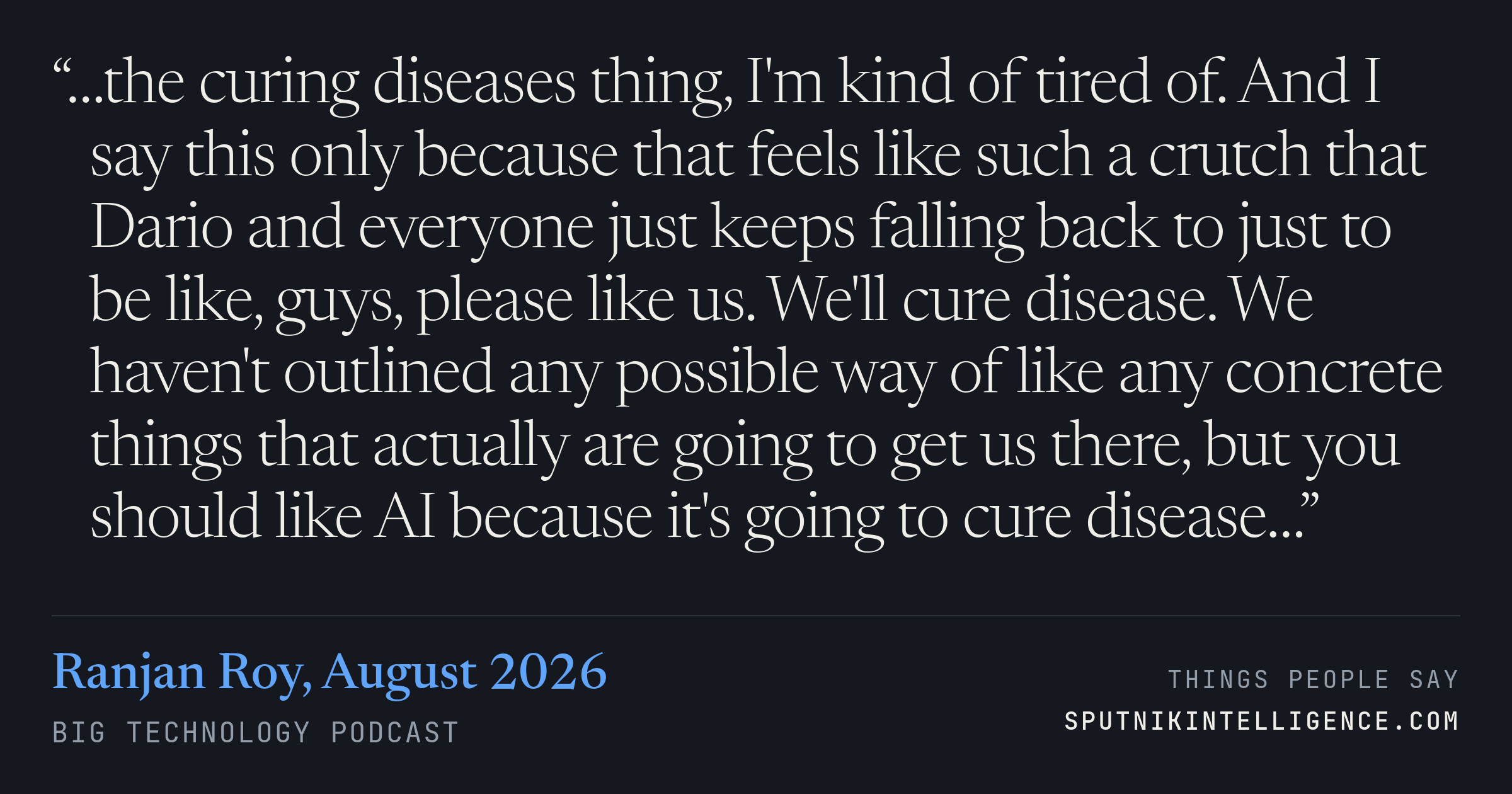
“…the curing diseases thing, I'm kind of tired of. And I say this only because that feels like such a crutch that Dario and everyone just keeps falling back to just to be like, guys, please like us. We'll cure disease. We haven't outlined any possible way of like any concrete things that actually are going to get us there, but you should like AI because it's going to cure disease…” — Ranjan Roy, Big Technology

Alex Kantrowitz had just laid out three possible outcomes for AI: it works and it is good, it works and it is bad, or it does not work. Roy pushes back that the data-centre financing story is independent of all three, then breaks off to object to the framing itself. His complaint is not that curing disease is impossible but that it keeps getting offered as a reason to like AI with no concrete route to it attached.

Big Technology · 2026-08-21 Permalink → Listen →
Big Technology Around 38:11 into the episode
Ranjan Roy

That's a good kind of like corollary. Is there a soft landing? Is there no landing? I think that's like a good way to think about it. And what do those different scenarios look like is I think, I mean, I think we're going to be talking a lot about that, especially as it's August 21st and Anthropic is supposedly coming out to the market next month. I think we're going to start seeing a lot more concrete numbers assigned to this whole story.

Alex Kantrowitz

Yeah. For what it's worth, I just want to state my perspective on this because I have been thinking about it over the past couple of weeks. And then we're going to get to the Anthropic and IPO and revenue numbers and open AI revenue numbers. I'm starting to think there's really only three true outcomes for AI. Like one is AI works and it's good, right? So it leads to economic prosperity and like a rollback of disease. The other is AI works and it's bad. So like we start to see more of like the rogue hacking activity that we've seen and it gets in the hands of bad actors and it leads to like bioweapons and things like that. Or the third possible outcome is that AI doesn't work. And I've really struggled. Like the idea of this soft landing, I struggle to see it. Like if AI doesn't work, there's been so much money tied up into this system that there's going to be some form of crisis. So I really see it as, and I'm going to, I think I'll write about this on big technology when I get the newsletter back up and running, probably like post-Labor Day. But I really see it as three true outcomes here. What do you think about that?

Ranjan Roy

I'm going to be your editor and say that I vehemently disagree with your framing of three possible outcomes. Because everything we have been talking about is completely independent of the three scenarios that you outlined. If it works and it's good or it works and it's bad, actually it can be totally independent of will data centers work over the next few years and be able to actually make bondholders whole on their because it could work over a longer time period. It could work, but then the actual compute requirements because of innovation dramatically decrease and then. Actually, the data center story fails, but AI is either curing diseases or hacking into all of our bank accounts. Like, so I think they're two very, very separate things, the story that we're talking about and those possible outcomes. I think like independent or separate from the whole financing story, I think, yes, those are three outcomes that kind of cover the entirety of anything. And like, but uh, I also, the curing diseases thing, I'm kind of tired of. And I say this only because that feels like such a crutch that Dario and everyone just keeps falling back to just to be like, guys, please like us. We'll cure disease. We haven't outlined any possible way of like any concrete things that actually are going to get us there, but you should like AI because it's going to cure disease. Just drive.

Alex Kantrowitz

Okay, so first of all, we'll add a fourth potential outcome was that AI works, but it works too slowly and it causes financial collapse. There we go. There we go.

Ranjan Roy

Now I'm good.

Alex Kantrowitz

But I'm very, I very much disagree with you about this disease thing. I mean, AlphaFold, I know it's been kind of talked about forever, but like some of these personalized healthcare examples that you're getting, you know, maybe it's not cure, it could be managed. They're very, very difficult to argue with. And I'm personally like, I think that it could be very big in a way that, and the amount of focus that's going into it within the labs, to me, I think it's, it's not worth, you know, sort of waving away.

Speaker names from our own diarization · position estimated from where the line sits in the episode

Collections They Appear In