EG

Ed Glaeser

Things Ed Says on Podcasts

Where to Find Them

Ed Glaeser has been a guest on Freakonomics Radio (3 times) , EconTalk , Ideas in Development and VoxDev Development Economics .

Recently: “Why Is It So Hard (and Expensive) to Build Anything in America? (Update)” on Freakonomics Radio (November 2026); “696. Build, Baby, Build!” on Freakonomics Radio (November 2026); “S3 Ep7: The perfect city?” on Ideas in Development (May 2026); “622. Why Does Everyone Hate Rats?” on Freakonomics Radio (February 2025); “S1 Ep55: Learning from our urban past” on VoxDev Development Economics (September 2021); “Ed Glaeser on the Economics of Paternalism” on EconTalk (September 2006).

What They Said

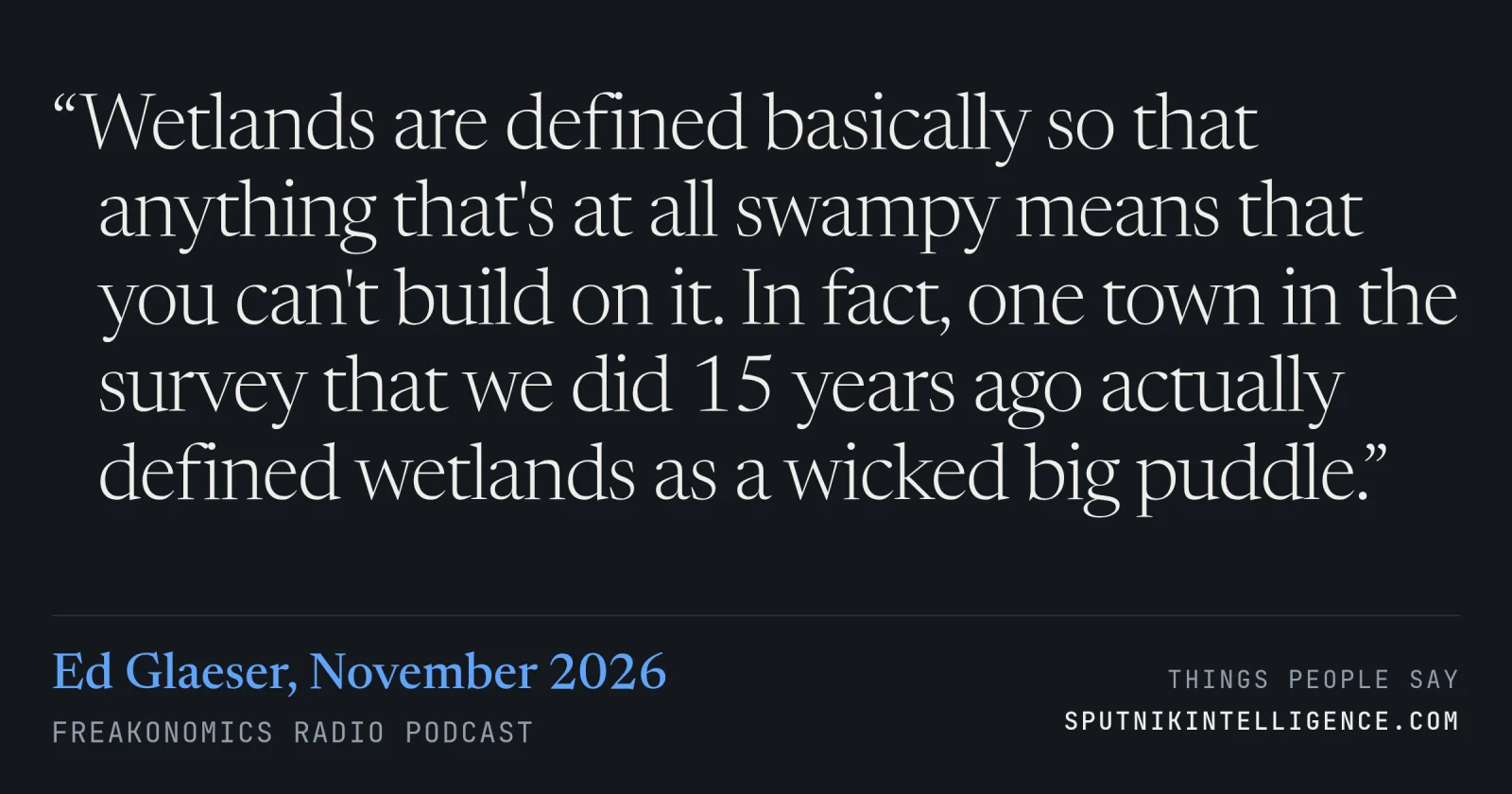
“Wetlands are defined basically so that anything that's at all swampy means that you can't build on it. In fact, one town in the survey that we did 15 years ago actually defined wetlands as a wicked big puddle.” — Ed Glaeser, Freakonomics Radio

Asked why he blames regulation for the construction problem, he points to local rules around Greater Boston, like minimum lot sizes and wetland definitions, that quietly stop building.

Freakonomics Radio · 2026-11-25 Permalink → Listen →
Freakonomics Radio Around 15:29 into the episode
Speaker 3

…what I think of as being behind this housing shortage, that incumbent owners have figured out how to use a maze of rules and regulations to protect what they have and to make sure that they don't have any sort of inconvenience. But people do pay a cost for it, and the cost is paid by outside.

Stephen Dubner

And why does Glazer think that regulations are behind this problem?

Speaker 3

…the most obvious limitations on building. Now, there are also a variety of more subtle ones. So, for example, in Greater Boston, almost universally, there are limitations on building next to wetlands that go beyond the state's already fairly rigorous rules on protecting wetlands. So, it's very easy to sort of think of wetlands and, oh, think this is the Everglades. This is a great natural thing. Wetlands are defined basically so that anything that's at all swampy means that you can't build on it. In fact, one town in the survey that we did 15 years ago actually defined wetlands as a wicked big puddle.

Stephen Dubner

So, you talk about all those regulations as if they have a pretty sizable negative component. On the other hand, I could say, hey, Ed, more labor regulation means there's greater safety and work-life balance. More building regulations means our buildings are safer, maybe have cleaner utilities and…

Speaker 3

There are plenty of regulations that we want. So, in the 19th century, New York became healthier not just because it built the Croton Aqueduct because it built sewers, but because it actually required tenement owners to connect to those sewers. And I am certainly in favor of regulations that…

Stephen Dubner

Glazer points to another unintended consequence of tougher regulations.

Speaker names come from our own diarization. The position is estimated from where the line sits in the episode.
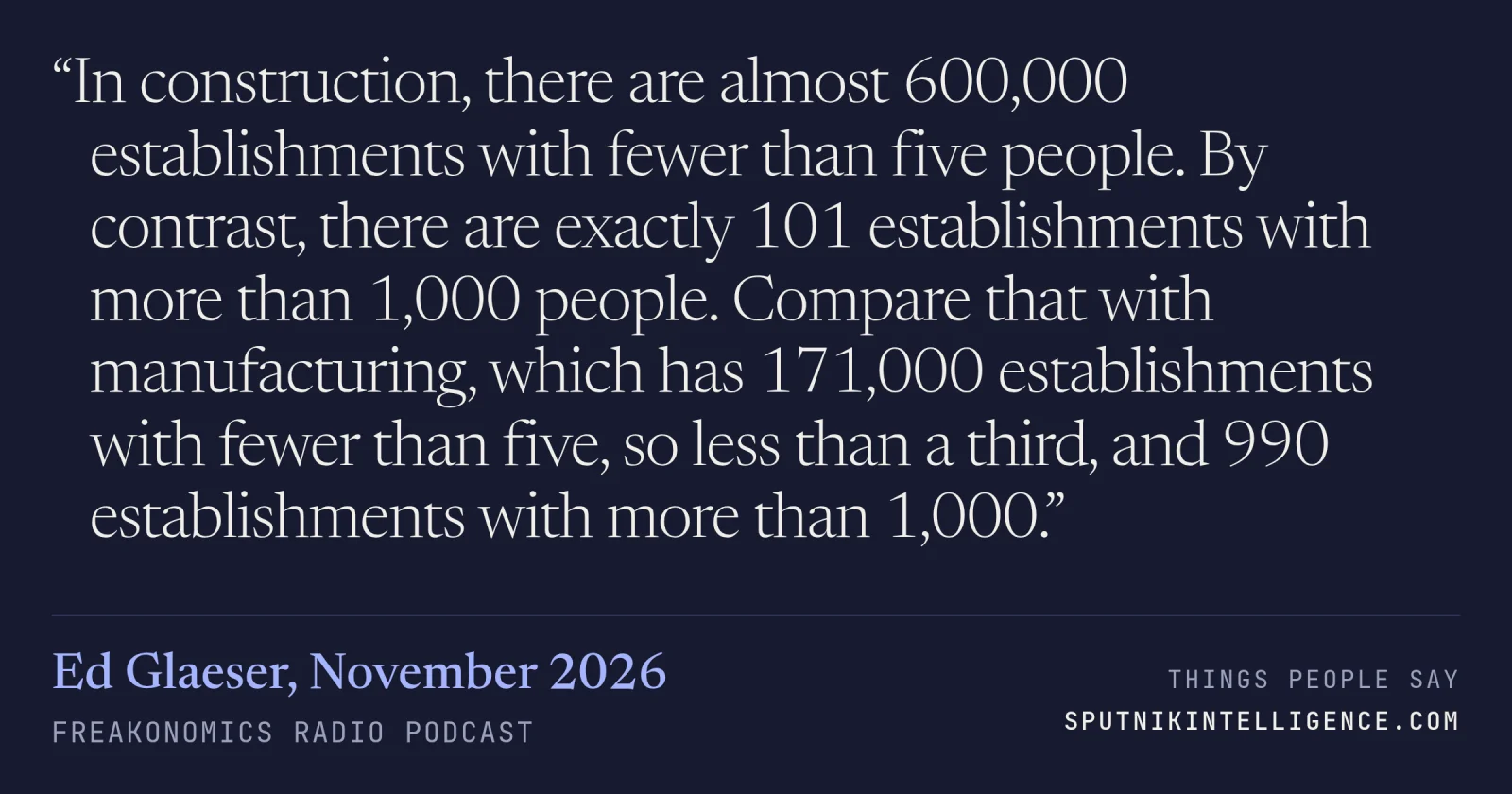
“In construction, there are almost 600,000 establishments with fewer than five people. By contrast, there are exactly 101 establishments with more than 1,000 people. Compare that with manufacturing, which has 171,000 establishments with fewer than five, so less than a third, and 990 establishments with more than 1,000.” — Ed Glaeser, Freakonomics Radio

The host had just said regulation pushed construction projects and firms to stay small. These firm-size counts show why construction never got the scale economies manufacturing did.

Freakonomics Radio · 2026-11-25 Permalink → Listen →
Freakonomics Radio Around 18:14 into the episode
Speaker 3

In lots of parts of the world, the projects got smaller and smaller, the lots got smaller and smaller.

Stephen Dubner

And what that means, Glazer says, is that most construction firms are also small, or construction establishments, as he calls them.

Speaker 3

So in construction, there are almost 600,000 establishments with fewer than five people. By contrast, there are exactly 101 establishments with more than 1,000 people. Compare that with manufacturing, which has 171,000 establishments with fewer than five, so less than a third, and 990 establishments with more than 1,000. So almost 10 times as many really big ones and less than a third really small ones. So Hard completely different skew of the size of the entity. A similar way of seeing the small size of this comes from the CoStar data, which is about residential parcels being developed. So out of their sample of about 3,700 parcels, the median parcel is 7.3 acres and has 3.2 units. These are tiny things. You're…

Stephen Dubner

The cost of construction varies a lot depending on where you are. In New York and San Francisco, you might spend around $730 per square foot. In Chicago, it's closer to $500. In Austin, it's just below $400. That's all according to 2026 data from Turner and Townsend. I asked Ed Glaeser, what are…

Speaker 3

So the beauty is, again, this is supposed to be actually the physical costs. And the Turner and Townsend data actually has elements of the things that go into the physical cost. They're going to highlight just the generic labor costs, which are just a lot higher in New York. Material costs, which…

Stephen Dubner

Part of that residual unexplained component, not just in New York, but anywhere that makes it hard and expensive to build, may be explained by a rise in what is called citizen voice. The economists Leah Brooks and Zachary Lisko recently published a paper about the rise in infrastructure costs in…

Speaker names come from our own diarization. The position is estimated from where the line sits in the episode.
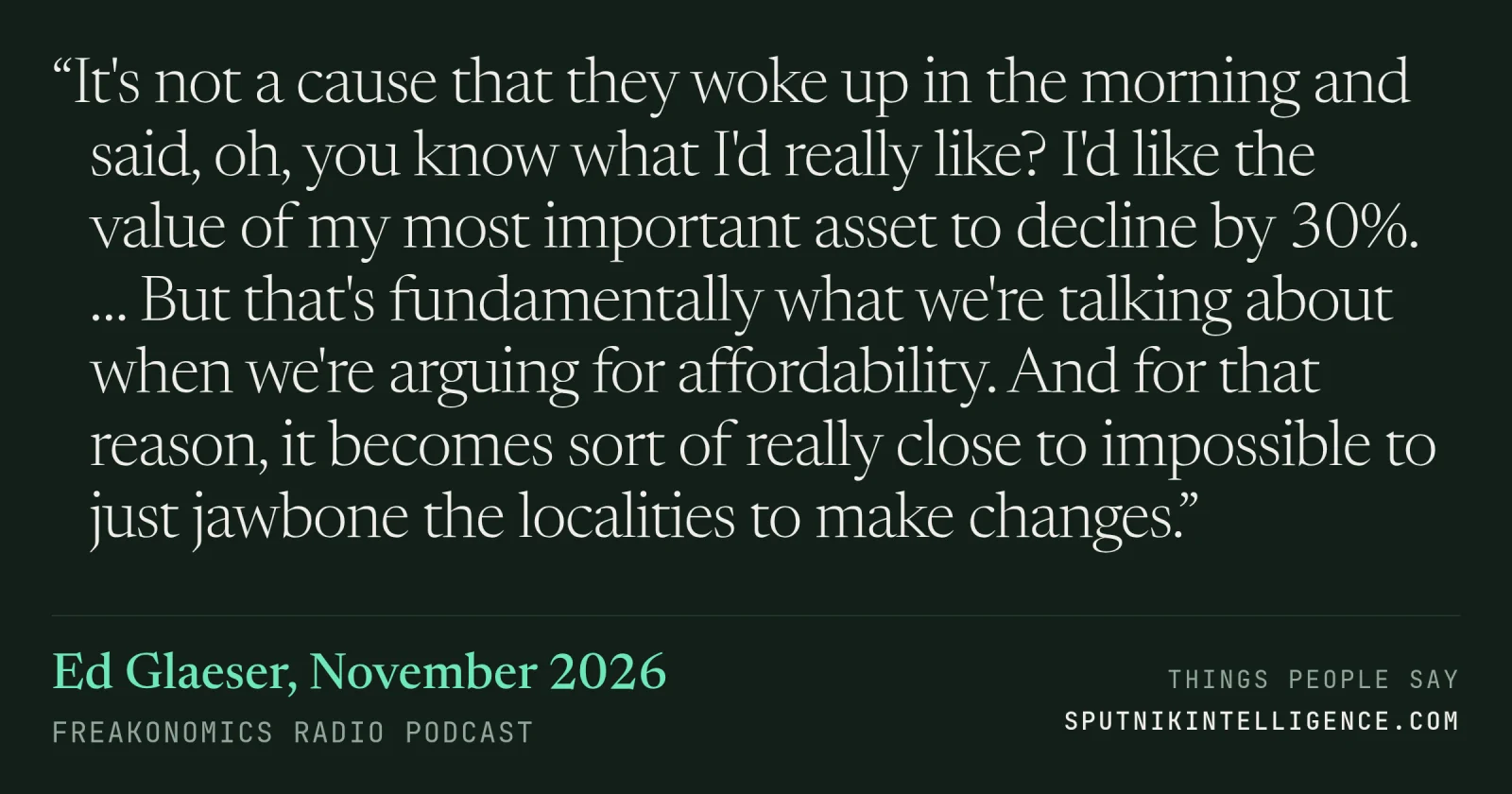
“It's not a cause that they woke up in the morning and said, oh, you know what I'd really like? I'd like the value of my most important asset to decline by 30%. … But that's fundamentally what we're talking about when we're arguing for affordability. And for that reason, it becomes sort of really close to impossible to just jawbone the localities to make changes.” — Ed Glaeser, Freakonomics Radio

Asked what could loosen regulation and boost building in the US. Land use is decided locally, and making housing affordable runs against the financial interest of the homeowners who vote on it.

Freakonomics Radio · 2026-11-25 Permalink → Listen →
Freakonomics Radio Around 49:12 into the episode
Speaker 2

And the reason that they've done that is if they've carefully analyzed the results, the costs, the efficiency, and the labor market and said, we have no chance of building what we need to build in the field over the next 10 years. So it's now time for us to tell the industry how to do it.

Stephen Dubner

And back in the U.S., what about easing up on some regulations to boost construction? Here again is the economist Ed Glaeser.

Speaker 3

So most land use regulations local, and most of the things that need to happen for this to change are local. This creates a particular challenge because, in fact, the cause of making housing affordable is not a cause that too many homeowners think is a particularly sensible cause. It's not a cause that they woke up in the morning and said, oh, you know what I'd really like? I'd like the value of my most important asset to decline by 30%. That would be a really great outcome for me, but that's fundamentally what we're talking about when we're arguing for affordability. And for that reason, it becomes sort of really close to impossible to just jawbone the localities to make changes. The push has to come from somewhere else, even if it's localities that are making the changes.

Stephen Dubner

Can you describe a future in America where the different players, with guidance from people like you and others, could produce a lot more housing more easily, more efficiently, and more cheaply? In other words, how important would that be to the functioning of this country and the society in the…

Speaker 3

Imagine Silicon Valley. Imagine Boston. Imagine New York. Imagine the possibility that some parts of these cities, and they wouldn't have to be huge if you allowed lots of density. We just tore up the rules. We just actually tore up the rules about how density could be. We said, you know, as of…

Stephen Dubner

That sounds like a really fun experiment to run. Is anybody doing it?

Speaker names come from our own diarization. The position is estimated from where the line sits in the episode.
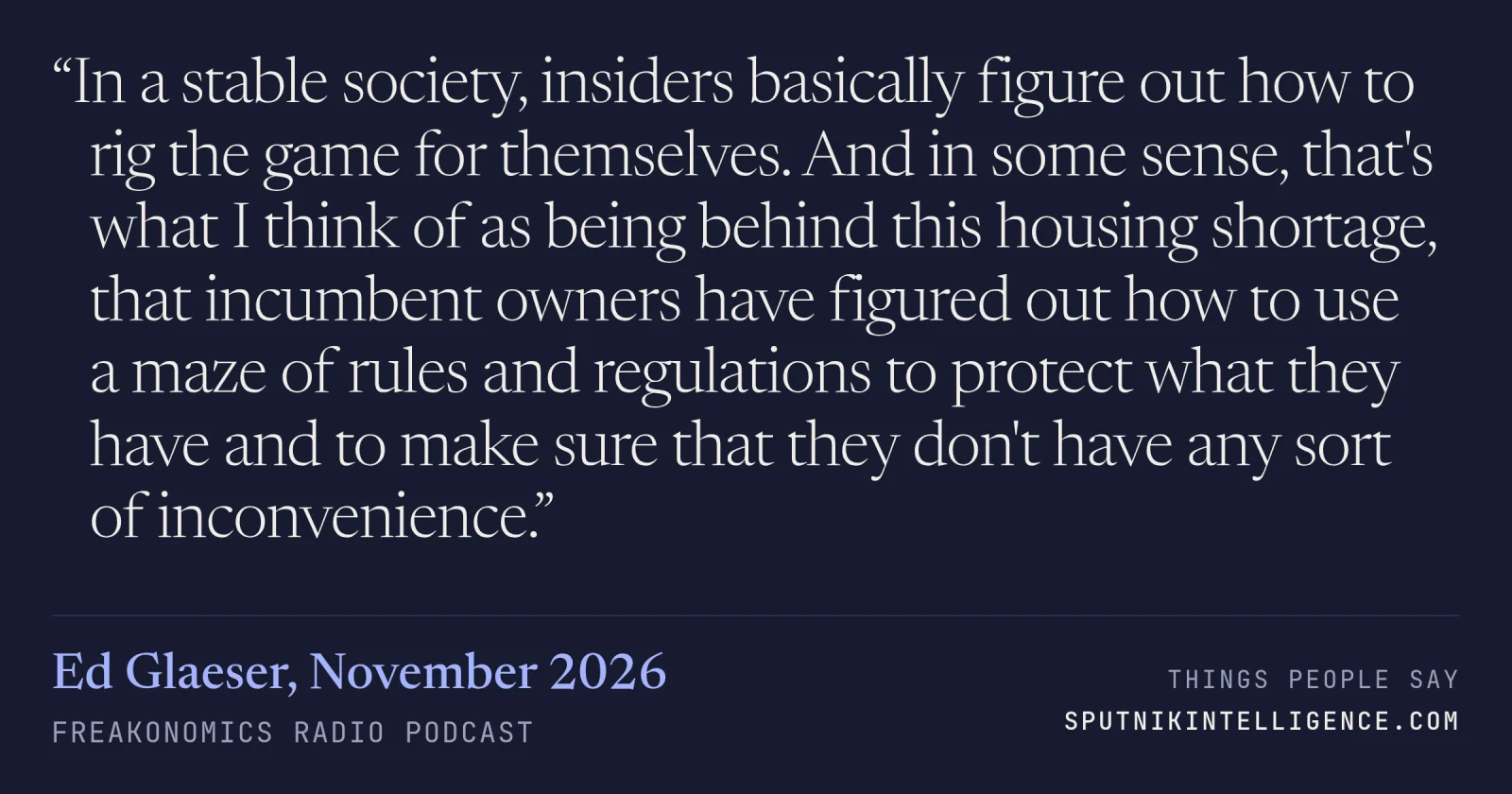
“In a stable society, insiders basically figure out how to rig the game for themselves. And in some sense, that's what I think of as being behind this housing shortage, that incumbent owners have figured out how to use a maze of rules and regulations to protect what they have and to make sure that they don't have any sort of inconvenience.” — Ed Glaeser, Freakonomics Radio

Asked what a US housing shortage of nearly 4 million units means in practice. The economist says it raises prices, shrinks the most productive cities and moves wealth from young people to older owners.

Freakonomics Radio · 2026-11-25 Permalink → Listen →
Freakonomics Radio Around 14:47 into the episode
Speaker 2

Much of my work in the policy side is focused on land use regulations and their pernicious effects on the affordability of American housing.

Stephen Dubner

…who think regulation has played a major role in the construction problem. And the consequences of this problem have been severe. Freddie Mac, or the Federal Home Loan Mortgage Corporation, estimates that the U.S. is nearly 4 million housing units short of where we ought to be. What does that mean?

Speaker 3

…generation or their grandchildren's generation, they still need to buy a home, but they're not going to be able to afford that home, at least not unless they've gotten very, very lucky. And so this sort of massive harming of the young. And in some sense, this is a larger phenomenon that's related to the things Mankar Olson wrote about 40 years ago in the rise and decline of nations, in which in a stable society, insiders basically figure out how to rig the game for themselves. And in some sense, that's what I think of as being behind this housing shortage, that incumbent owners have figured out how to use a maze of rules and regulations to protect what they have and to make sure that they don't have any sort of inconvenience. But people do pay a cost for it, and the cost is paid by outside.

Stephen Dubner

And why does Glazer think that regulations are behind this problem?

Speaker 3

I will certainly not claim that the evidence for that is ironclad, but I will push what I think is my preferred hypothesis, which is that what all the regulation did was it ensured that it became very, very difficult to focus on mass production. The most obvious is just minimum lot size. A rule in…

Stephen Dubner

So, you talk about all those regulations as if they have a pretty sizable negative component. On the other hand, I could say, hey, Ed, more labor regulation means there's greater safety and work-life balance. More building regulations means our buildings are safer, maybe have cleaner utilities and…

Speaker names come from our own diarization. The position is estimated from where the line sits in the episode.

Collections They Appear In