Nilay Patel had contrasted China's stable long-term planning with the shifting US tariff announcements. Shih argues the churn doesn't just add noise: it stops companies committing to factories at all, which helps explain why US reshoring hasn't shown up.
…They said, we need to be good at all these things, like information technology, biotechnology, semiconductors, they still have a ways to go. But, you know, they identified civil aircraft. They identified all these different technologies, communications technology, software, you know, robotics.
…on the show usually ends up talking to me about how they scramble to buy RAM at affordable prices to make their products, which has to keep them from doing anything else. How would you contrast that? Can we get out of this moment where it's a pure scramble, or is this fully shaken everything up?
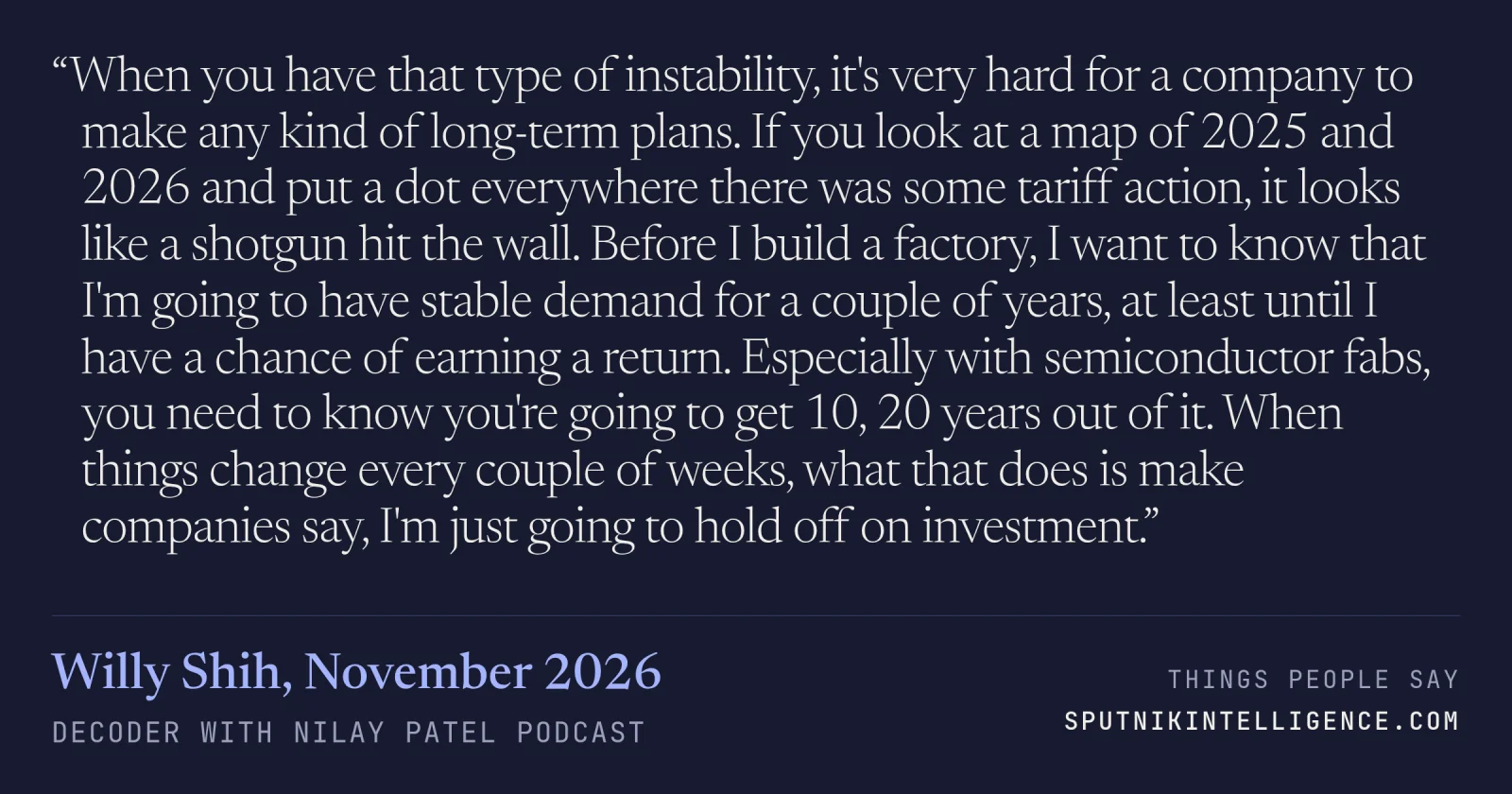
We're in a very transactional environment. You know, everything is short-term. And these rapid changes that you see, like on the tariffs, if you look at a map of 2025 and 2026 and put a dot everywhere there was some tariff action, it looks like a shotgun hit the wall, right? You know, there's all these spots all over the place. Okay. And the problem with that is when you have that type of instability, it's very hard for a company to make any kind of long-term plans, right? Before I build a factory, I want to know that I'm going to have stable demand for a couple of years, at least until I have a chance of earning return on that thing. Okay, I've talked to a couple of companies about, and these were overseas companies thinking about coming into the U.S. market, and they said, well, you know, I can't do it because things keep changing. Okay, do I go into Mexico? Do I go into the U.S.? What part of the U.S. do I go into? Especially things like semiconductor fabrics. Like you need to know that you're going to be able to get 10, 20 years out of it. And it's like when things change every couple of weeks, what that does instead is say, I'm just going to hold off on investment, right? Because it's just too uncertain. It changes too often.
Are you seeing that slowdown in investment? Are you seeing companies say we can't actually invest in manufacturing?
It varies. You know, I see that for a lot of companies saying, you know, where do I want to put my production operations? Okay, now we see some things like car plants coming into the U.S. And usually that's a function of the pain has just been too great. Okay. But, you know, the whole auto tariff…
Support for this show comes from Outshift by Cisco, which is Cisco's incubation engine for frontier technology. Imagine a company where every department can talk, but none can work together. Decisions stall, people spend all day chasing updates, mistakes slip through the cracks. That's the…