
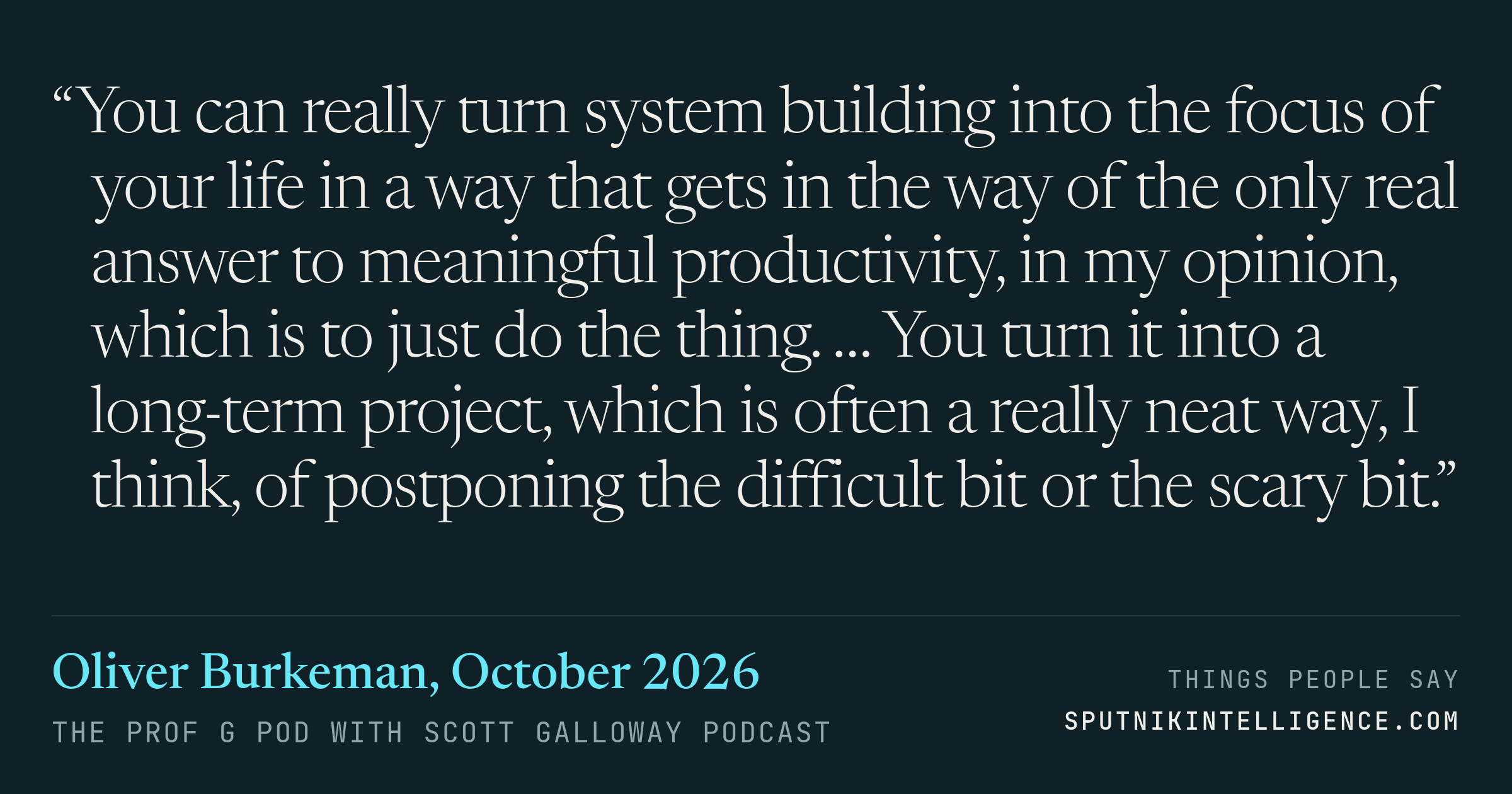
Scott Galloway asked why Burkeman argues against productivity systems. Burkeman says the alternative is to take one real action today, such as meditating for five minutes, instead of training to become a meditator six months from now. That, he says, often takes more nerve than starting a life-changing system.
…something else view of eternal life. Yeah, if we sort of in some sense live forever and ever and ever and ever, I think that would be terrible and sort of catastrophically meaningless in certain ways. But yeah, I think then I can say maybe most of these lessons and perspectives wouldn't apply. In
your book, Meditation for Mortals, your latest book, you argue against implementing systems that promise to optimize people's routines and habits for maximum productivity. Why don't they work? And why do So many people believe they do.
I mean, I'm not sure they can't work, but you know, you'll be very well aware of this kind of broad notion that systems are better than goals as a way of organizing your time. And I think that's probably true. But what I noticed in myself and in some other people as well is that you can really turn system building into the focus of your life in a way that gets in the way of the only real answer to meaningful productivity, in my opinion, which is to like just do the thing. You sort of identify a problem in your life or a place you'd like to get to or a goal that you have, and then you sort of set about becoming the kind of person who would be really good at doing those things. So, you know, taking the courses, reading the books, developing the skills. You turn it into a long-term project, which is often like a really neat way, I think, of postponing the difficult bit or the scary bit. And in all those cases, you could have just done like taken one action that was going to be the act, that would be being that kind of person, right? So just one of the examples in the book, you hear that meditation is really…
The book opens with a chapter, and I love this. It's worse than you think. Basically, it's an argument for radical acceptance. Why start there? And can you talk more about that?
I mean, I think you have to start there. I wanted to start there because it is that kind of, first of all, let's come crashing down to the ground and then pick ourselves up and see what we can do. Let's step into reality first. And all I mean by that is that in our quest for more control, in our…
We'll be right back after a quick break.