After visiting a town near Hangzhou full of vibe coders, Wang says she asked how much money they actually make. Few had profitable products; most were earning from selling AI courses.
Odd Lots · 2026-11-23
Permalink →
Listen →
Odd Lots
Around 21:23 into the episode
Speaker 4
…this dread exists in China as well. It is a consensus that many occupations and many majors offered in university will no longer be meaningful. But still, I do think Chinese people are cynical about education. This is why I got myself into investigating this AI education industry in China. Oh,
Joe Weisenthal
yeah, what's that all about?
Speaker 4
So I went to this Liangzhu Vibe coding town, and the one core question I want them to answer is how much money you can actually make with your Vibe coding project. And not many people are actually doing, actually building profitable businesses like that AI fortune telling company. Many Vibe coders told me that they make money by selling AI classes. I was like, what do you mean by selling AI classes? And then I realized it is a vast and unregulated and sort of lucrative industry that's just new and just out there. When I hear
Joe Weisenthal
selling AI classes, by the way, I hear selling praying on people's fears that here is this thing that's going to take off and you better learn how to use these things and pay me some money because otherwise you're going to be left behind.
Speaker 4
Yeah, absolutely. So after learning about this, I started to discover like many more AI classes that filled different corners of the Chinese internet from classes named from DeepSeek 101 to how to get rich with AI to how to AIGC 101. All those classes are out there. So I went to this one company…
Joe Weisenthal
this is an MLM kind of thing. This is what we would, it's MLM.
Speaker names come from our own diarization. The position is estimated from where the line sits in the episode.
Tracy Alloway asked why China has struggled to export culture like film and music. Wang passes on a metaphor she was given about working under censorship, and says it flattens creative output.
Odd Lots · 2026-11-23
Permalink →
Listen →
Odd Lots
Around 43:48 into the episode
Speaker 1
a lot of anti-US propaganda, right? And then people were talking about like, oh, AI is going to be a big component of future government propaganda.
Speaker 3
…a, it's slightly a tangential question, but it's related to this. Do you have a theory for why China has struggled to export, I guess, more cultural things like movies, music? I mean, we've seen Japan go through the J-pop era, K-pop, Korean films. Yeah. And China seems to have really struggled with
Speaker 4
that. There's definitely one reason is living in a society where there's a metaphor, someone told me, which is as a content creator or as an artist in China, it's like walking in a dark room where there are 10 pieces of furniture you cannot touch. If you touch it, then you will die. So this is the reality of creating something in China. Given this mindset or experience, giving the censorship mechanism, giving there are just like many invisible lines out there that could trigger something, some consequences. So I would say people in China are less creative now. You see a flattening effect of the Chinese creative industry. And I guess the second one is China really lacks a…
Speaker 3
It's always steel.
Speaker 4
Yeah, exactly. Like for steels, like we shall, we shall build. Like this is where China's core strength lays. So I guess boosting the entertainment industry and like exporting culture goods to the rest of the world hasn't really been China's strategic emphasis. I guess that's we're living in the…
Joe Weisenthal
I've also heard people say that just unlike, say, Japan and Korea, that entertainment creators have a gigantic domestic market to sell to and that they don't, you could be very successful creating entertainment content without it going to the globe and a different, because it's the scale of that…
Speaker names come from our own diarization. The position is estimated from where the line sits in the episode.
Asked about China's boom in AI-generated video drama, Wang says she set out to find a soft-power success story. Instead she found local governments mass-producing AI content to look like they back a strategic industry.
Odd Lots · 2026-11-23
Permalink →
Listen →
Odd Lots
Around 39:40 into the episode
Speaker 1
and where they come from? Because as you describe
Speaker 3
it in your piece, it's sort of like if Detroit, I guess, nowadays became like this giant AI slot factory. Yeah, I really wanted to write a techno-optimistic story about AI slops. It's a noble goal. Yeah, it's a noble goal. The more I get into the story, the more people I talk to, the more I realize that it could be an illusion because people have been telling me the Chinese vertical AI dramas could be a real tool for China to export soft power. It could be a real Chinese innovation. So, really, I was hoping to find like more innovative or creative stories to write about. But later, I discovered that China has already established what I call the industrial slop complex. It is a result of many factors. One of the…
Speaker 1
literally with videos, right? Because they're sort of like easy to make. Yeah, look what we made.
Speaker 3
Exactly. And then, AIGC, AI content-generated, AI-generated video is the lowest bar to enter this AI as a strategic industry. So, you'll see many cities like Qingdao, Wuhan, Zhongzhou, those cities are normally don't really associate themselves with tech. They're the ones jumping onto this AIGC…
Joe Weisenthal
This is very interesting because this is what people would say is one of the classic problems with certain like top-down economic planning. It's like, guys, we really need to have more AI. And then a bunch of regional leaders, it's like, all right, let's get that. Yeah, it's the overcapacity. Yeah…
Speaker names come from our own diarization. The position is estimated from where the line sits in the episode.
Tracy Alloway asked why surveys show people in China far more enthusiastic about AI than Americans. Wang gives two reasons; this is the first, the absence of any organized way to say no. The second is that past industrial upgrades visibly improved people's lives.
Odd Lots · 2026-11-23
Permalink →
Listen →
Odd Lots
Around 14:09 into the episode
Speaker 1
…The $500 offer is available for new business checking accounts with qualifying activities through 1-21, 2027. Eligibility and qualification requirements must be met. Additional restrictions may apply. Please speak with a business banker for more information. JPMorgan Chase Bank NA, member, FDIC.
Speaker 4
Okay, so DeepSeek is the sort of moment when a lot of people get excited about AI in China. Let me ask you a basic question first. Why do they seem to be more excited about AI than a lot of people here in the West? I don't want to talk in generalities. I am talking in generalities. Obviously, there are exceptions on both sides of the ocean, but just why in general does it seem like Chinese people seem to be embracing AI or at least experimenting with it? Yes. So the pooling data actually indicates that there are 83% of Chinese people believe that AI would be beneficial to their life and work. In contrast, the number in the US is 38, which means the US is much more pessimistic about AI itself. And oh, yeah, I think there are a few reasons why the Chinese society and Chinese people seem to, in a sense, radically embracing AI. The first reason is what choice do they have, right? Can they say no to this technology? There is…
Joe Weisenthal
That makes a lot of sense. So you wrote this piece. You said something that I want to go back to now. China's vibe coding capital. And you wrote about that for the New Yorker. And in that piece, you talk a lot about this company that built an AI-powered fortune telling app. And there's like, when I…
Speaker 4
Yeah, this one charming thing about this vibe coding town, to give a little bit of context, it is a small town that sits outskirts of Hangzhou. Hangzhou is China's tech hub. That's where DeepSeek, Alibaba, and Unitree is in. And this vibe coding capital called Liangzhou is 20, 30 minutes from…
Joe Weisenthal
Austin 25 years ago, but it's not the case anymore.
Speaker names come from our own diarization. The position is estimated from where the line sits in the episode.
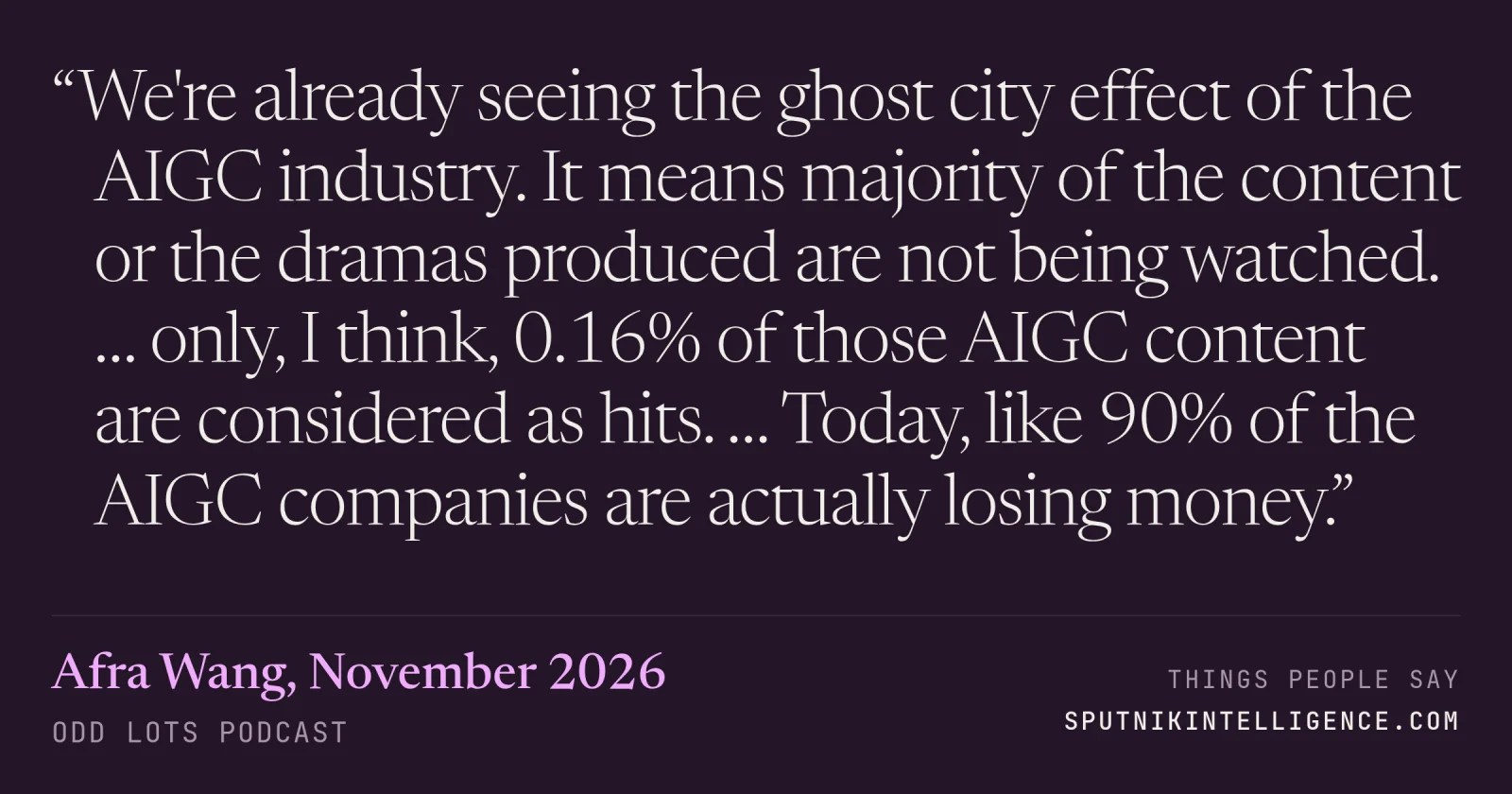
The hosts asked about AI-generated micro-dramas in China. Wang says output is set to reach millions of shows but almost none get watched, and blames local governments competing to show Beijing they are doing AI. The figures are her own.
Odd Lots · 2026-11-23
Permalink →
Listen →
Odd Lots
Around 41:44 into the episode
Speaker 3
…of Beijing is basically being seen as a statin island of Beijing. And the Mental Go government be like, we're going to attract many AI talents to come to us. We're going to cultivate them to be the AIGC talents and we're going to establish a flourishing AIGC industry. So this is a reality. As
Joe Weisenthal
Tracy said, though, there's a lot of demand for AI slops, so it just might work.
Speaker 3
…was like, what is that thing that she's watching? It looks really weird. Yeah. Yeah. I mean, today's China is producing a lot of AIGC short dramas. I'm talking about there's a projection for next year and say next year there will be 5 million those AI drama shows that can be disseminated through your app on your smartphone. And today the industry Industry is actually not doing really well. Like we're already seeing the ghost city effect of the AIGC industry. It means majority of the content or the dramas produced are not being watched. If you have a hit rate, because the short video industry is very power lawy, it's like only the top content are being seen by the majority of people. The reality is only, I think, 0.16% of those AIGC content are considered as hits. And only those hits can meaningfully bring some revenue. And today, like 90% of the AIGC companies are actually losing money. And then it is a result of this…
Speaker 1
The moment I actually first really noticed some of the China AI-generated videos was in the early days of the Iran war
Speaker names come from our own diarization. The position is estimated from where the line sits in the episode.
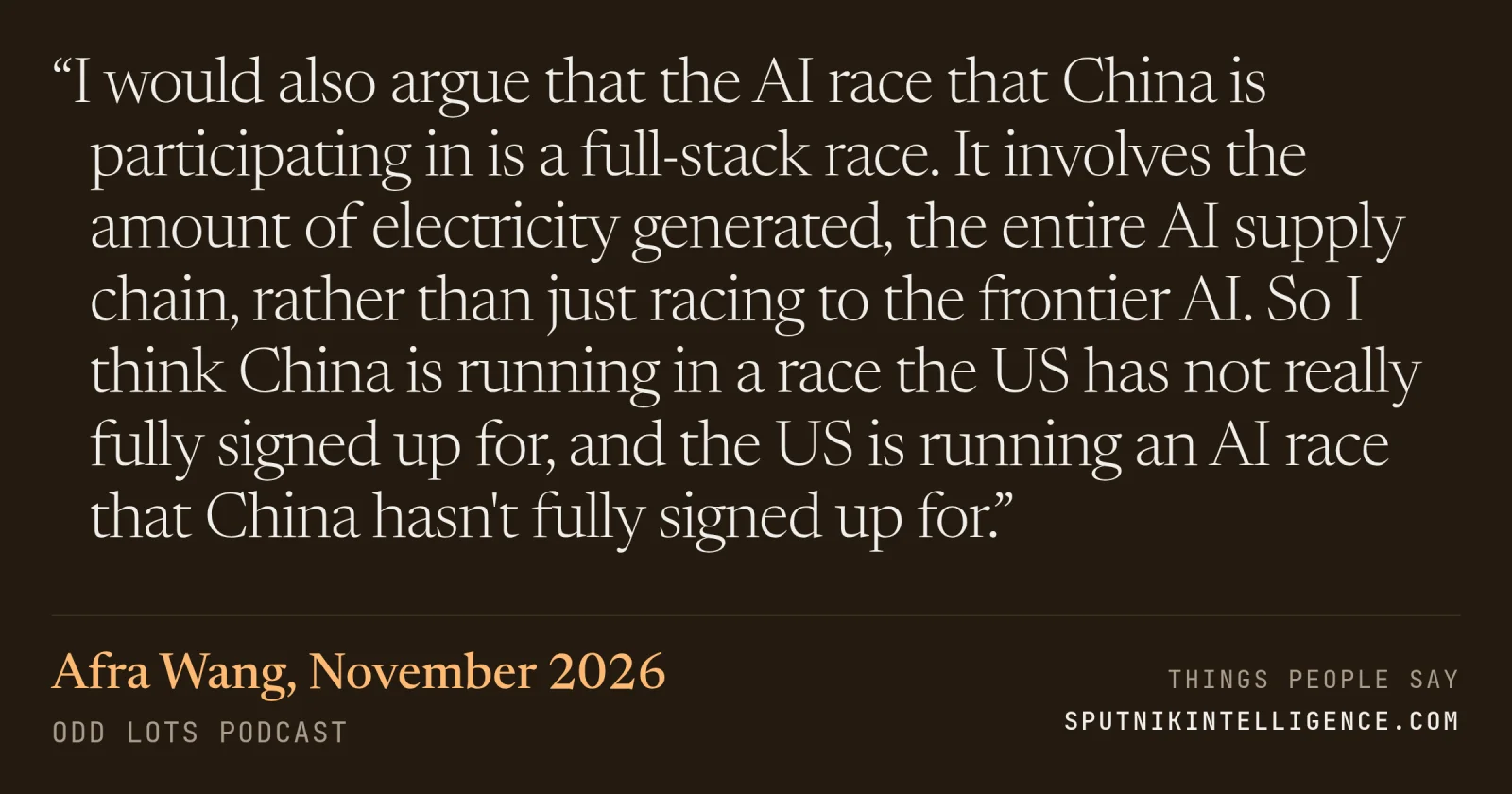
Joe Weisenthal asked when China will wake up to AGI risk the way some Bay Area thinkers say it should. Afra Wang, who reports on AI in China, says China isn't AGI-pilled and reframes the competition: the two countries are running different races.
Odd Lots · 2026-11-23
Permalink →
Listen →
Odd Lots
Around 08:37 into the episode
Speaker 4
…me is the today's trajectory especially the frontier labs that the US the US labs are doing has a reasonable and predictable curve it is an exponential curve and I do think similar curve might happen in China now so speaking from someone who is really RSI pilled I think China has yet to wake up so
Joe Weisenthal
you agree with these like that actually that basic thing is like yeah they should probably wake up about this
Speaker 4
right I actually In a sense, I do agree with you. I do think China has not filled the AGI yet. I'm quoting Ilya Saskiver here. He's like, Feel the AGI. It might soon. But now, I would also argue that the AI race that China is participating is a full-stack race. It is a race that involves the amount of electricity generates, it involves all sorts of the entire AI supply chain rather than just racing to the frontier AI. So, I think China is running in a race where the US has not really fully signed up for, and the US is running AI race that China hasn't fully signed up for. So, like, both countries are running on their own race and interpreted, interpreting this competition in different ways.
Speaker 1
This might be a weird question, but is one of the reasons that China, I mean, China is catching up on a lot of the frontier models, at least if you look at various benchmarks,
Speaker 4
but it started out slower than the US, obviously. How does the actual Chinese language play into the development of LLMs? Because, I mean, I remember like just trying to type Chinese characters on a phone can be very challenging, depending on what system you use and whether you use like pinyin or…
Joe Weisenthal
obviously, ChatGPT, you could use it in Chinese, but it was what was distinct for China about DeepSeek, besides it being Chinese, is that having been trained on a lot of Chinese tech specifically, it felt like reading actual Chinese as opposed to maybe like English translated into Chinese or…
Speaker names come from our own diarization. The position is estimated from where the line sits in the episode.