
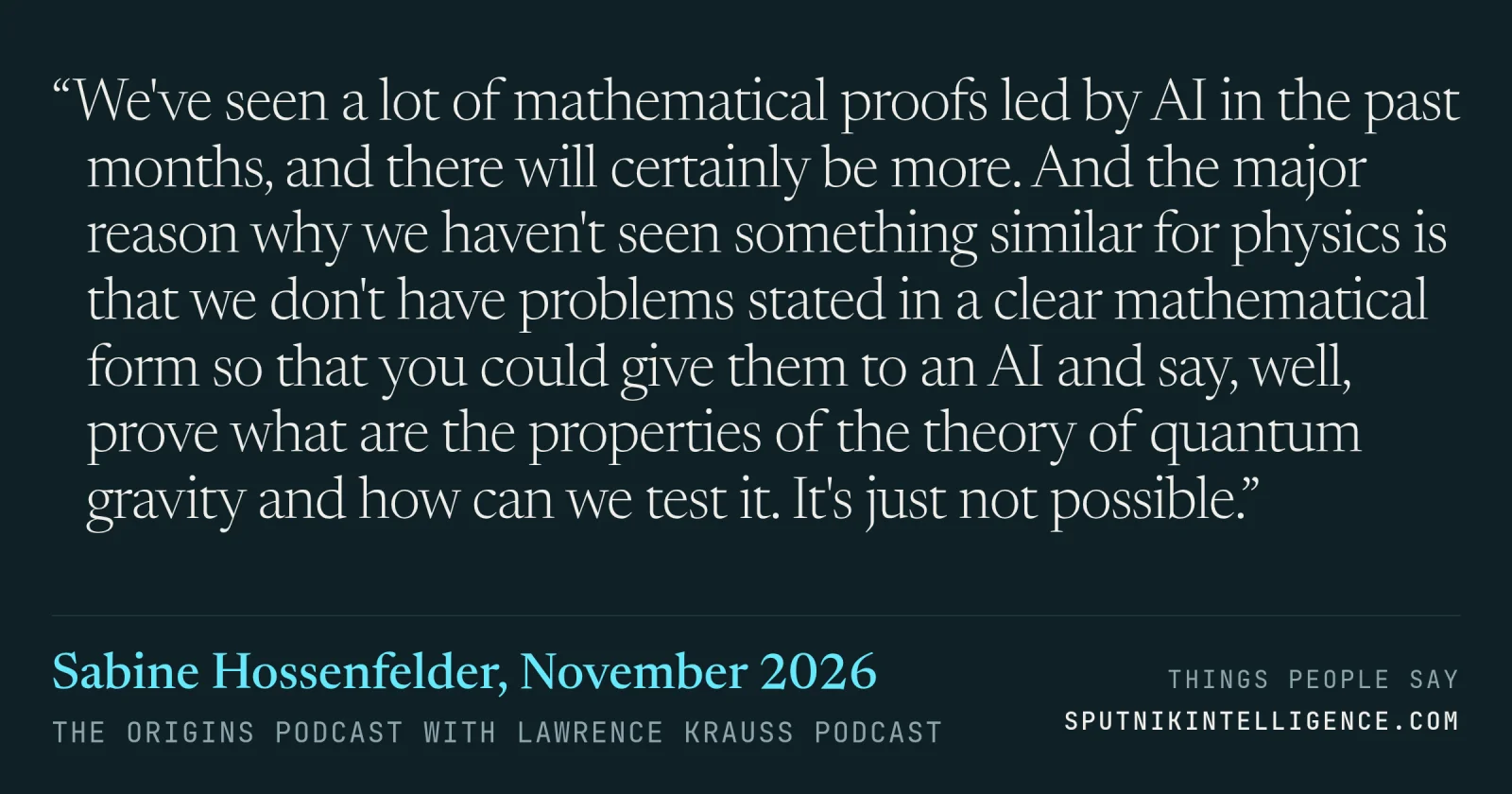
She was explaining why she finds a "reverse physics" program, an effort to rebuild physics from a small set of principles, interesting. Her point is that physics isn't stated precisely enough for AI to do what it has started doing in mathematics.
…this kind of thing and it was hugely inspirational. They wanted to know everything about rockets and space flights and gravity and so on and so forth. And since then, I kind of think, you know, I've underestimated the inspirational value of doing this kind of thing. It's not the scientific turnout.
…go. Speaking of something that may have less use than you claim, let's talk about something that to me seems completely useless, but obviously it interests you. It's reverse physics for quantum mechanics. So you referred to your paper. and I've looked at it and tell me why you find it interesting.
…this is something that one should definitely try. And I think it might not work, but I think it's a good idea that trying because it's actually something different from the usual grand unified theory of everything kind of stuff. And the other reason is that a fairly rigorous axiomatic approach is something that would be very easily digestible by AI. And now I've said AI after all. So you see, we've seen a lot of mathematical proofs led by AI in the past months, and there will certainly be more. And the major reason why we haven't seen something similar for physics is that we don't have problems stated in a clear mathematical form so that you could give them to an AI and say, well, prove what are the properties of the theory of quantum gravity and how can we test it. It's just not possible. And so personally, I think it's good to at least try to formulate the theories that we have more mathematically rigorously. And I think that whether we like this or not, it's probably going to happen just because people are doing it with AI. Like this recent Young Mills, you must have seen this, like with the controversy about whether they should release the proof or not, which I think is a…
Well, it's good that some people do it, I guess. It looks to me like it's almost philosophy and therefore I cringe. But I was, look, when I was at Harvard, there was a group that did axiomatic quantum field theory. And they basically spent years and years and years trying to prove that a very…
I think it's interesting is that we might actually have, for the first time, found something that we actually disagree on. It's because I think that both things can be true. You have to look for experiments and try to uncover new laws of physics, but you also have to know what it is that you're…
Well, you know, and now you've shamed me in a way because I realize people who look at glass houses shouldn't throw stones. And you reminded me that last year I worked on, as we talked about briefly, a number of papers that were not that different that asked about a theory of everything. And…