Asked how private business owners allocate capital compared with public companies, Zwick says buybacks and dilutive acquisitions are often what established firms do when growth runs out. Smaller private firms, he argues, can still grow by simply finding more customers.
Motley Fool Hidden Gems InvestingAround 15:42 into the episode
Eric Zwick
…might be a little different than the Magnificent Seven. So I think like as a public market investor, that's what we think about all the investors are flooding into those seven bets. What are some like maybe interesting contrarian bets? Those are some thoughts I have on that on that question. One
Rachel Warren
…wealthy, as you call them in the book, how do they tend to think about capital allocation? Because I also think that there's often parallels that we can draw when we're looking at quality businesses in the public markets from what we see in terms of the actions taking place in the private markets.
Eric Zwick
Yeah. So I see some of these acquisitions or like, so throwing capital back into investors through buybacks, it's sort of like, you know, the consequence of having run out of good ideas. And, you know, in some cases, like the dilutive acquisition is, well, we see the writing on the wall with our main business line, which is trending, you know, down. And so in the absence of this acquisition, it's going to look even worse. So it could still make sense to do it, even if it's like not a great, you know, it's not going to like, you know, lead to salvation for the company. Stealthy…
Speaker 4
As an investor and stock picker, a lot of my day is spent researching ideas and looking for new investment opportunities. I find myself using Claude more and more to help with that process. Not only can I do it faster, it helps me reach better decisions. I can tell you it's a lot more than just a…
Speaker 3
Purchase new carpet from the Home Depot and get. it installed for free right now shop the stylish choices and simple pricing of carpet from home decorators collection traffic master or life proof with pet proof technology and see for yourself why nobody beats our prices enjoy new carpet with free…
Rachel Warren
Yeah, and it's interesting to think about how as investors and public companies who sort of gain indirect exposure to these players just by nature of their relationships with some of these big players. When you were writing this book, as we get to the end of our time here together today, I'm…
Speaker names come from our own diarization. The position is estimated from where the line sits in the episode.
The economist describes what surprised him most while researching his book on who America's top earners really are. Rather than gilded-age industrialists, the typical top-1% household owns a mid-sized private business, and medical practices led the list.
Motley Fool Hidden Gems InvestingAround 19:38 into the episode
Speaker 3
…traffic master or life proof with pet proof technology and see for yourself why nobody beats our prices enjoy new carpet with free installation right now at the home depot offer valid october 15th through november 1st 2026 exclusions apply for licenses see home depot.com slash license numbers
Rachel Warren
…just by nature of their relationships with some of these big players. When you were writing this book, as we get to the end of our time here together today, I'm curious, what surprised you the most in your research as you were learning about these main street entrepreneurs and their businesses?
Eric Zwick
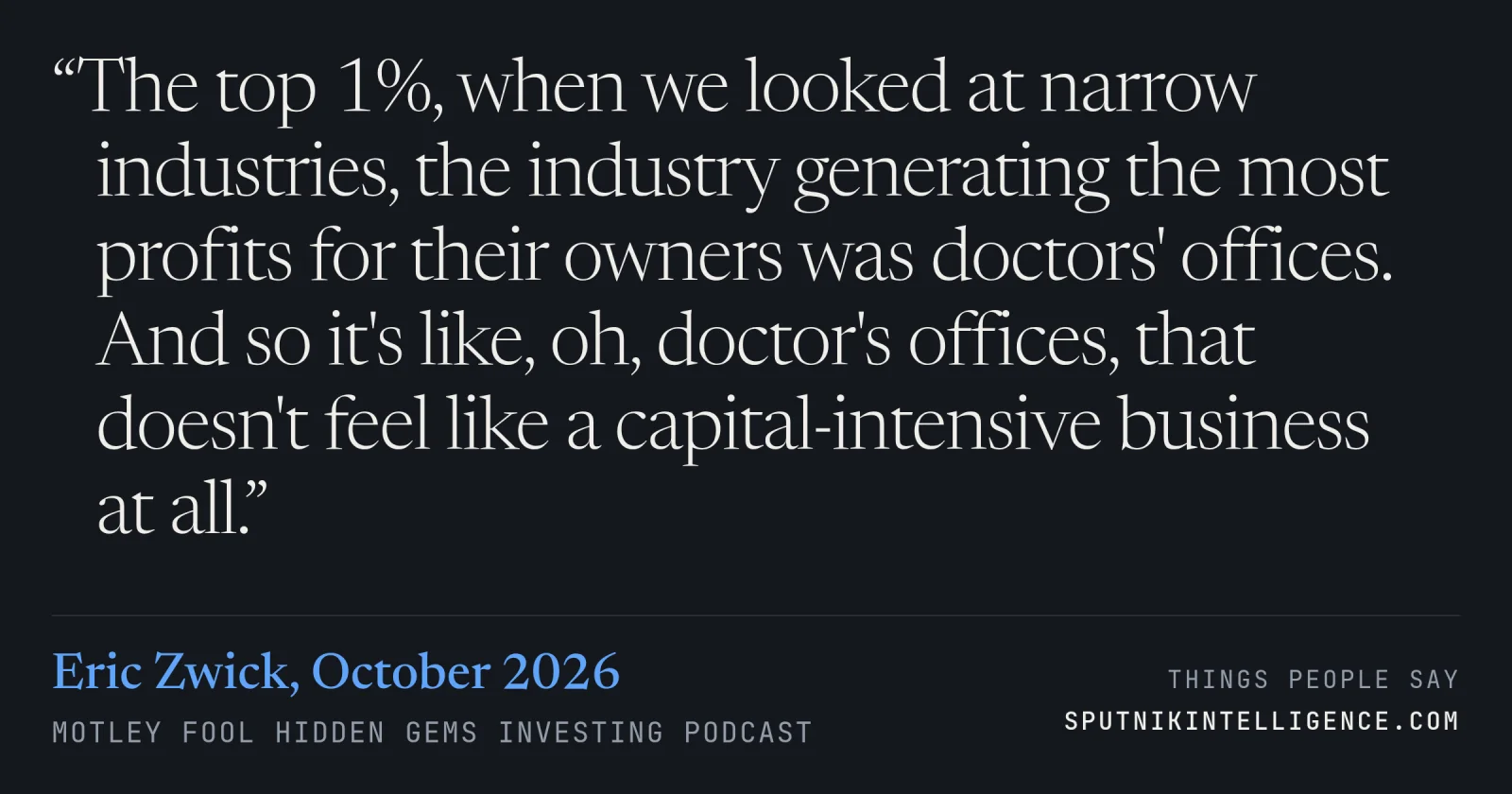
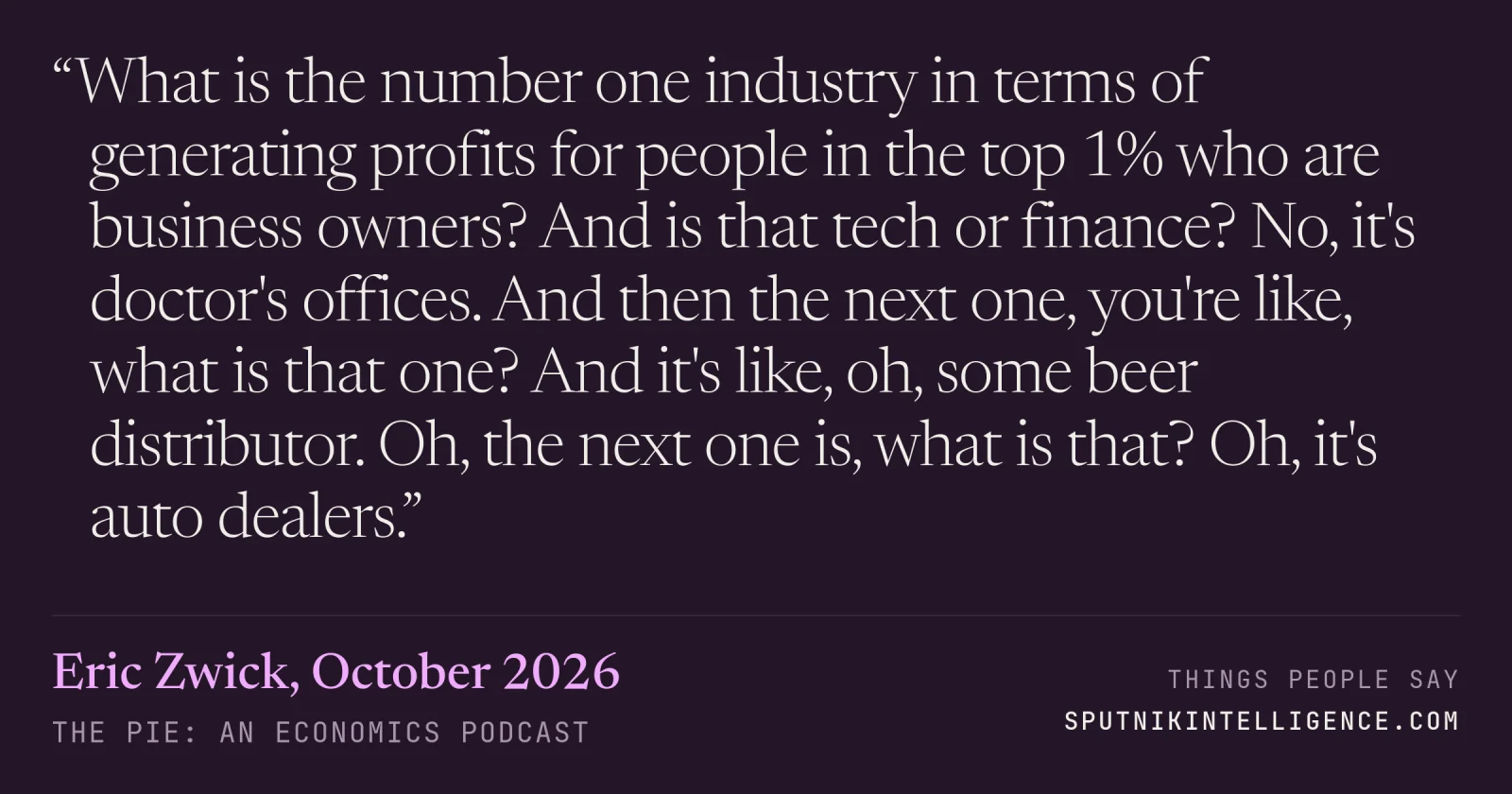
…it's sort of like you actually meet these people that are in the top 1% and see what they're doing and get a little bit about their stories from their own mouths. And you're like, oh, this is not the typical 1% or even 0.1%er is not like the money bags, monopolist, gilded age person. It's like a private business owner with a mid-market business. Like, you know, there are tons of these people. The top 1%, when we looked at narrow industries, the industry generating the most profits for their owners was doctors' offices. And so it's like, oh, doctor's offices, that doesn't feel like a capital-intensive business at all. That's really just they are running practices they've structured as businesses so they can you know pay themselves a bit lower wages but higher profits get better tax treatment but also scale the business up and sell some of the services and so on um that that doctors do but there's just a ton of doctors and uh healthcare is 18 of the economy and you know a big chunk of it is not hospitals or…
Rachel Warren
and one final question for you as well um you know just as investors who are hearing all of this and and drawing on the lessons that you've uh showed us today i i also wonder what are some key elements metrics we can be looking at tracking the health of the economy tracking the health of markets…
Eric Zwick
that's good i mean so thinking about these everywhere millionaires right some of the more aggregate tangible retail sales consumption kind of data right like sort of these businesses are often selling you know say like the fast casual dining right so you're like looking at those kinds of metrics…
Rachel Warren
Thank you so much for that, Eric. It's been so great to speak with you today. And for those who are listening or watching, check out Eric's new book co-authored with Owen Zeidar, the everywhere millionaire who is really rich in America and how they got there. Thank you so much, Eric.
Speaker names come from our own diarization. The position is estimated from where the line sits in the episode.
Zwick, co-author of a book on America's "everywhere millionaires," explains how state franchise laws meant to protect small car dealers from big manufacturers now shield them from competition. He puts beer distributors, realtors and licensed professions in the same category.
…it seems like the tax policy has been designed to protect their wealth, preserve their wealth. Yes, expand access, but make it easier to get to that point. And we have seen this widening of inequality. So I guess, Owen, what do you make of the tax breaks that we have made for this group of people?
Speaker 4
…industries, like auto dealerships, beer distributors, which sounds to me like an expression of that problem that you bring up. So could you expand on that, Eric? How did we come to this, arrive at this place of protecting monopolies in industries that a lot of us don't really think about that much?
Speaker 1
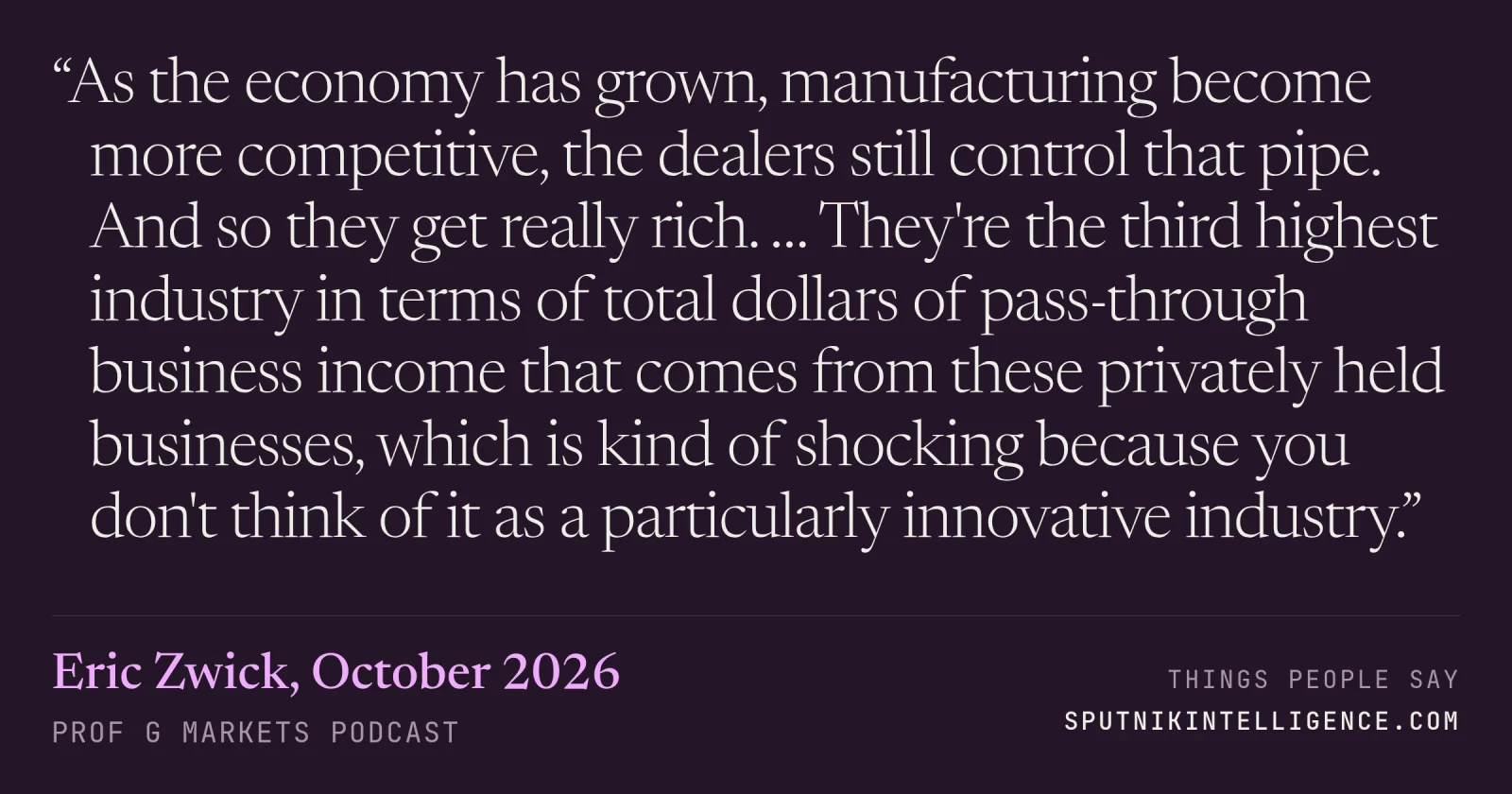
…to, you know, Ford next to, and they all have the same person's name under it, as opposed to a sedan shop? It's like a legacy of these auto dealer protections. And as the economy has grown, manufacturing become more competitive, the dealers still control that pipe. And so they get really rich. And so they end up being just like an incredibly central character in this sort of top 1% income share. They're the third highest industry in terms of total dollars of pass-through business income that comes from these privately held businesses, which is kind of shocking because you don't think of it as a particularly innovative industry. And it's not an industry where folks are that rich. I think in lots of other countries, it's a legacy of these little protections. Other industries where we kind of see these everywhere millionaires setting up kind of barriers to enter, the beer distributors. We talk about the realtors, which have a different way of protecting their turf using either control of the MLS or using the contact track…
Speaker 4
We'll be right back after the break. And if you're enjoying the show so far, send it to a friend and please follow us on YouTube, Spotify, or wherever you get your podcasts.
Ed Elson
Today's show is brought to you by Vanguard. To all the financial advisors listening, let's talk about bonds for a minute. Capturing value and fixed income is not easy. Bond markets are massive, murky, and let's be real. Lots of firms throw a couple of flashy bond funds your way and call it a day.…
Speaker 4
We're back with Prof G Markets. It sounds like one of the learnings is that, and correct me if I'm wrong, but it sounds like the learning is that it was a great thing to be an entrepreneur. And we're watching an entire generation of Americans who are now reaping those benefits of making that bet on…
Speaker names come from our own diarization. The position is estimated from where the line sits in the episode.
Zwick explaining the term "middlegarks", the oligarchs of the middle. His point is that these millionaires are spread across every congressional district and write the rules both through lobbying and by holding office themselves.
The Pie: An Economics PodcastAround 46:07 into the episode
Tess Vigeland
You've coined this term for this group as a whole, middlegarks. Love that. The oligarchs of the middle, a bit of a Tolkien joke. Unpack that for us. What makes them a distinct kind of political actor
Speaker 3
as opposed to just rich people who vote?
Eric Zwick
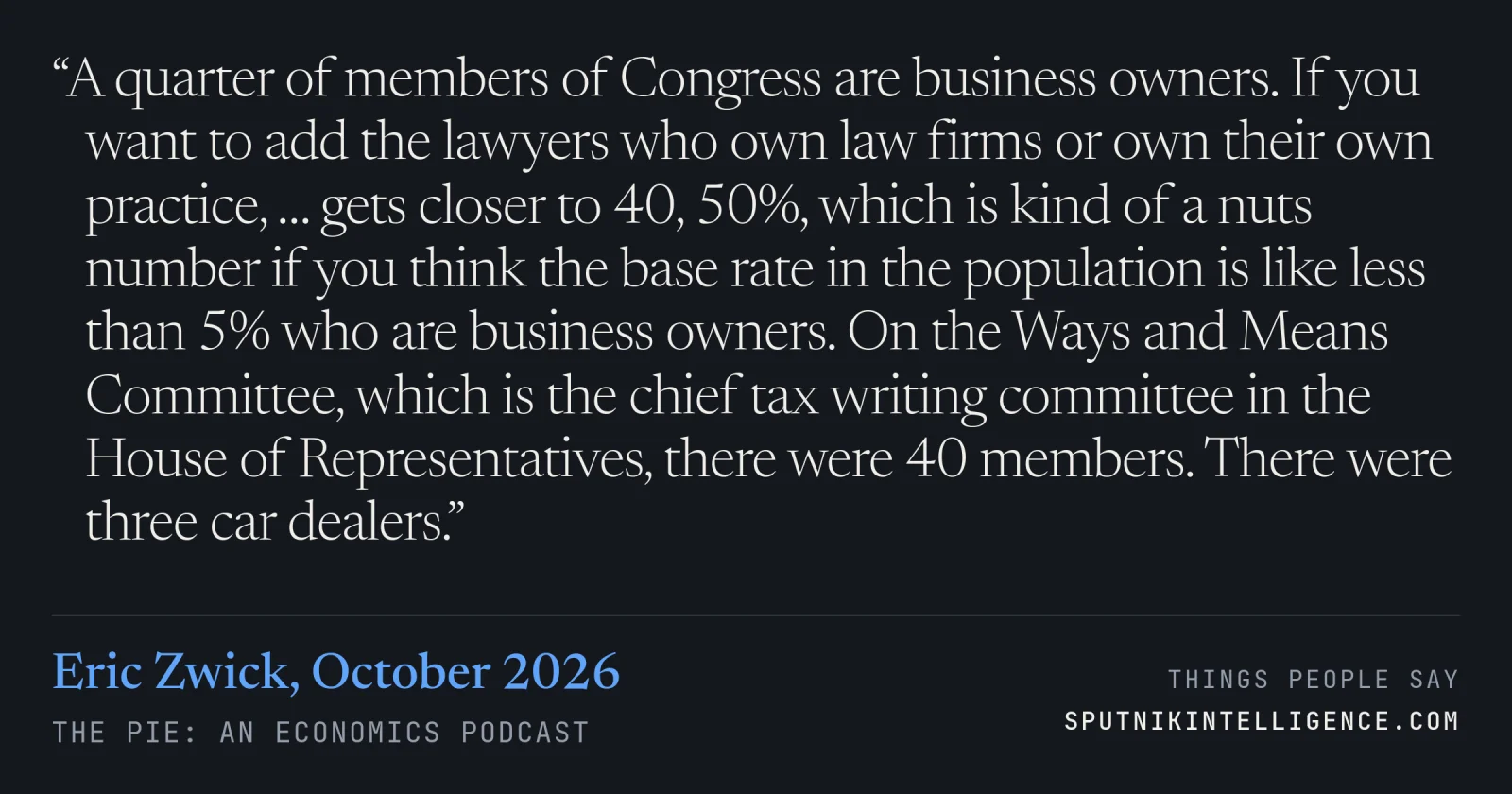
…for all the members. So it's not just a few people that can write the rules. It's this much broader class of people. And they write the rules through lobbying. They also write the rules through becoming elected officials. So a quarter of members of Congress are business owners. If you want to add the lawyers who own law firms or own their own practice, so sort of equity owners in a law law firm, gets closer to 40, 50%, which is kind of a nuts number if you think the base rate in the population is like less than 5% who are business owners. On the Ways and Means Committee, which is the chief tax writing committee in the House of Representatives, there were 40 members. There were three car dealers. That's like crazy, you know, disproportionate representation. If you go below federal level to state and local level, often these elected officials, this is part-time work. It might not be compensated at all in a lot of states or localities or compensated very poorly. So who can afford to do that? Who has the flexibility and their job to do that? And who might have a vested interest in doing it…
Tess Vigeland
People keep calling this a second Gilded Age, right? And you really push back on that framing in this book. And yet we're talking about a lot of very, very, very wealthy people, even if they're not Bezos Musk wealthy. Why doesn't the Vanderbilt and Rockefeller comparison hold up?
Eric Zwick
So I think that Gilded Age metaphor or idea really conjures this image of a small number, much smaller number of maybe very powerful industrialist monopolists that are occupying positions of power and throwing around ungodly amounts of wealth to get what they want. So the Rockefellers, the…
Tess Vigeland
Even if it might feel like it.
Speaker names come from our own diarization. The position is estimated from where the line sits in the episode.
Zwick describing the moment confidential IRS data showed where top-1% business income actually comes from. He says pass-through income from mundane 30-to-50-person businesses drove more than half the rise in the top 1% income share since the late 1980s.
The Pie: An Economics PodcastAround 19:55 into the episode
Eric Zwick
…of the businesses that are generating it? And that's what we were able to do in our data project is sort of make that connection for the first time at scale for all the businesses in the economy, basically, especially this emerging class of private businesses that people hadn't previously studied.
Tess Vigeland
So as you were in the basement, what was the moment that this clicked for you when you kind of first linked, okay, here's a business tax, a business's tax filings, and here's the actual person who owned it. And you thought, wait a minute, there's a bigger story here than we thought.
Eric Zwick
Yes. So it was a series of years of projects, research papers, where you're kind of using the questions to try and pull back a layer of the onion, pull back another layer of the onion. One of the first realizations was, okay, everybody's talking about income inequality and its rise. But we don't know exactly how it's happening and where it's coming from. So one thing we did quite early on was say, okay, the top 1% income share, it's gone up since the late 1980s a lot. This is in Piketty's work. Where is that coming from? It turns out just the categories of income driving it, it's not salary and bonuses. It's not dividends and rents from like large public companies either or from real estate. It's pass-through business income. So it's income coming from businesses that people own. That's driving more than half of the rise of the top 1% share from the late 1980s through to 2021, 2022. And it's even more important if you move above the top 1% to the top 0.1%. Almost all of them are these private business owners. So that was one realization. Okay, that's pretty interesting. We have to understand this…
Tess Vigeland
Once you had done this with this confidential IRS data, you had to find a legal way to put faces to the numbers for the book without breaking anonymity. So you turn to things like, and you referenced this already, you know, the private jet, the yacht ownership registries, since those are public.…
Eric Zwick
Yeah, exactly. So, I mean, this is one of the really fun things we do in the book. It's almost like a how-to to find these people. They're like lurking all around us. You don't even realize it. You're like economic detectives. We're totally in that's the tax ninja thing, right? You're sort of like…
Tess Vigeland
Let's see if I can get a small business loan.
Speaker names come from our own diarization. The position is estimated from where the line sits in the episode.
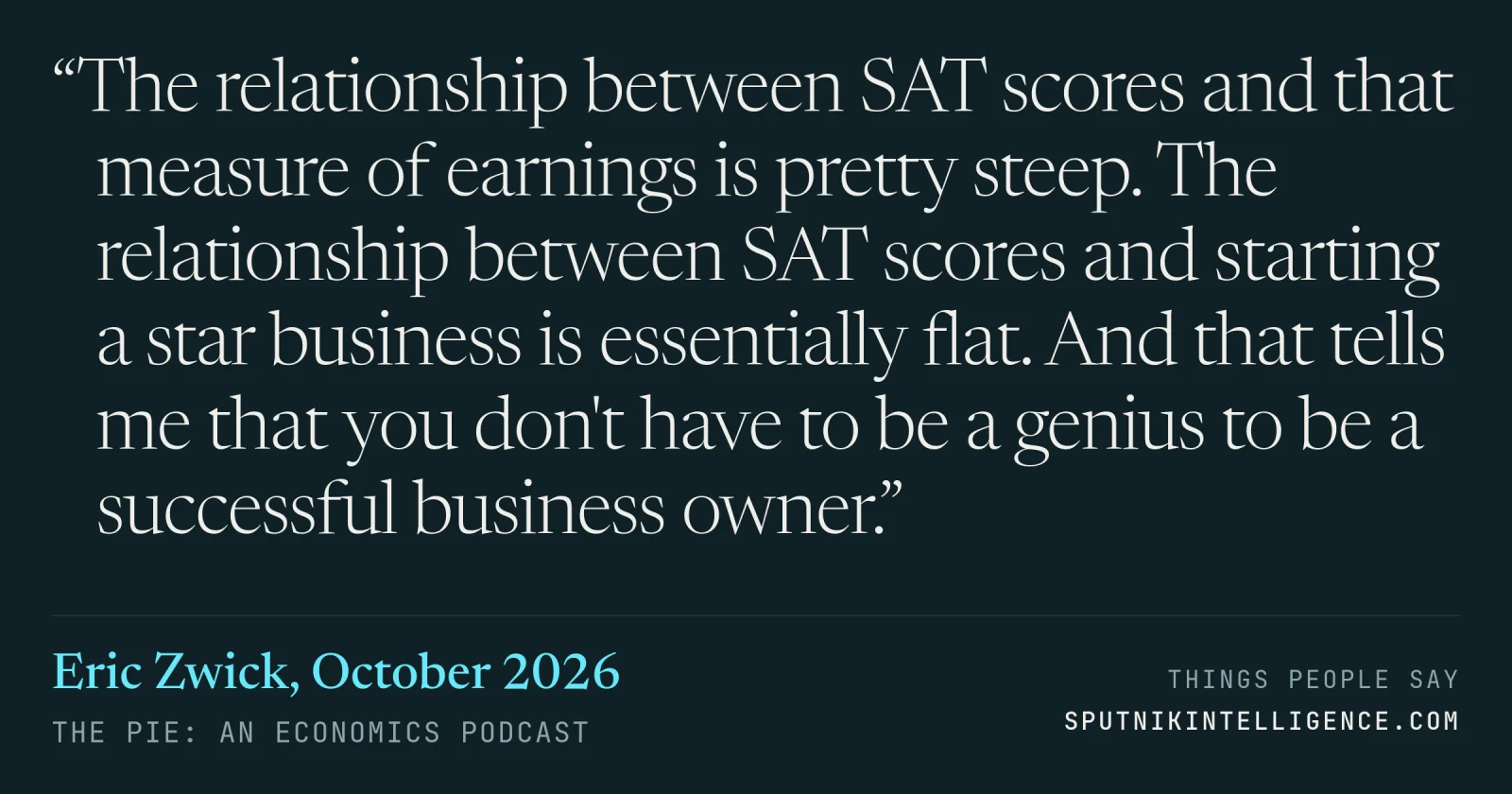
Economist Eric Zwick, discussing his research on America's private-business millionaires, compares test scores with salaried earnings at 35 and with founding a highly successful business. He argues that relentlessness and early work experience matter far more than raw brains.
The Pie: An Economics PodcastAround 34:35 into the episode
Eric Zwick
…pass on, they haven't set up the business to be handed over. And so that's really sort of, it's not physical capital. It's not a monopoly card that has hotel on it that you can just pass on from generation to generation. It's kind of human capital that's kind of much, much harder to transfer.
Tess Vigeland
…from Kevin Murphy, of course. Of course. Nobody's disputing Kevin. Kids who score in the top 10% on the SAT only become founders about 1.3 times as often as kids who score at the median, barely more at all. So if it's not brains, what actually predicts who ends up building one of these businesses?
Eric Zwick
…Because I think one idea that's very much in the conventional wisdom about how to get ahead, we do as well as you can in the SAT, go to a really prestigious school, and then you get that job at McKinsey or JPMorgan, you get a really high salary, and that's like the path to prosperity. And yeah, you can do quite well comfortably that way, but there's going to be a ceiling there. And it turns out the relationship between SAT scores and that measure of earnings is pretty steep. The relationship between SAT scores and starting a star business is essentially flat. And that tells me that you don't have to be a genius to be a successful business owner. Like you said, IQ is not kind of the necessary factor entering in. So what does matter, as we've discussed before, like early labor market experience and being able to put that to work to solve a real problem that has sufficient size such that you can find a lot of customers that are willing to pay for the solution you've devised. Being able to run that business requires, especially in the early…
Tess Vigeland
Let's pick up on that inheriting because not everyone in the book earns their way in. You call inheritance the shortcut. How big a share of mainstream millionaires actually got there that way versus bootstrapping, starting from nothing? Yeah,
Eric Zwick
so it's a non-trivial share. We estimate it's about a third, maybe 25% to a third of top 1% owned businesses, different ways of defining who the top 1% are, inherited their business. And that's a lot. So, a lot of family businesses, multi-generational family businesses, including the Brockway car…
Speaker 3
doing it for us. Yeah. Yeah. I'm
Speaker names come from our own diarization. The position is estimated from where the line sits in the episode.
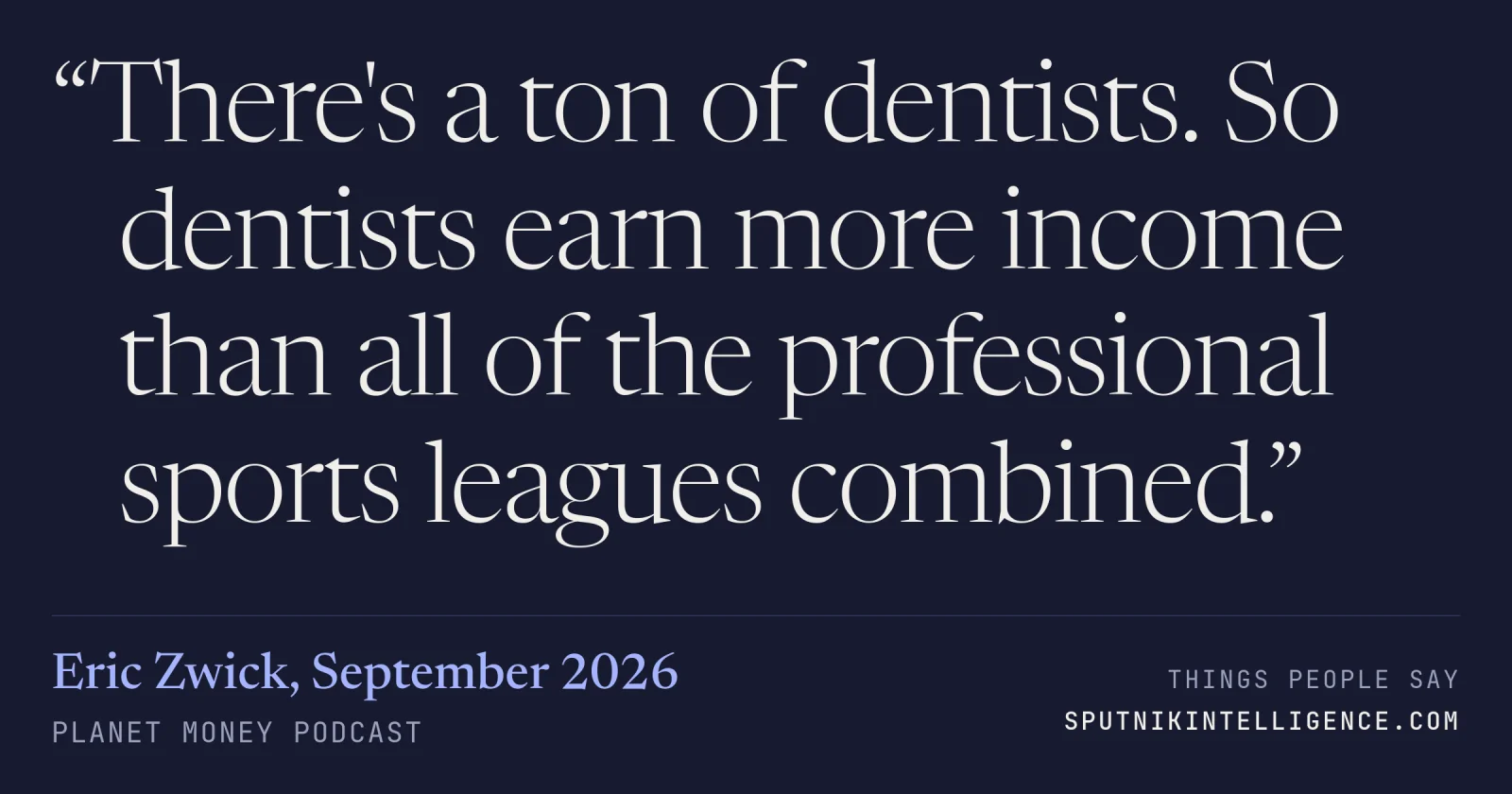
Zwick, an economist who studies who actually makes up the top 1%, is walking the hosts down a ranked list of industries — dentists come in at number 21, ahead of most of what people picture when they picture wealth. He adds immediately that the comparison is "a funny statistic" that he thinks comes from a dental lobbying organization. His larger argument is that the road to the 1% runs through Main Street businesses, not Silicon Valley or Wall Street.
dentists. There's a ton of dentists. So dentists earn more income than all of the professional sports leagues combined.
Greg Rosalsky
Wow.
Eric Zwick
Which is like a funny statistic from, I think, I mean, from a dental lobbying organization that we like talking about.
Greg Rosalsky
Ironically, I'm smiling at that statistic right now. Your teeth are great, Greg. Oh. So, anyways, the road to the 1%, it turned out to be pretty darn diverse. It wasn't just like Silicon Valley and Wall Street. It's like businesses you see walking down your local main street. And
Speaker names come from our own diarization. The position is estimated from where the line sits in the episode.