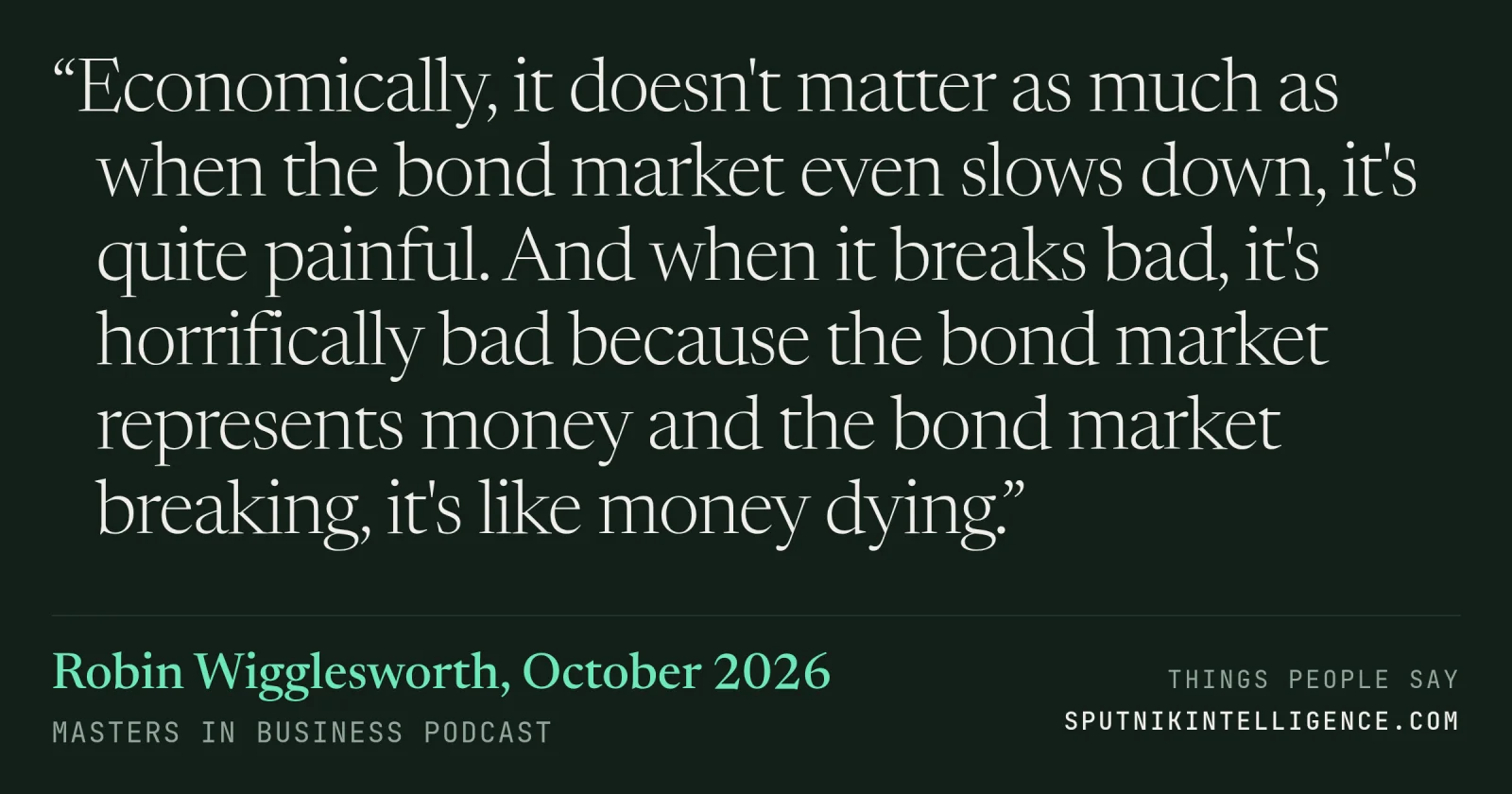
Wigglesworth compares the dot-com stock crash, which he calls an economic nothing burger, with what happens when the bond market seizes up. He wrote a history of the bond market.
That's about right. Yeah. I think the Dow only fell about 36, 37. Yeah, because it's a bit more industrial. It hadn't
Speaker 2
as much tech stuff. Well, I mean, economically, it was a nothing burger. That was like one of the shortest shallows recessions in U.S. history. And I think that
Speaker 1
shows that, you know, obviously it wasn't fun for people that lost money. And it was a big event. Even I remember that pretty well. But economically, It doesn't matter as much as when the bond market even slows down, it's quite painful. And when it breaks bad, it's horrifically bad because it's kind of the bond market represents money and the bond market breaking. It's like money dying. It's, you know, there's this famous quote from Mark Twain. He said, it's not what you know for sure. No, it's not what you
Speaker 2
don't know. That's the problem. It's what you know for sure that just ain't so. It's when you take something that you think is safe and solid and good and it blows up in your face. That's when you get shocked. That's when the big nasty economic outcomes happen. So if you invest money in stocks or…
Barry Ritholtz
be surprised when it goes bad. But at the same time, you think of treasuries, you think of conservative, A-rated, even corporate bonds, investment-grade bonds, they're called investment-grade. You don't expect them to go to go belly up. So there's so many things I want to talk about with this. You…
Speaker 2
surprised me because I didn't think it was going to be that interesting. There were lots of abolitionists, actually, in various stages of this story, I was pleased to see. So Lewis Tappan, him and his brother ran a classic merchanting business. They were ardent, hardcore abolitionists. They were…
Speaker names come from our own diarization. The position is estimated from where the line sits in the episode.
Barry Ritholtz asked Wigglesworth why he went from relaxed to worried about an AI bubble. His answer: the dot-com crash was mostly an equity event, but AI spending is increasingly funded by credit and off-balance-sheet liabilities.
…like kind of an evil Santa Claus, like very intense eyes, bigger, big, bushy white beard. I think he was fascinating. And also maybe because he's now so synonymous with the crash of 1873, his genuinely valuable role that he played in America. And I think maybe deserves recognition as well, I guess.
Barry Ritholtz
So I'm legally obligated to ask a question about AI these days. You were quoted saying you were profoundly relaxed about the possibility of an AI bubble, but then piling on all of this debt changes things. So what changed your mind?
Speaker 1
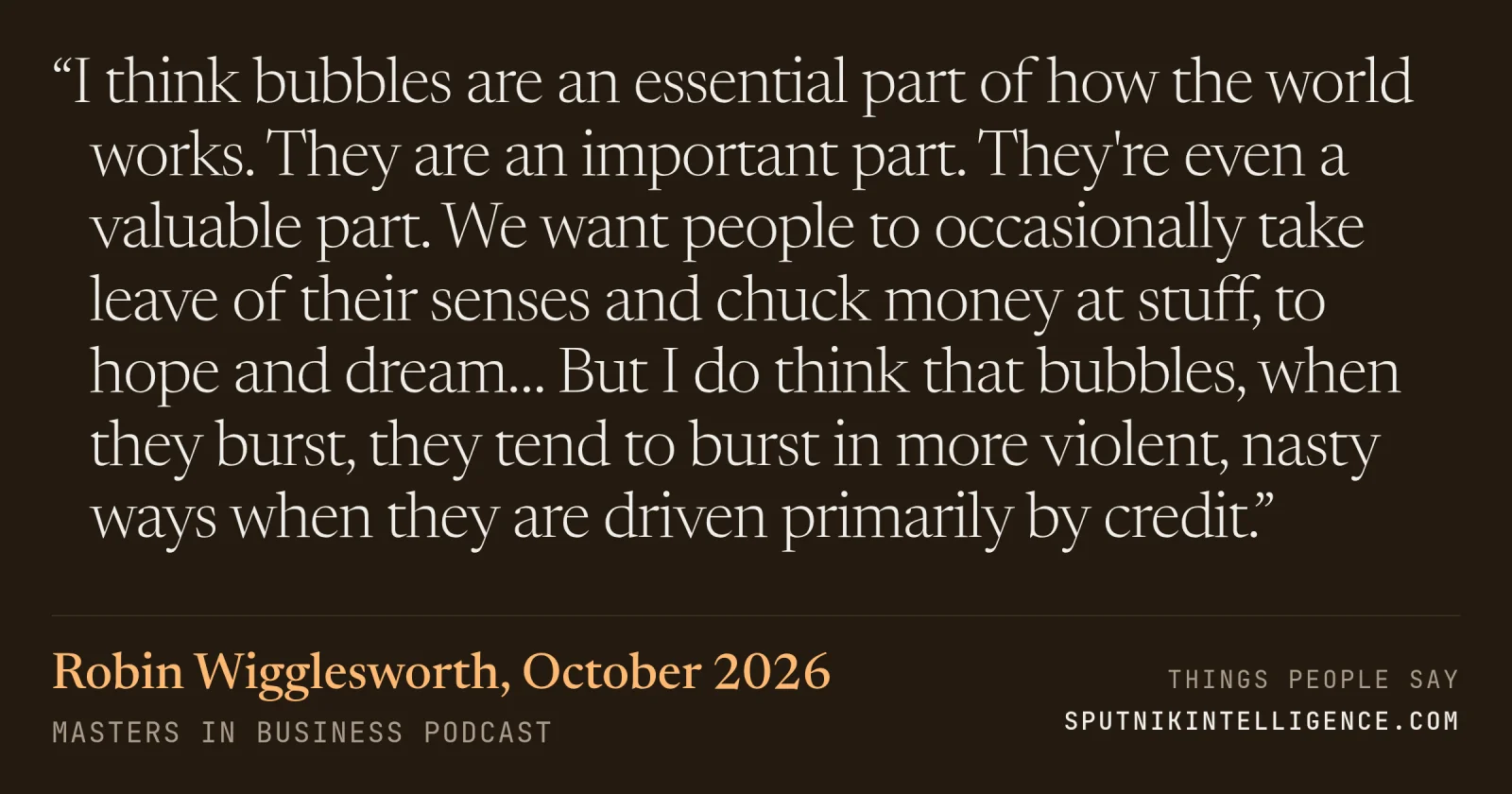
Well, I'm profoundly relaxed about bubbles just because I'm not an efficient market zealot, but I just, I can't spot them, certainly. I don't really believe anybody can. And in fact, I think bubbles are an essential part of how the world works. They are an important part. They're even a valuable part. We want people to occasionally take leave of their senses and chuck money at stuff, to hope and dream, rather than just kind of be a boring journalist who always thinks everything's going to go badly. That is how quite often big leaps of progress happen. But I do think that bubbles, when they burst, they tend to burst in more violent, nasty ways when they are driven primarily by credit. So we talked about the dot-com bubble as a classic example that was primarily in the equity landscape. Didn't…
Barry Ritholtz
You remind me, there's a wonderful book that if you haven't read, you should absolutely put in the top of your list, which is it's by Dan Gross, Pop, Why Bubbles Are Great for the Economy. My favorite chapter is all of the fiber that was laid. Rollable Crossing, Metro Media Fiber, $1,000 a mile.…
Speaker 1
I don't know. I don't know whether it's misallocated. I mean, if it is, if it's going to cure cancer, bring peace to the Middle East and make us an interplanetary species, maybe this isn't misallocation. I don't know. And I think we all have to be humble given what's going on about how much we do…
Barry Ritholtz
not AI. You don't need. That's not. Well, basically,
Speaker names come from our own diarization. The position is estimated from where the line sits in the episode.
Ed Zitron described Japanese retail investors buying SoftBank bonds partly out of loyalty to its founder. Wigglesworth says the same identity-driven investing is alive in the US. (The transcript garbles Musk's name; corrected here.)
…that's like a 4% premium. But the problem is that currencies move around a lot. So you can easily get wiped out on the carrier trade. So it's always one of those kind of popular things when the world looks safe and fine. And then it kind of blows up in people's faces when it suddenly doesn't.
Ed Zitron
…there are regular people that buy the bonds because of Masayoshi. Son. It's just a completely different thing than you'd have over here in America, partly because we don't have zero interest rates or didn't for a long time. And so a company basically steps in almost like a sovereign bond issuer.
Robin Wigglesworth
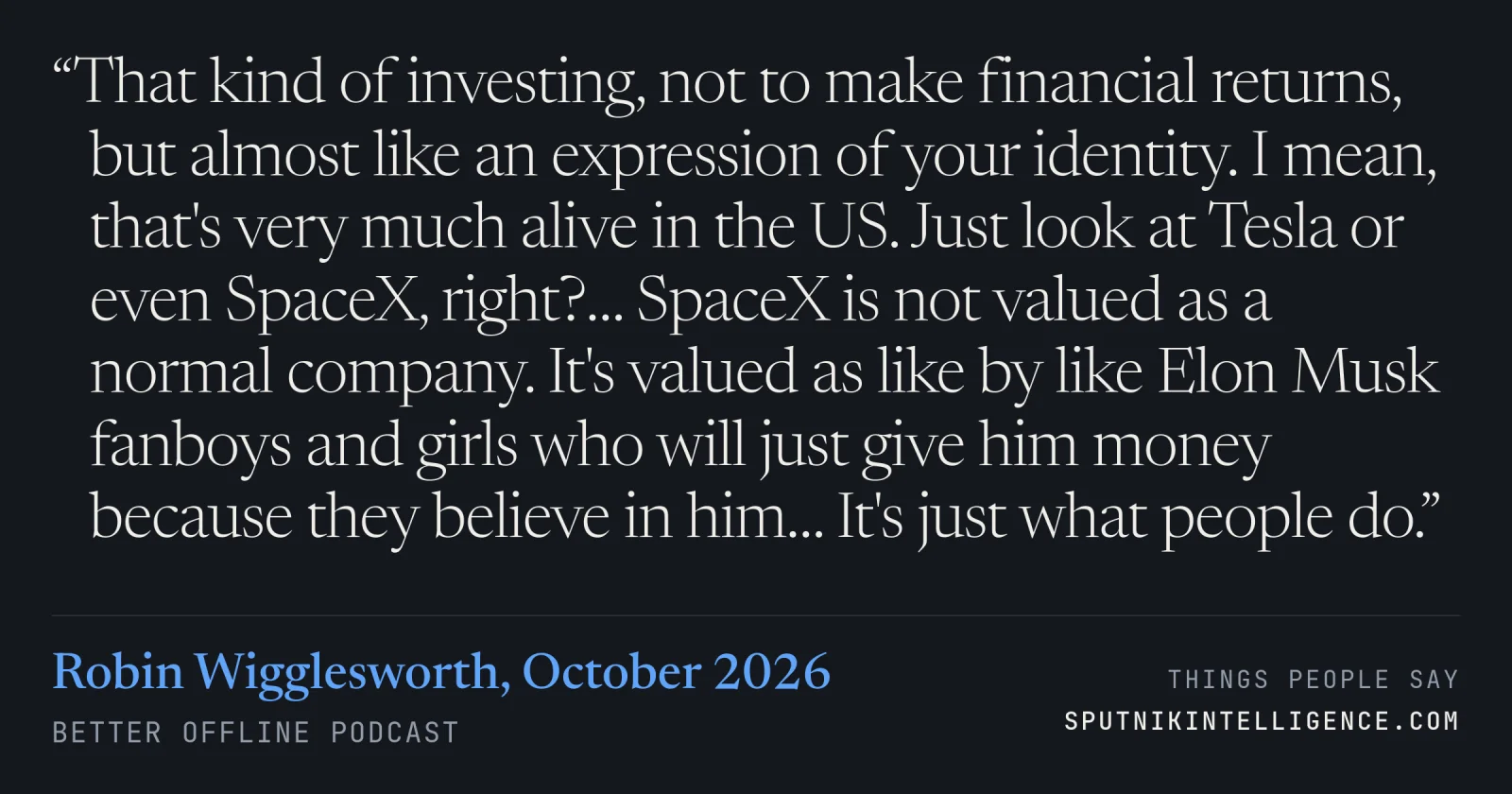
Yeah. It will just benefits from low interest rates. But like interest rates were pretty low in the US for a long time and that benefited all sorts of companies there too. And that kind of investing, not to make financial returns, but almost like an expression of your identity. I mean, that's very much alive in the US. Just look at Tesla or even SpaceX, right? We were talking about SpaceX. SpaceX is not valued as a normal company. It's valued as like by like Elon Fusk fanboys and girls who will just give him money because they believe in him. And it is not something that it is entirely divorced and unanchored for any sort of normal financial analysis. It's just what people do. But like what people are doing with SpaceX in the US was the stock, I guess I didn't know this about Japan, but like maybe Japanese investors are doing with soft bank bonds over there.
Ed Zitron
Kind of. Actually, this leads me to my final and most complex question. So with that in mind, of all of the bonds that were raised during the interest-free era in 2020, 2021, talk to me about maturity walls. So how big is the when I say maturity wall, just for the listeners, it's a bunch of debt…
Robin Wigglesworth
I have to admit, like maturity walls, it's just basically, let's say, if I'm like Wiggles Corp and I've issued like a few bonds maturing at different years. So let's say I have next year I only have a billion dollars worth coming due. The year after that, I've got like 4 billion. And then suddenly…
Ed Zitron
cash flow negative right now. Oracle is in a very weird spot, though, because they run the risk of becoming a fallen angel. But I understand what you mean.
Speaker names come from our own diarization. The position is estimated from where the line sits in the episode.
Explaining to Ed Zitron why the lowest-rated corner of the junk bond market is where economic stress shows up first, and why it has been looking skittish lately. Bond investors can't make 100x their money, he says, so they lean toward pessimism.
…of the market, because those are companies that might survive if the economy stays healthy, but are exceptionally vulnerable because they've got so much debt that whenever the economy turns, they might very quickly keel over. And that's where we've seen definitely like a bit of skittishness lately.
Ed Zitron
So just so that I'm following you, because they are the most vulnerable, when things are turning, they're the ones that get hit first.
Robin Wigglesworth
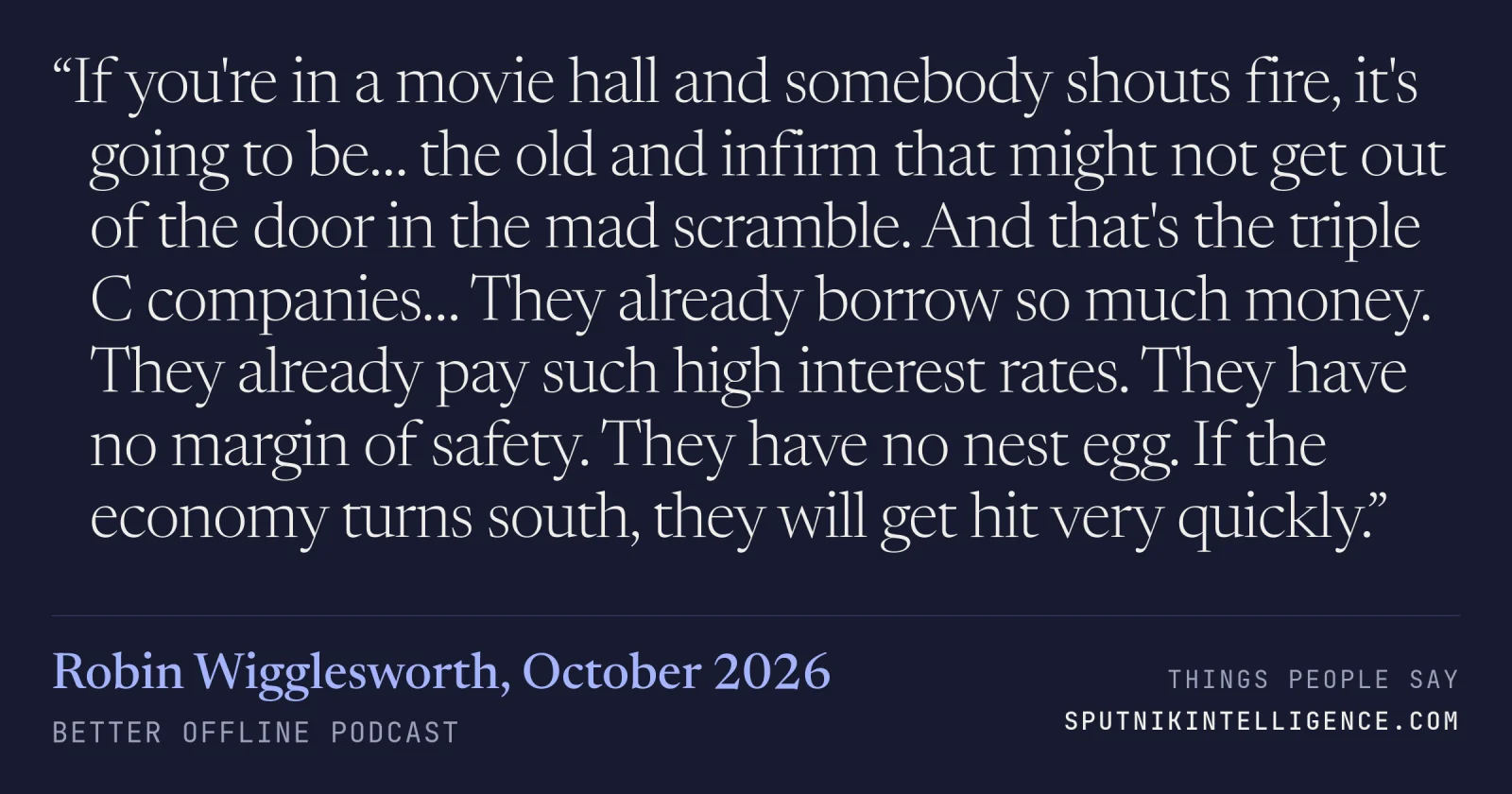
Yes. They are kind of, I mean, to stretch a metaphor, if you're in a movie hall and somebody shouts fire, it's going to be the old people that don't get out of the door quickest, the old and infirm that might not get out of the door in the mad scramble. And that's the triple C companies. So those are the ones where you can kind of see worries. Where they already borrow so much money. They already pay such high interest rates. They have no margin of safety. They have no nest egg. If the economy turns south, they will get hit very quickly.
Ed Zitron
And yeah, even just bringing up the ratings agency right now, they're dependent upon favorable business, financial, and economic conditions to meet their financial commitments. So yeah, that's fascinating. I never even thought of it like that, even though it's blatantly obvious. So here is another…
Robin Wigglesworth
Well, it's mostly, and it does get a little bit loopy at times, but it's mostly that SpaceX is valued so highly by the stock market. So companies, and countries are very different, but companies have something called a capital structure. Like there's a hierarchy of who gets wiped out. The last…
Ed Zitron
hit, what do you mean? As in the value of their shares go to zero.
Speaker names come from our own diarization. The position is estimated from where the line sits in the episode.
Felix Salmon had just put it to him that the Treasury market used to belong to the most boring investors in the world, central banks that bought bonds and sat on them, and is now in the hands of traders who move fast and overreact. Wigglesworth agreed and went further. The market he calls the global financial system's bunker is now dominated by extremely leveraged hedge funds running the basis trade, which he says makes it more brittle and is genuinely alarming.
…think should get more attention. You know, it's partially just the fact that every guy. Government in the world has been borrowing a ton over the past few years. And that big global savings glut that people like Ben Bernanke used to talk about, that's looking slightly less glutty these days. Well,
Felix Salmon
it's actually disappeared, right? It's like gone.
Robin Wigglesworth
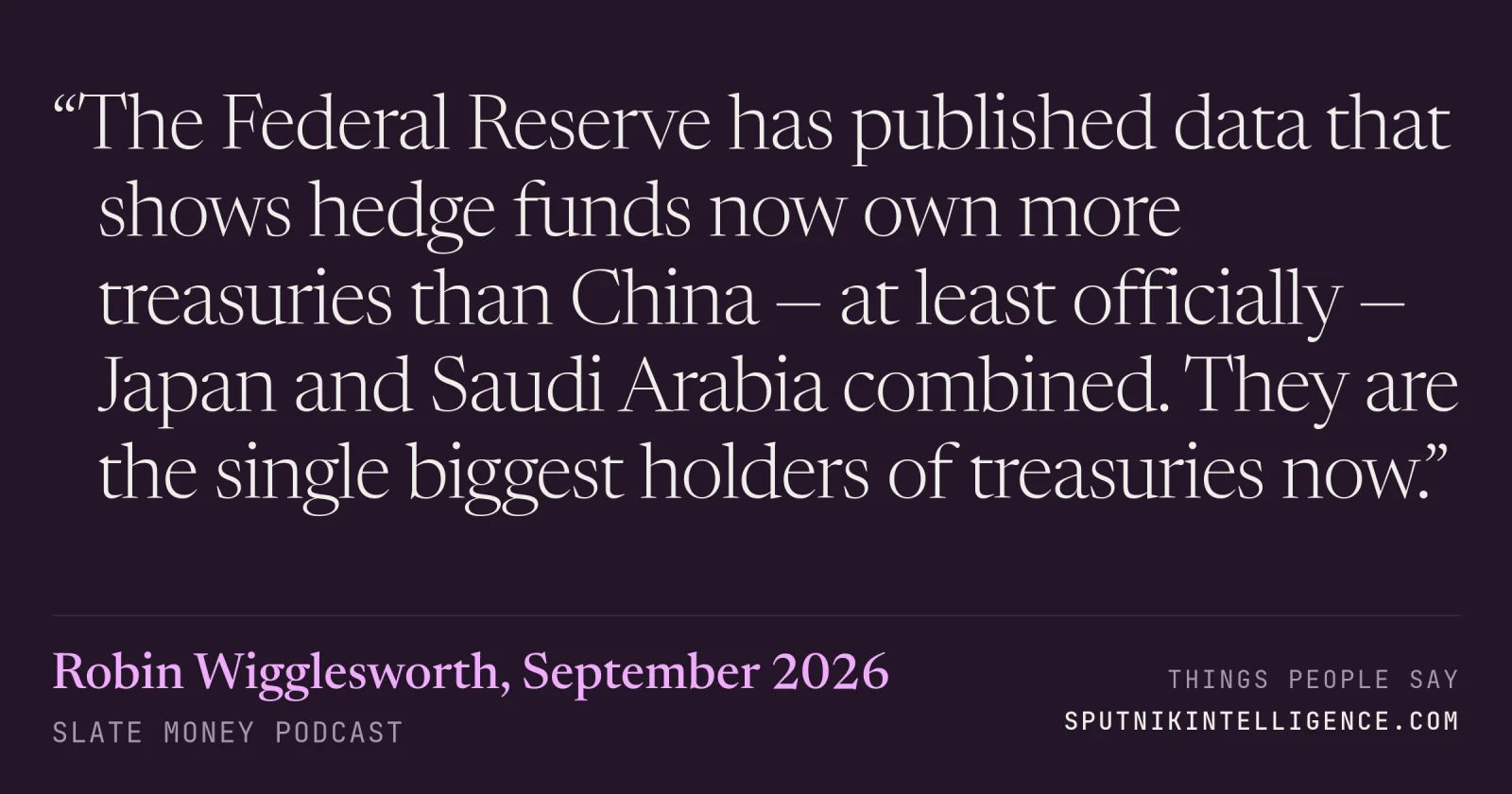
You can measure it in different ways. And for example, like the China one, for example, like China looks like it's selling or moving out of treasuries. I'm pretty certain that what China's actually doing is that they're getting state-owned banks to buy treasuries instead. And they're buying U.S. agency debts or bonds issued by Fanny and Freddie that are guaranteed or implicitly guaranteed by the U.S. government. So it's kind of treasuries in drag and they're just hiding it. I think it's foreign investors not really selling much, but like they can't absorb the sheer amount of new bonds coming to hitting the market all the time. And hedge funds have really stepped into the breach. That is true actually in the UK as well and in Europe too. But the US is where it's super clear, where the Federal Reserve has published data that shows the hedge funds now own more treasuries than China, at least officially, Japan and Saudi Arabia combined. They are the single biggest holders of treasuries now. That
Elizabeth Spiers
seems so hedge funds are not the transparent democratic institutions we celebrated earlier in the conversation. Establish that.
Robin Wigglesworth
No, but I'd say some of like a big chunk of this is actually them almost rendering a service. I mean, I hate to carry water for hedge funds here, but really it's basically there's all sorts of technical arbitrage opportunities where they're not really like, they're not YOLOing into treasuries.…
Felix Salmon
basis trade. So it's
Speaker names come from our own diarization. The position is estimated from where the line sits in the episode.