CEO of Ritholtz Wealth Management, the investment advisory firm he co-founded with Barry Ritholtz. A former stockbroker, he built a following writing about markets and the conflicts of interest in traditional brokerage on his blog, The Reformed Broker. His commentary centers on portfolio strategy, earnings and where money is actually moving, covering topics like AI capital spending, semiconductor stocks and big tech earnings rather than short-term calls.
He hosts The Compound and Friends, his own podcast, and appears regularly as a co-host on CNBC's Halftime Report. He also shows up as a guest on other finance and tech shows, including Prof G Markets, Big Technology and Invest Like the Best. He has published two books on markets and financial media, Backstage Wall Street and Clash of the Financial Pundits.
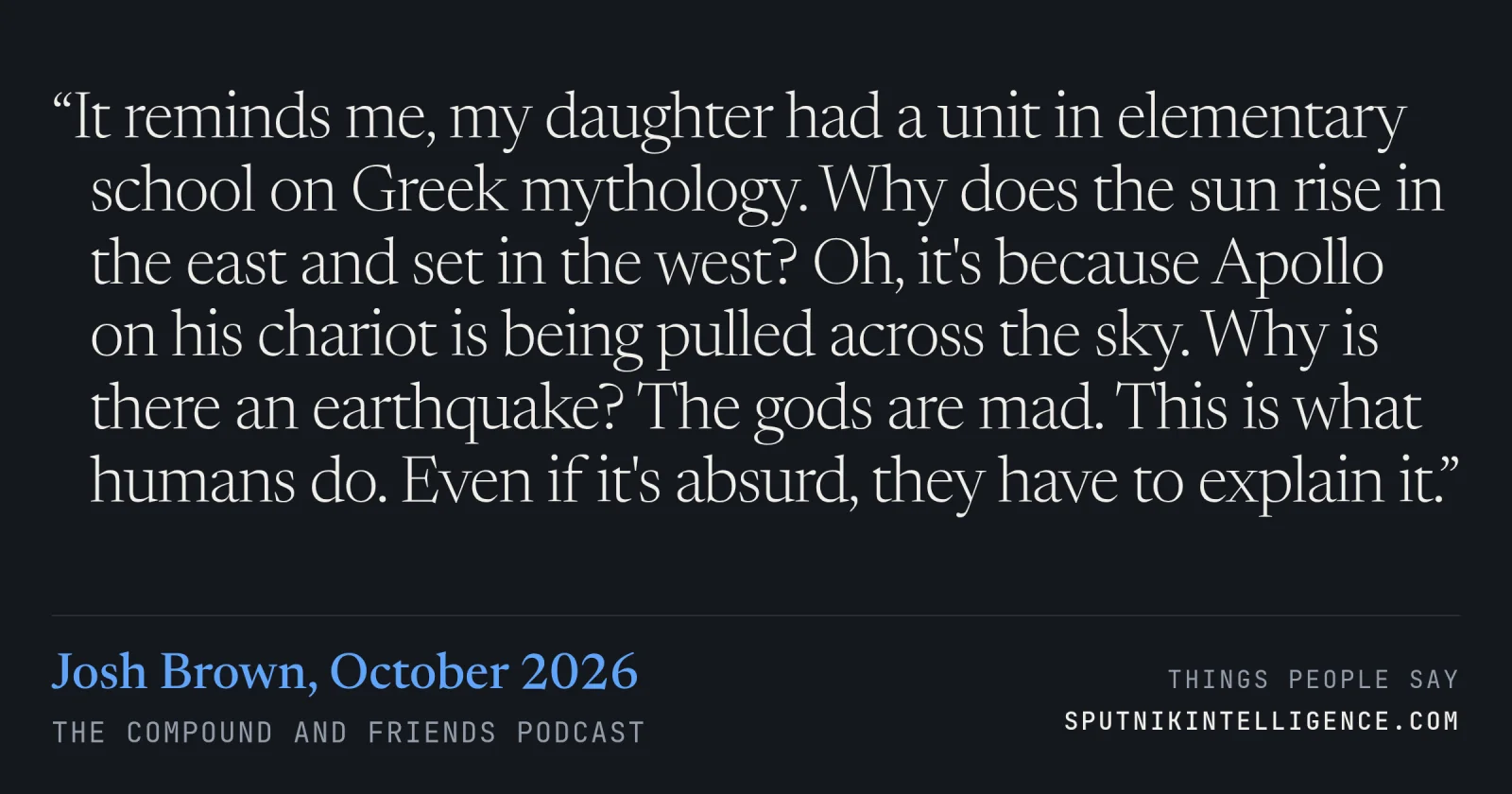
His guest had just described how stat-arb funds, multi-manager pods and retail drive daily single-stock moves. Brown uses the Greek mythology comparison to say market headlines are often after-the-fact stories for moves caused by automated, crowded trading.
The Compound and FriendsAround 34:59 into the episode
Michael Batnick
stocks that are like, obviously Spotify and Netflix are related-ish, but for a year, it was the exact same chart, like identical. And there's a million different stocks like that that trade that just trade, they're just in the same basket of stocks that people are buying and selling.
Alex Altmann
…it three to six week. And that's generally on single stock pairs as well for mean reversion around earnings. That's why on earnings day, the majority of a single stock flow is coming from discretionary. And then on non-earnings day, the vast majority is coming from quant and retail. And then in the
Josh Brown
media, people are looking at the preponderance of all of this data and they're coming up with the story that explains it to non-market participants who don't appreciate the degree to which this is computers trading with computers. And it sort of reminds me, I taught my daughter had a unit. I remember in elementary school, they were learning that Greek mythology. So she's like sitting reading this book. She's like, she can't make heads. Why are they giving us fairy tales to read? I say, you don't understand. This was science. Like, why does the sun rise in the east and set in the west? Oh, it's because Apollo on his chariot is being pulled across the sky and he's glowing. And so that's the sun. Why is there an earthquake? The gods are mad. You did this. Why is there a volcano? Like, this is what humans do. They need, even if it's absurd, they have to explain it. So in the media, they're looking at the net result of all this stat orb and everything that's happening. That's not a satisfying explanation. Why did the market change its mind about AI today? Is yes, and because, and then they find the headline…
Speaker 4
I mean, this is the shameless plug to like the team. You know, like
Alex Altmann
the whole point of why we exist is to kind of, we, yeah, the bets team at Barclays. Like, how many
Josh Brown
of you are there?
Speaker names come from our own diarization. The position is estimated from where the line sits in the episode.
Josh Brown's "real bear case" for frontier AI labs. He expects companies to set AI budgets by department and use harnesses that send most work to cheap open-weight models, keeping premium models for the few tasks that need them.
…But I do think that this is the crux of the matter. The Fortune 500 CEOs and CFOs two years ago said, do AI to their employees. What do you mean? I don't know. I'm on a stage every week somewhere, and everyone's talking about these amazing things that they're doing with AI. Go do some AI. Okay.
Ed Elson
Do it.
Speaker 2
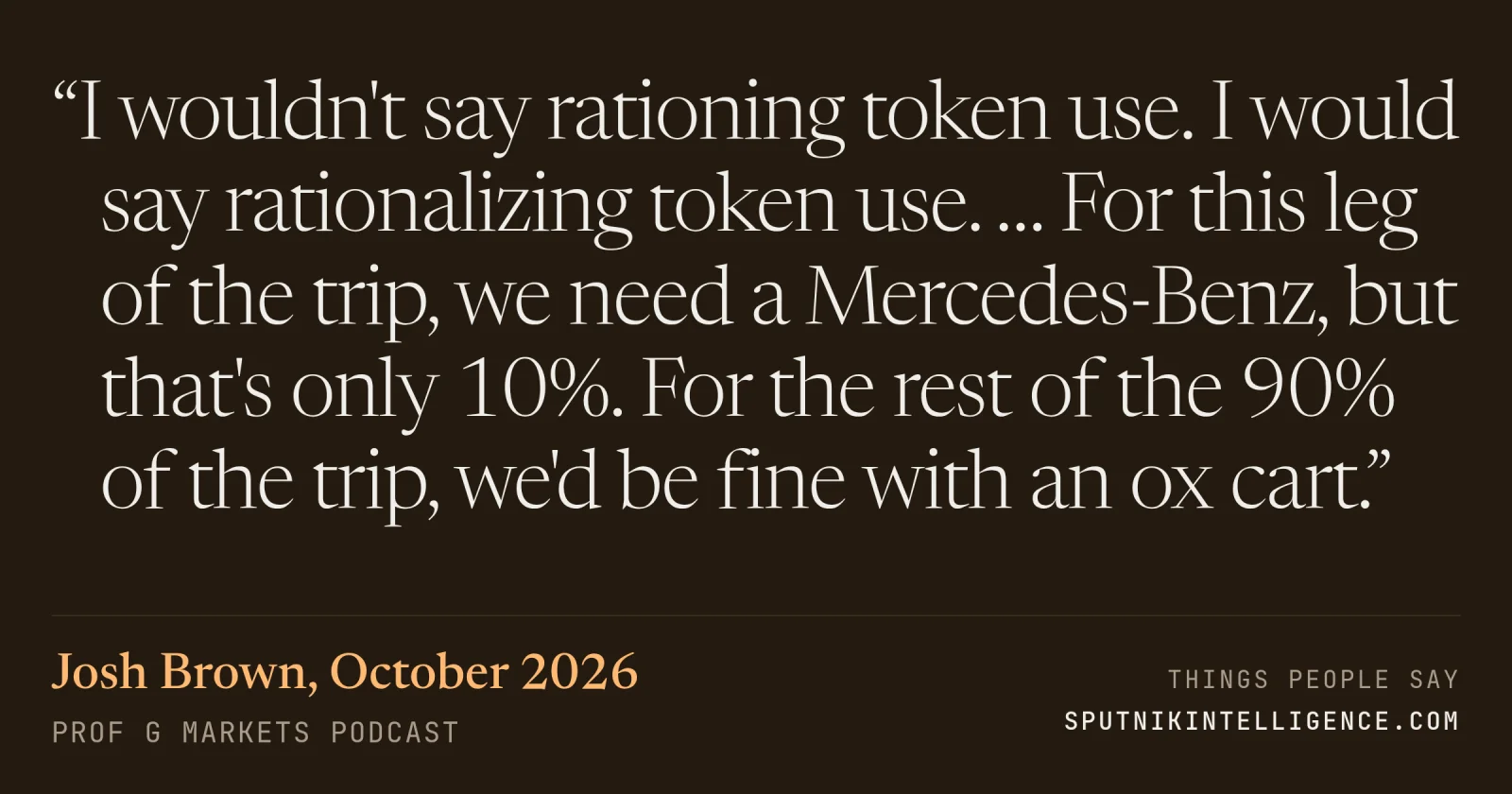
…now you have two things happening at once. And this is the real bear case. Number one, there's going to be some sort of budget on AI use company-wide. And they're going to have to make decisions like, okay, this department gets X dollars in budget for AI. That department only gets Y dollars because what the hell are we doing here? We're not running experiments. We're running a business. Okay. So I wouldn't say rationing token use. I would say rationalizing token use. Okay. So that's one thing. The second thing is the free weight, the open weight models, the free models, and just this idea that there actually are no switching costs. And a Fortune 500 business with a sophisticated IT department and an army of consultants, they look at the quarterly numbers. They say, why are we, you know, seven cents per share behind expectations? Where do we trace it back to?…
Ed Elson
We'll be right back after the break. And if you're enjoying the show so far, send it to a friend and please follow us on YouTube or on Spotify or wherever you get your podcasts.
Scott Galloway
Support for the show comes from VCX, the public ticker for private tech. For generations, American companies have moved the world forward through their ingenuity and determination. And for generations, everyday Americans could be a part of that journey through perhaps the greatest innovation of…
Speaker 2
This episode is brought to you by Google Chrome. You think you know a browser, but Gemini and Chrome, that's new. It can help you with practically anything on the web, like restoring a vintage motorcycle from a 50-page restoration block, or finally break down that long article you've had open for…
Speaker names come from our own diarization. The position is estimated from where the line sits in the episode.
Scott Galloway asked about Ken Griffin and Ray Dalio calling the market a bubble. Josh Brown points out that semiconductor earnings keep beating estimates while almost no chip stocks are making new highs, and that some memory makers trade at PEG ratios near 0.1.
…that's true. I think they could do a Series G and easily raise $100 billion. I think this is the smart move to the ducks are quacking on Wall Street. If you never learn anything from me other than this, it's good enough. When the ducks are quacking, you feed the ducks. That's what they're doing.
Scott Galloway
All right. So, Josh, we're increasingly hearing open-quote bubble claims. Ken Griffin and Ray Dalio both suggested last week that we're in a bubble. What's your response to the bubble question today?
Speaker 2
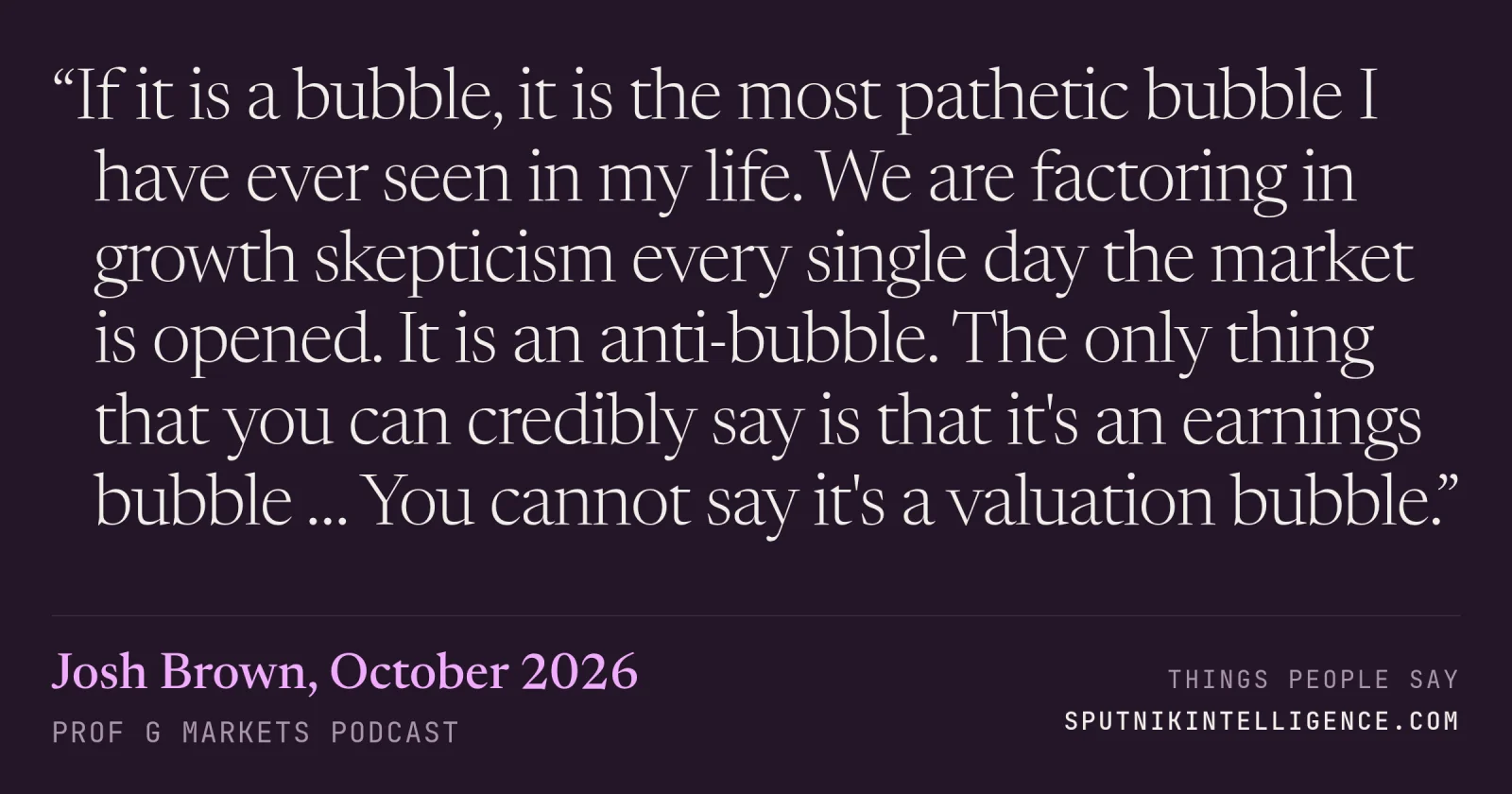
If it is a bubble, it is the most pathetic bubble I have ever seen in my life. We are discounting. We are factoring in growth skepticism every single day the market is opened. It is an anti-bubble. The only thing that you can credibly say is that it's an earnings bubble and that the profitability our tech giants are enjoying today is not sustainable. You could say that. You cannot say it's a valuation bubble. The semiconductor industry is the largest contributor to tech earnings growth. And there's a lot of tech earnings growth. And the semis are by far the biggest contributors. The year-over-year estimate for tech earnings growth is 65.6% for the quarter that we're in now. Just think about that number for a second, okay? Sector-wide. It's not one company. 65% for the tech sector. If you exclude…
Scott Galloway
I pity the fool that thinks this is a bubble. Another Rocky quote.
Speaker 2
NVIDIA's forward PE is 15 times earnings. This is the lowest valuation I think in history on a forward earnings basis, you have ever had the opportunity to buy NVIDIA. Now, I'm not saying it should be 30 times. Should it be 15? And if it is 15, the only bubble must be there for in this year's…
Ed Elson
Scott, I agree with Josh. Keep talking about it. Do you have any follow-ups?
Speaker names come from our own diarization. The position is estimated from where the line sits in the episode.
Brown had just read out IBM's CEO saying large enterprises are scrutinizing the real ROI of their AI spending, and noted the labs launching cheaper models. The prediction is his own.
The Compound and FriendsAround 58:59 into the episode
Josh Brown
do the paperwork, though. Yeah. Testamentary stuff. Yeah.
Jill Schlesinger
Yeah. Well, I mean, there is something to be said for a real relationship. It's attention. It's, it's hearing what somebody is saying and valuing it. It's like, I see you. I hear you. So these
Josh Brown
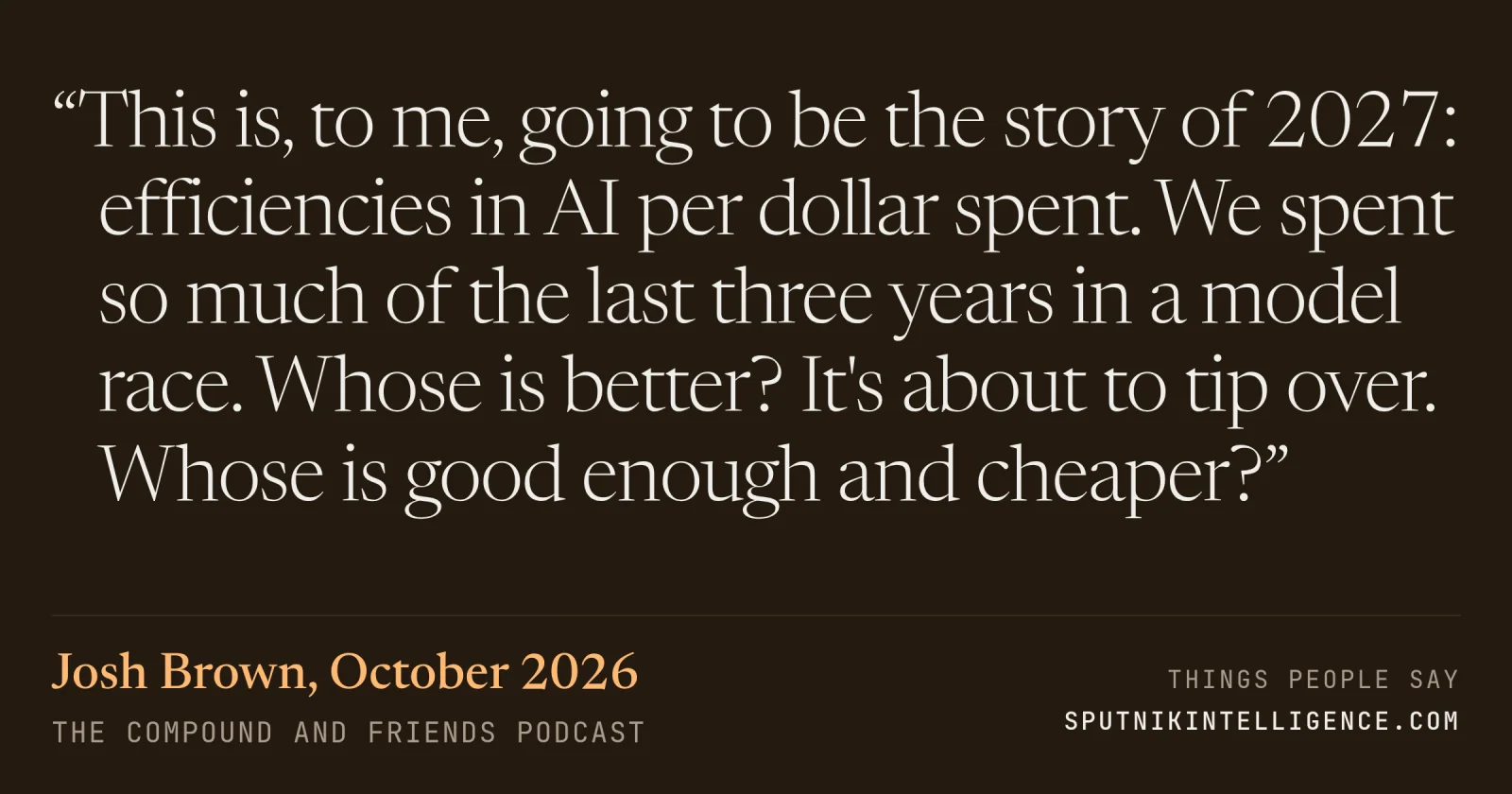
…of their AI spend is. That's the CEO said this yesterday. They are also getting worried if some of the AI spending is completely out of control with no real return. No One and Anthropic are launching more affordable models. OpenAI introduced lower cost mid-range additions to GPT-6 in September. And this month, Anthropic unveiled Haiku 5.5 for Claude, which is better performance at a lower cost. This is, to me, going to be the story of 2027: efficiencies in AI per dollar spent. We spent so much of the last three years in a model race. Whose is better? It's about to tip over. Whose is good enough and cheaper?
Jill Schlesinger
Well, you had someone on recently who mentioned this on the show, and I can't remember. I'm sorry, I've forgot which guest. I believe it was Jensen Huang. Exactly. Who's a good dear friend and our favorite guest? Good friend. You know, I think there's an interesting trend of when it is good enough…
Josh Brown
a private jet. Exactly.
Jill Schlesinger
Exactly. And it's funny. I remember I once talked to someone in the business who was a fintech company. And I remember them telling me, well, I just want you to know, you know, we have the best tracks. We have the best systems. It's incredible. It's like we're the bullet chain of financial…
Speaker names come from our own diarization. The position is estimated from where the line sits in the episode.
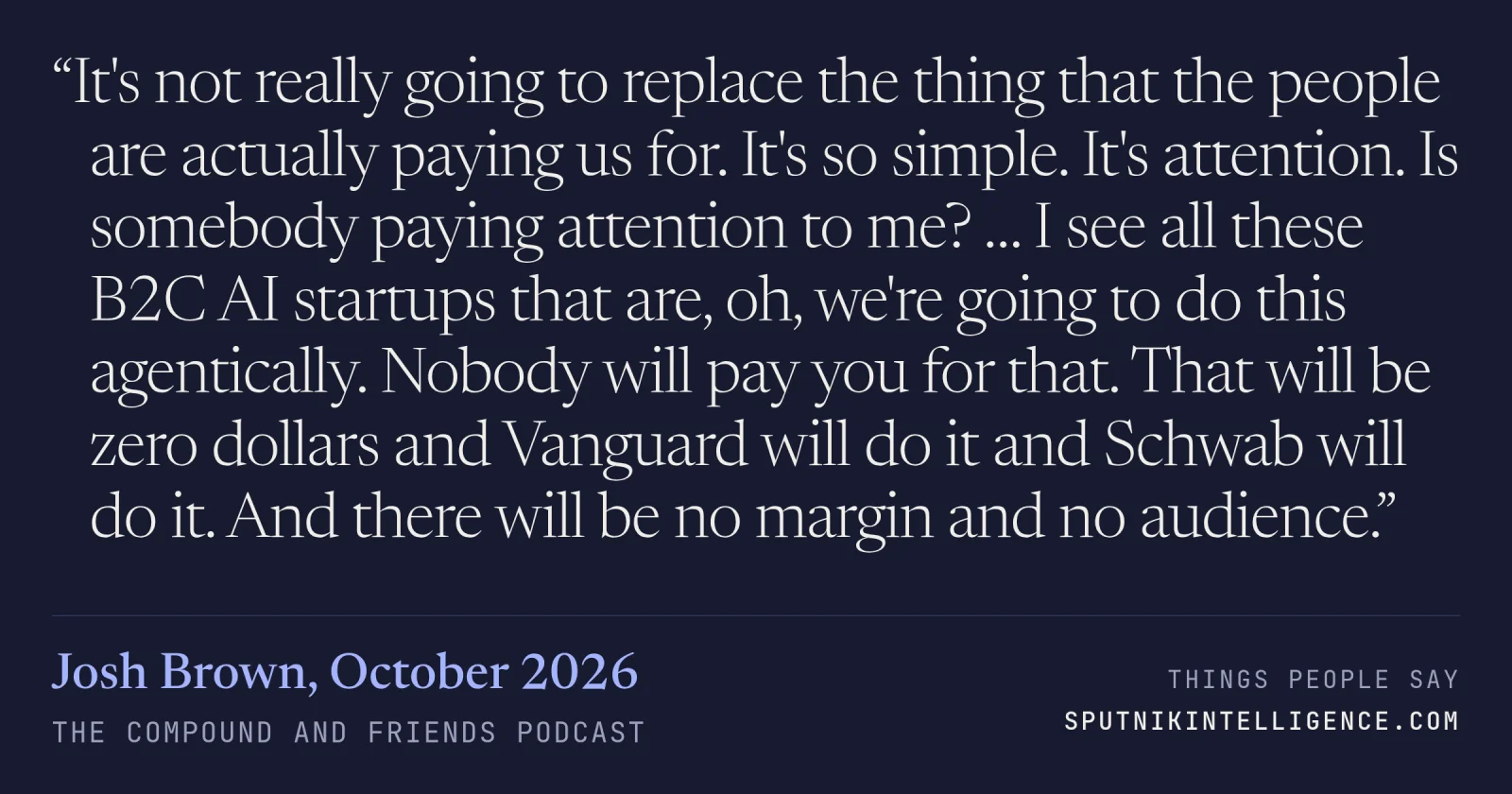
Brown, who runs a wealth management firm, says his firm uses AI all over the place to scale. But he argues clients pay for someone who listens and remembers them, which consumer AI advice apps can't sell.
The Compound and FriendsAround 57:41 into the episode
Josh Brown
something, the planning part has been solved by software for a generation. The hard part is the attention.
Jill Schlesinger
Exactly. And the management of the person.
Josh Brown
People, they need to be heard. They need to think out loud. They need to say things and see how they land on the person they're saying it to. They need somebody that thinks of them and remembers things that might be important for them. And they need to have the sense that there's somebody else who has a stake in things turning out well. We're using tons of AI, like all over the place. I'm paying the bills. Okay. It's great. It will absolutely enable us to scale up and serve more clients. It'll take our most talented advisors and give them a third or fourth hand to work with. It's amazing. We love it. It's not really going to replace the thing that the people are actually paying us for. It's so simple. It's attention. Is somebody paying attention to me? I can't say yes. And you will get an automated response as soon as you send us an email that has no value. Nobody could sell that. I see all these B2C AI startups that are, oh, we're going to do this agentically. Nobody will pay you for that. That will be zero dollars and Vanguard will do it and Schwab will do it. And there will be no margin and no audience.
Jill Schlesinger
I was speaking to a bunch of women investment advisors last year and like sort of an off-site that I was helping them out with. And we were talking about like what is, you know, your business and how you're growing it. And they're asking me about like podcasting and this and that. I said, pay…
Josh Brown
Right. These people's clients will leave them for a higher rate on their cash.
Jill Schlesinger
Yeah. And or just me or someone who pays attention. Or if you're, I mean, I do think like I hear this from women all the time. Oh, this, this broker, this Yutsy guy at Wirehouse ABC talks to my husband. My husband's dead. I'm out of there. Yeah. And you don't think that that woman is sticking…
Speaker names come from our own diarization. The position is estimated from where the line sits in the episode.
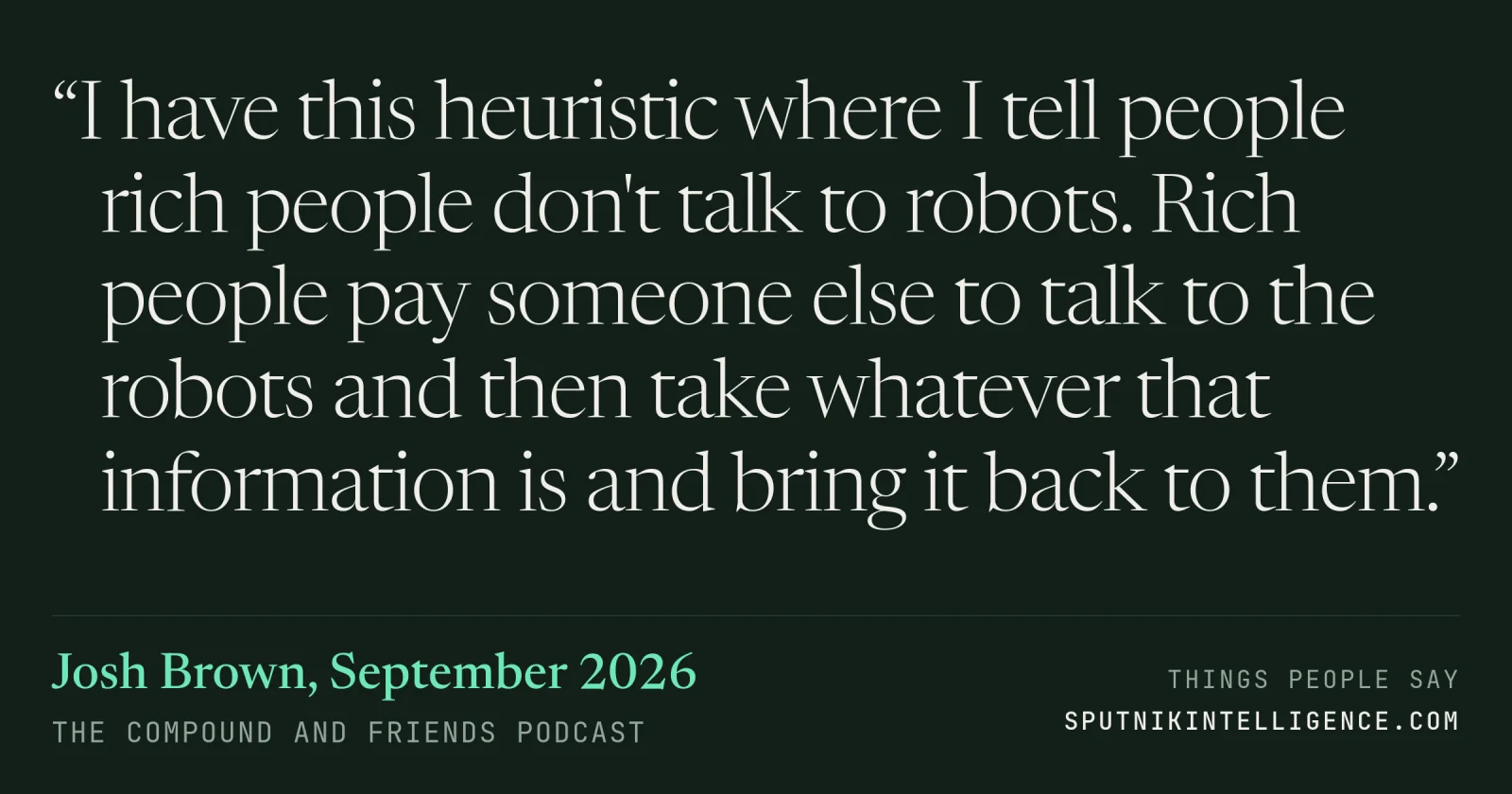
Jens Nordvig had just noted that clients still pay for vetted, human-filtered market information even with so much free data around. Brown answers with a rule he says holds in both the hedge fund and wealth management worlds, then extends it to travel agents and Expedia. The claim is not that the machines are bad but that paying a person to operate them is itself the status good.
The Compound and FriendsAround 25:56 into the episode
Josh Brown
Yeah.
Jens Nordvig
…of years ago, we thought, okay, that's. Phasing out completely. But because there's so much information out there that is not vetted at all, there's actually some that really want to pay for having something that has like an extra layer of like total real-time personal color and vetting on top.
Josh Brown
I have this heuristic where I tell people rich people don't talk to robots. Rich people pay someone else to talk to the robots and then take whatever that information is and bring it back to them. Like within reason. Wealthy people don't plan vacations on Expedia. If their travel agent is utilizing Expedia for information, that's fine. But they want a person who's responsible. And I think that corollary is a pretty good one, both for the hedge fund world and for wealth management world. You talk to the machine. Tell me what it says. Call me back. I think that's always, there's always going to be a component of that.
Jens Nordvig
And it's also a matter of making sure that the machine, even though if the machine is mathematically correct, like the machine might get outdated. So we need to continually make sure that we know what's happening in the market. Like there's a lot of our models that is based on, okay, what's the…
Josh Brown
Right.
Jens Nordvig
So we can give like one, it's okay if I give a specific example. Yeah. So like Korea is a pretty interesting country now, right? Because it's probably the country where the AI revolution is impacting everything the most. Obviously in the US, AI is very important, but it's US is a bigger country…
Speaker names come from our own diarization. The position is estimated from where the line sits in the episode.