
Alex Bores

Things Alex Says on Podcasts

New York State Assembly member and former software engineer who is behind the RAISE Act, New York's AI safety law for frontier model developers (from memory). Ran in the 2026 Democratic congressional primary on a platform centered on AI policy, and co-founded Who Decides, an organization working to give the public a voice in how AI develops. Appears as a guest on Prof G Markets, The Ezra Klein Show, Scaling Laws, Odd Lots, Equity, WIRED's Uncanny Valley, On with Kara Swisher and GD Politics, talking about third-party audits, catastrophic AI risk and data center concerns. Has written for the Transformer newsletter.

Where to Find Them

Alex Bores writes Central Air , hosts Scaling Laws and writes Transformer . They have also been a guest on GD POLITICS (2 times) , Prof G Markets (2 times) , Prof G Media (2 times) , For Humanity: An AI Risk Podcast , Equity , Nobody Knows Anything , Uncanny Valley | WIRED , Odd Lots , Squawk Pod , The Ezra Klein Show , On with Kara Swisher , The Cognitive Revolution" | AI Builders, Researchers, and Live Player Analysis and The Indicator (Planet Money) . They also write for Alex Bores on Substack.

Recently: “Democrats Sweep Congress — And Stocks Explode Higher” on Prof G Media (November 2026); “Democrats Sweep Congress — And Stocks Explode Higher” on Prof G Markets (November 2026); “Live from Emory Law: Stacey Abrams joins Alex Bores & Kevin Frazier” on Scaling Laws (November 2026); “Alex Bores Puts The Odds Of AI Doom At 20%” on GD POLITICS (October 2026); “Alex Bores Puts The Odds Of AI Doom At 20%” on GD POLITICS (October 2026); “AI Regulation Is Simpler Than You Think” on Prof G Media (September 2026).

What They Said

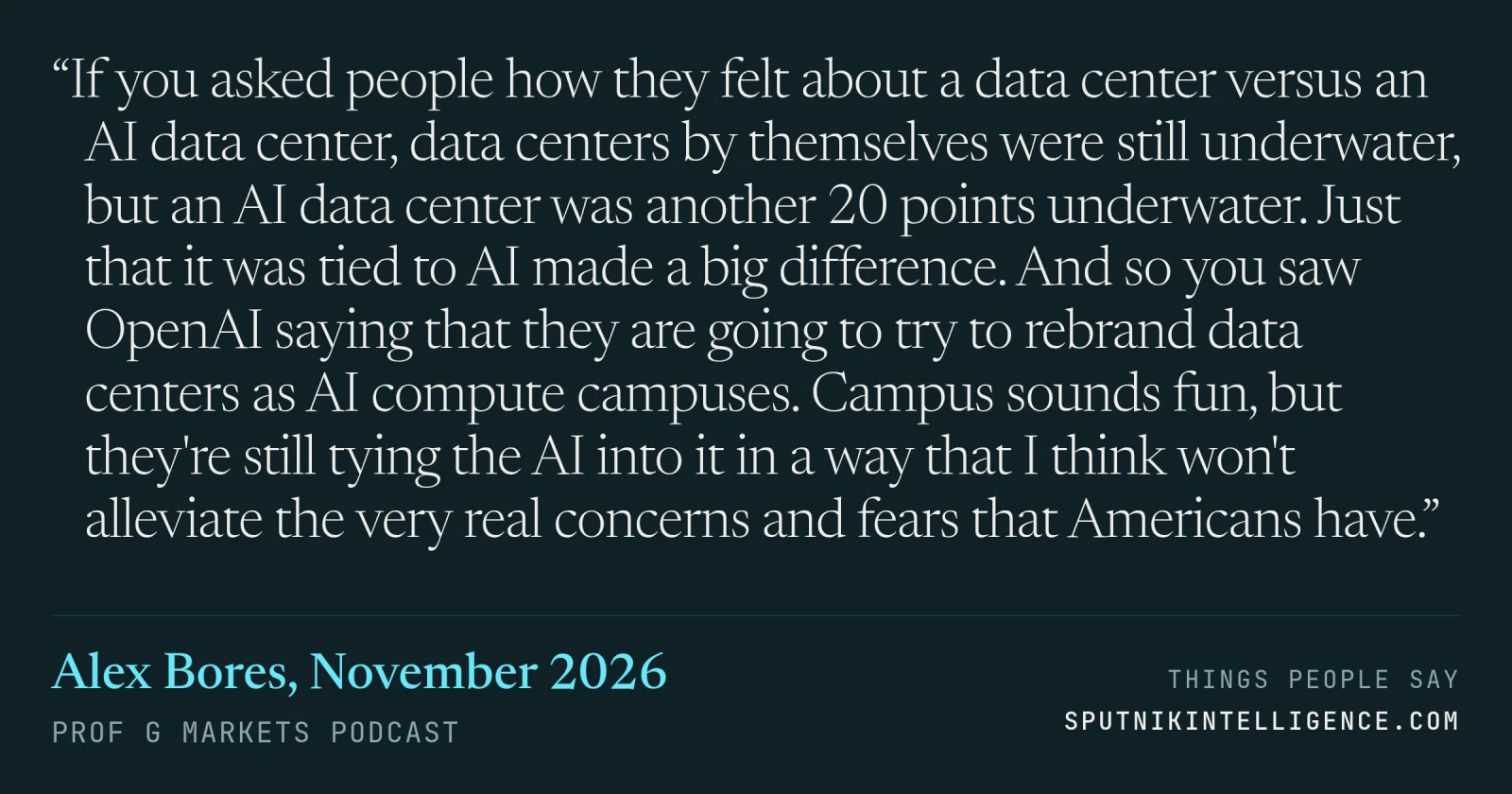
“If you asked people how they felt about a data center versus an AI data center, data centers by themselves were still underwater, but an AI data center was another 20 points underwater. Just that it was tied to AI made a big difference. And so you saw OpenAI saying that they are going to try to rebrand data centers as AI compute campuses. Campus sounds fun, but they're still tying the AI into it in a way that I think won't alleviate the very real concerns and fears that Americans have.” — Alex Bores, Prof G Markets

Asked what voters worry about most with data centers, Bores lists local concerns like water and energy bills, then cites polling that the AI label alone makes them markedly less popular.

Prof G Markets · 2026-11-05 Permalink → Listen →
Prof G Markets Around 28:38 into the episode
Alex Bores

…to pass federally. So, the fact that there were people running who were made clear that they were going to stand up to entrenched interests, that they were going to try to empower the American people, was a resounding message. And whether that was on data centers or broadly on regulation on AI.

Ed Elson

What do you think voters? Voters are most concerned about when it comes to the data centers. I feel like there's a whole swath of things that people have expressed. But I mean, what ranks highest, do you think?

Alex Bores

It's tough to separate out the different pieces of it, but there's a debate about whether it is AI itself or just the data center. There's lots of things that are just local concerns with the data center. People express a lot of concern about water usage. So in the U.S., that's pretty highly regulated, and we've seen much better behavior than what we've seen in other countries. But the energy prices that might spike because of it, even when a data center is promising to bring its own energy, if it puts a lot more demand on the components that generate energy, that could raise prices for your local utility that's doing it as well. So whether people will truly get their bills frozen or reduced because of a data center has become a big issue. But there was really interesting polling that showed if you asked people how they felt about a data center versus how they felt about an AI data center, data centers by themselves were still underwater, but an AI data center was another 20 points underwater. Just that it was tied to AI made a big difference. And so you saw OpenAI saying that they are going to try to rebrand data centers as AI compute campuses. I mean, campus sounds fun, but they're still tying the AI into it in a way that I think won't alleviate the very real…

Ed Elson

You have proposed more stringent regulation on AI and data centers. You had co-sponsored a bill in New York that would have paused data centers, data center construction for a year. It ended up happening by a different measure that Governor Hochul later implemented. But when I hear that, this idea…

Alex Bores

Well, I think it was Camus who said humans aren't rational. They're rationalizing. So the philosophy of the mind and of the voters we can put off there. But there is a, you know, if a data center, I like to point out there are plenty of data centers that exist in my hometown of New York City.…

Ed Elson

it's a great point. Just looking at the market's reaction. So it seems as though investors basically believe that this blue wave, this blue tsunami, essentially means that we're going to have very stringent regulation on data centers, or at least data center construction is going to be…
Speaker names come from our own diarization. The position is estimated from where the line sits in the episode.
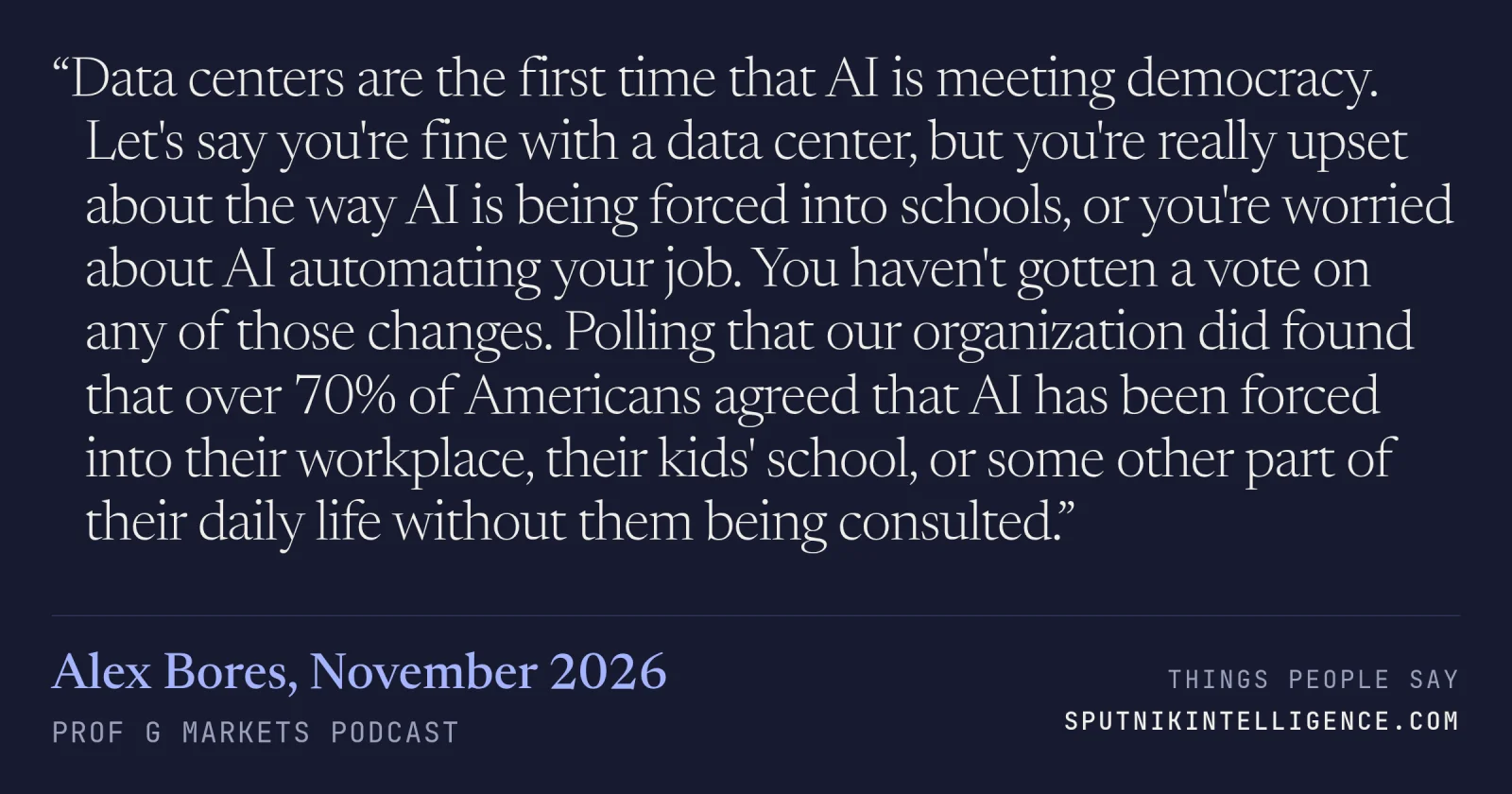
“Data centers are the first time that AI is meeting democracy. Let's say you're fine with a data center, but you're really upset about the way AI is being forced into schools, or you're worried about AI automating your job. You haven't gotten a vote on any of those changes. Polling that our organization did found that over 70% of Americans agreed that AI has been forced into their workplace, their kids' school, or some other part of their daily life without them being consulted.” — Alex Bores, Prof G Markets

The host asked whether voters are irrationally anti-AI. Bores answers that local data center votes are one of the few places people get a direct say on AI, which explains why so many restrictions passed.

Prof G Markets · 2026-11-05 Permalink → Listen →
Prof G Markets Around 30:33 into the episode
Alex Bores

…was tied to AI made a big difference. And so you saw OpenAI saying that they are going to try to rebrand data centers as AI compute campuses. I mean, campus sounds fun, but they're still tying the AI into it in a way that I think won't alleviate the very real concerns and fears that Americans have.

Ed Elson

…being sort of mischaracterized, caricatured in some way as AI equals bad, so we hate this thing. Am I wrong in thinking that? Is there a little bit of, I don't know, sort of an anti-AI cult that is causing people to maybe irrationally dislike these things, or is it all rational and warranted?

Alex Bores

Well, I think it was Camus who said humans aren't rational. They're rationalizing. So the philosophy of the mind and of the voters we can put off there. But there is a, you know, if a data center, I like to point out there are plenty of data centers that exist in my hometown of New York City. They're just in buildings. They're not these big campuses that impose on land use in lots of ways. So there are legitimate concerns about land use, about power, about noise in some of these places, and all of that's reasonable to talk about. And then there's this separate fact that data centers are the first time that AI is meeting democracy. And so let's say you're fine with a data center, but you're really upset about the way AI is being forced into schools, as we saw news with Google this week. Or you're worried about the impact of AI on chatbots or even AI automating your job. You haven't gotten a vote on any of those changes. Polling that Who Decides did, that our organization did, found that over 70% of Americans agreed that AI has been forced into their workplace, their kids' school, or some other part of their daily life without them being consulted. And so they just feel alienated from being able to make any choice with this technology. And if the first choice you…

Ed Elson

it's a great point. Just looking at the market's reaction. So it seems as though investors basically believe that this blue wave, this blue tsunami, essentially means that we're going to have very stringent regulation on data centers, or at least data center construction is going to be…

Alex Bores

think your characterization is spot on, and I find it fascinating, right? It expresses a bet that there will be stringent regulation on building new data centers, that that capacity will be. Curtailed, but that there won't be regulations that impact the profits of the tech companies and the AI…

Ed Elson

Based on the investors' reaction here, it seems as though they believe, investors believe Wall Street believes that data centers are essentially going to be gutted. I mean, it's a pretty strong reaction that we're seeing. And I imagine they, I mean, you are kind of the face of this movement in a…

Speaker names come from our own diarization. The position is estimated from where the line sits in the episode.

Collections They Appear In