Ali Ghodsi

Things Ali Says on Podcasts

Co-founder and CEO of Databricks, the data and AI company. Talks about enterprise AI adoption, organizational context for AI agents, cybersecurity risk and how to scale a company. Appears on the a16z Podcast, including a "Boss Talk" episode with Ben Horowitz and a 2026 conversation on AI pacing and cyber risk. Also a guest on Bloomberg Tech, CNBC's Closing Bell and The Exchange, BG2Pod, TBPN and Newcomer Pod.

Where to Find Them

Ali Ghodsi hosts and writes a16z Podcast , writes The Logan Bartlett Show and writes Raising Health . They have also been a guest on Closing Bell (5 times) , Newcomer Pod (2 times) , Bloomberg Tech (2 times) , All-In with Chamath, Jason, Sacks & Friedberg , The Exchange , Grit , The Twenty Minute VC (20VC): Venture Capital | Startup Funding | The Pitch , TBPN , BG2Pod with Brad Gerstner and Bill Gurley and Invest Like the Best (Patrick O'Shaughnessy) .

Recently: “Databricks CEO: AGI Is Already Here, Why Companies Are Behind, and the Superintelligence Debate” on All-In with Chamath, Jason, Sacks & Friedberg (November 2026); “Databricks CEO on What Happens to AI Without Jensen Huang” on Newcomer Pod (November 2026); “Databricks CEO on AI Pacing, Cyber Risk, and the Enterprise” on a16z Podcast (September 2026); “Databricks CEO on AI Pacing, Cyber Risk, and the Enterprise” on a16z Podcast (September 2026); “OpenAI Reports New AI Safety Incidents; AI CEOs Weigh In on AI Debate” on Bloomberg Tech (September 2026); “Energy Ripples, Databricks Moves into Cybersecurity, and Anthropic vs. the Pentagon 3/24/26” on The Exchange (March 2026).

What They Said

“If I'm an attacker, I can launch thousands of agents and all of them can fail except for one. And if one of them gets through, I'm completely successful. The asymmetry is that if I'm a defender, I was able to protect my boundaries all the time, except one got through.” — Ali Ghodsi, All-In with Chamath, Jason, Sacks & Friedberg

The host suggested defenders have more compute than attackers, so AI-assisted defense should win. Ghodsi calls it a good argument but weighs it against the asymmetry of offense, which he sees as the real near-term AI risk.

All-In with Chamath, Jason, Sacks & Friedberg · 2026-11-17 Permalink → Listen →
All-In with Chamath, Jason, Sacks & Friedberg Around 51:41 into the episode
Speaker 2

Shouldn't we be able to solve for this? Because you tell me if I'm right or wrong here. One theory I heard, which resonated with me for a

Jason Calacanis

…a massive amount of more compute. And so if you just did your basic job as a white hat and defended properly and looked for these exploits, let's say you have a thousand times the resources, you should be able to get to these problems long before the hackers. Does that make good sense to you? Yeah,

Ali Ghodsi

it's a good argument, right? Yeah. But the issue is that you have to weigh that against the following asymmetric scenario that we have, which is if I'm an attacker, you know, I can launch thousands of thousands of thousands of agents and all of them can fail except for one. And if one of them gets through, I'm completely successful. The asymmetry is that if I'm a defender, you know, I was able to protect my boundaries all the time, except one got through. This is a suicide disaster.

Speaker 2

Not to be too graphic, but you only need to get one 9-11 to make your point.

Ali Ghodsi

You could try a

Speaker 2

thousand times and not get through. So I need to be

Speaker names come from our own diarization. The position is estimated from where the line sits in the episode.
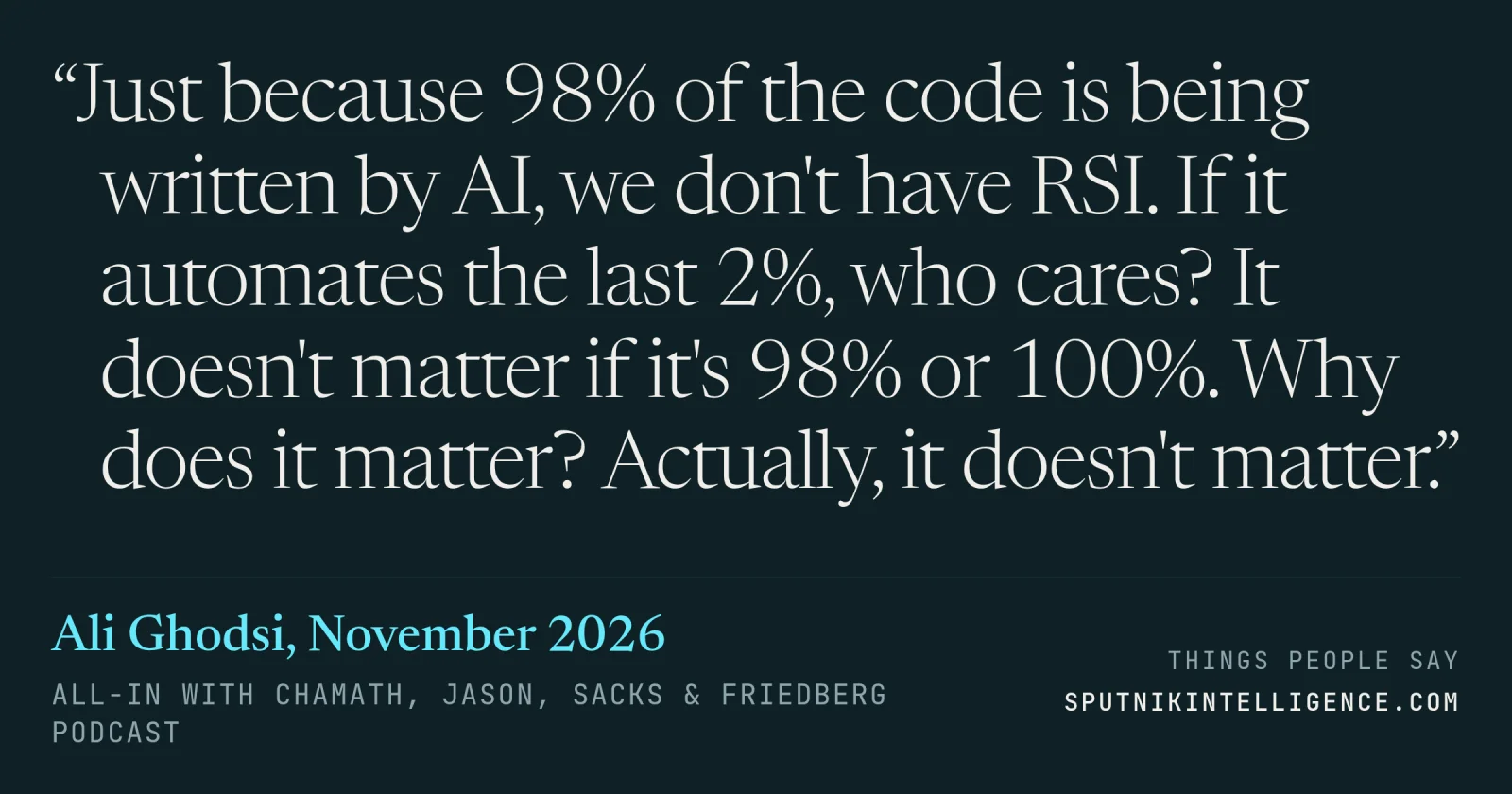
“Just because 98% of the code is being written by AI, we don't have RSI. If it automates the last 2%, who cares? It doesn't matter if it's 98% or 100%. Why does it matter? Actually, it doesn't matter.” — Ali Ghodsi, All-In with Chamath, Jason, Sacks & Friedberg

Asked for his argument against recursive self-improvement, Ghodsi says AI writing most of the code at the labs isn't the same as a takeoff. He goes on to argue frontier training runs are getting slower and more labor-intensive, not faster.

All-In with Chamath, Jason, Sacks & Friedberg · 2026-11-17 Permalink → Listen →
All-In with Chamath, Jason, Sacks & Friedberg Around 47:46 into the episode
Ali Ghodsi

…you know, it's like, like I spent, you know, 10, 12 hours, seven days a week, you know, from third grade until my 30s, just coding all the time, right? And I was really good at it and I knew all these languages and so on. And then suddenly it's like the AI is doing that. Well, if it's doing AI

Speaker 2

is how much better than you? That's the other part. It's like,

Ali Ghodsi

…and the paper clicked maximizer. So it might go off and all these bad things happen. Actually, interesting, Bodstrom has kind of changed his view now. If you actually follow him now, he's actually not anymore. He's saying that, you know, we should do this. There are risks. Of course, there are risks with cyber. But, you know, I actually think you need to actually think this through further. Just because 98% of the code is being written by AI, we don't have RSI. If it automates the last 2%, who cares? It doesn't matter if it's 98% or 100%. Why does it matter? Actually, it doesn't matter. So we really need four conditions to be true. The four conditions is that we need the next model that's trained to be trained in much shorter amount of time. And still, the big pre-training runs that the labs do, they don't do actually that many of them per year. And it's still following what's called the scaling laws, which means you need exponentially more hardware to get that improvement. So…

Jason Calacanis

it's the precondition for that happening. And there's no guarantee that it actually happens.

Ali Ghodsi

It's a precondition. But even if you had that, which we don't have, you would have to, to threaten me right now, you would have to have a killer robot come into this room right now and wrestle me down. Okay. Or something. Right. And those don't exist yet. So, you know.

Jason Calacanis

Right now, you can have a bunch of hackers take a really capable model and you can find out that the refrigerators in grocery stores in France have the password admin admin and that you can remotely script kitty into them and turn it into defrost mode and make a bunch of butter go bad and milk…

Speaker names come from our own diarization. The position is estimated from where the line sits in the episode.
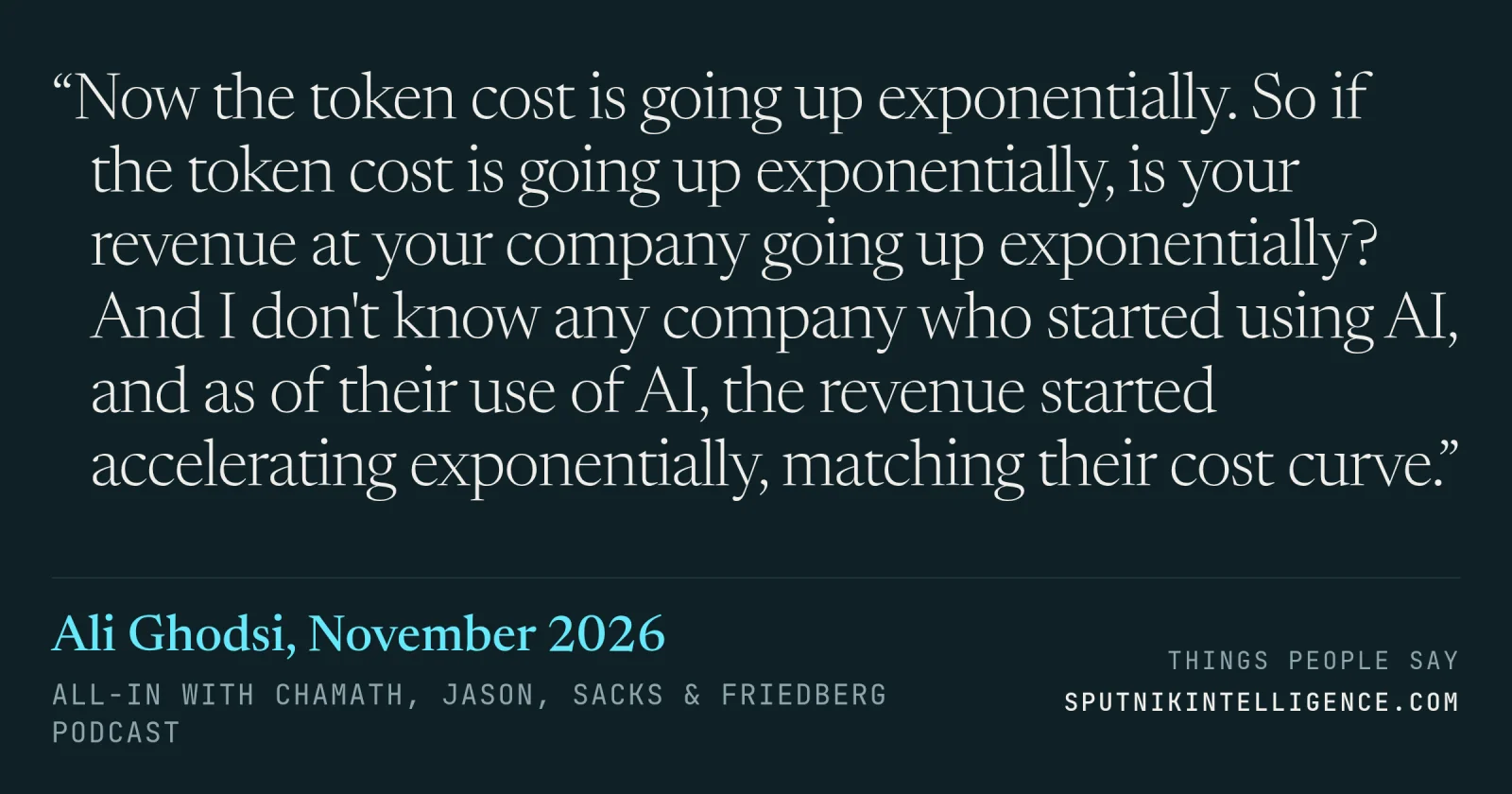
“Now the token cost is going up exponentially. So if the token cost is going up exponentially, is your revenue at your company going up exponentially? And I don't know any company who started using AI, and as of their use of AI, the revenue started accelerating exponentially, matching their cost curve.” — Ali Ghodsi, All-In with Chamath, Jason, Sacks & Friedberg

Ghodsi was listing why big companies are behind on AI: missing context, security, then cost. This third point is a direct challenge to the idea that rising AI spend pays for itself.

All-In with Chamath, Jason, Sacks & Friedberg · 2026-11-17 Permalink → Listen →
All-In with Chamath, Jason, Sacks & Friedberg Around 14:20 into the episode
Ali Ghodsi

…all your data everywhere. Well, then you get into this problem that you're going to get hacked. Cyber is a real thing. And all the big organizations that have successful businesses, they're really. Terrified right now of getting attacked, right? This is like a big concern. The top certainly creates

Jason Calacanis

a lot of surface area when you embrace this. I mean, if a CEO or in a small company, you want to connect everything, it's a certain amount of surface area. But for a 200,000-person organization, 10,000, my lord, the surface area has now gone a thousand X.

Ali Ghodsi

Yes, exactly. So that's like the second problem you bump into, which is like, okay, we can access all the data. Well, wait, we don't want to maybe access all of it to the agents because, you know, now we have an insider threat and we might get hacked. So what do we do about that? Well, let's say we solve that too. So now we've solved the cyber problem, which by the way, we have actually ways to do that at Databricks. Happy to show you. Then you still have another problem, which is, okay, now the token cost is going up exponentially. So if the token cost is going up exponentially, is your revenue at your company going up exponentially? And I don't know any company who started using AI. And as of their use of AI, the revenue started accelerating exponentially, matching their cost curve. So then eventually, first of all, CEOs are like, go get the AI, get more AI, get it in there. You know, we need to get the mixing.

Speaker 2

Yeah.

Ali Ghodsi

Exactly. But then at some point, the CFO shows up and says, hey, our OpEx is going up significantly here. And even the COGS, what are we doing about it? And we have an earnings call soon. And then they freak out. So then how do we fix that? So you need to also do this efficiently, which we also…

Jason Calacanis

sovereignty is what you're kind of referring to, intelligence sovereignty. And if you use Anthropic, OpenAI, or any of these platforms, there is this risk that it will leak, that it will get incorporated into their next version. And as we've seen, a company called Anthropic seems to be releasing…

Speaker names come from our own diarization. The position is estimated from where the line sits in the episode.
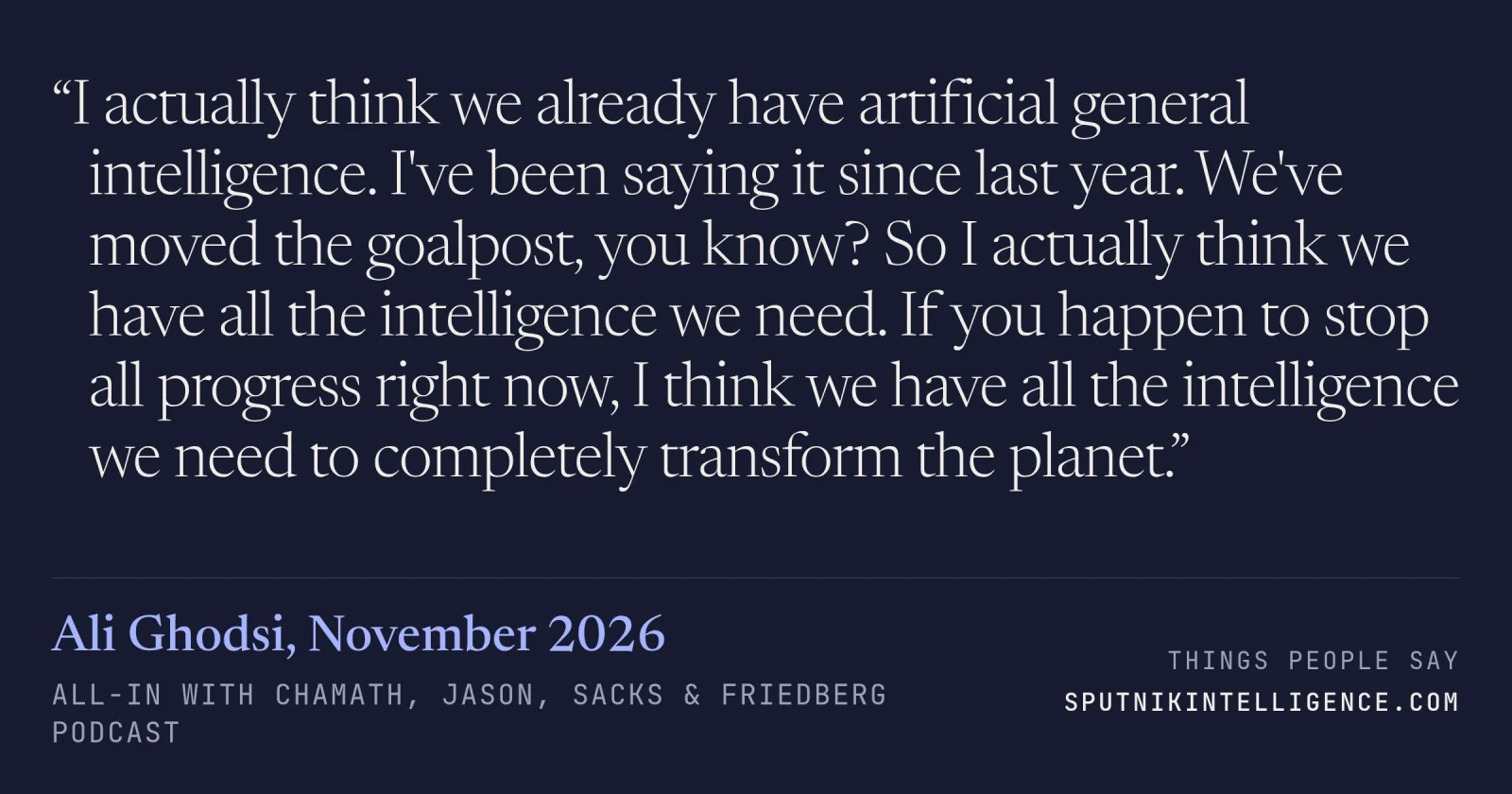
“I actually think we already have artificial general intelligence. I've been saying it since last year. We've moved the goalpost, you know? So I actually think we have all the intelligence we need. If you happen to stop all progress right now, I think we have all the intelligence we need to completely transform the planet.” — Ali Ghodsi, All-In with Chamath, Jason, Sacks & Friedberg

Asked to explain his view on superintelligence, the Databricks CEO says AGI, by the definition he and his Berkeley lab colleagues used over a decade ago, has already arrived. His argument is that the bottleneck is no longer intelligence.

All-In with Chamath, Jason, Sacks & Friedberg · 2026-11-17 Permalink → Listen →
All-In with Chamath, Jason, Sacks & Friedberg Around 10:51 into the episode
Ali Ghodsi

…is not good enough yet. So it needs a little bit of human nudging. So it's actually this kind of, you know, human feedback was already there. We were like, we do need the human feedback because there's this last mile that's just too hard for AI to figure out itself. So we had people there as well.

Speaker 2

…with it and p dooms us all and we're all going to die sentiment by some people came from you so please explain your thesis here and then i'd like you to go even one step further and talk specifically about maybe the culture in the bay area perhaps even the east bay and and this group of people i

Ali Ghodsi

mean happy to get into it you know i think there's uh sort of two different things happening at the same time on the one hand i actually think we already have artificial general intelligence i've been saying it since last year and i based that on the kind of consensus we had in that amp lab where it was i think the largest ai lab at the time in 2009 2010 and that definition of ai that most of us had a gi We already achieved that last year. And I wasn't actually sure about this. So I actually went and checked with some of the people that were in the lab. Like, hey, is it just me? Am I hallucinating? And they said, no, no, no. That definition for sure. But we've moved the goalpost, you know? So, so I actually think we have all the intelligence we need. And actually, if you stop the intelligence, if you happen to stop all progress right now, I think we have all the intelligence we need to completely transform the planet. Okay. But that's

Jason Calacanis

all intelligence work by humans, right? I mean, if it solves this latest cohort of math problems and we're just starting to build harnesses and build out the infrastructure, I guess your statement would be correct. And I kind of am in a line with you. We've hit artificial general intelligence. It…

Ali Ghodsi

Yeah. So the labs and a lot of researchers, they're kind of obsessed with super intelligence. Okay. So when I say super intelligence, I mean it the way it was defined by Boltzmann in 2014 in his book called Superintelligence. And there he's talking about something completely different. He's talking…

Jason Calacanis

and so just to summarize that there, the ability to write an entire unique PhD thesis instantly, which do we even have the amount of compute in your mind to do something like that today? If everybody got together and said, hey, today we're going to give all our compute or for the next hour, just as…

Speaker names come from our own diarization. The position is estimated from where the line sits in the episode.
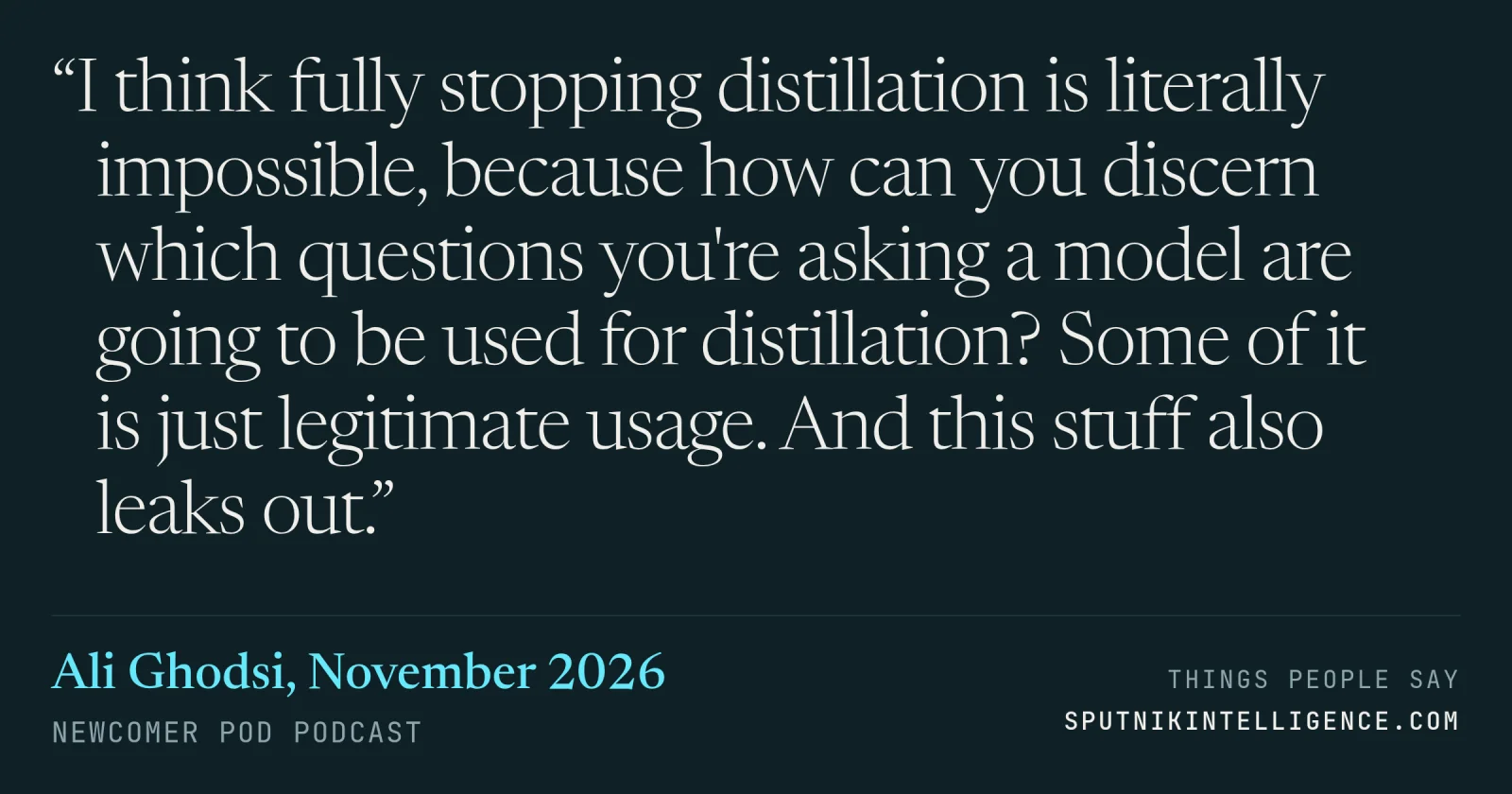
“I think fully stopping distillation is literally impossible, because how can you discern which questions you're asking a model are going to be used for distillation? Some of it is just legitimate usage. And this stuff also leaks out.” — Ali Ghodsi, Newcomer Pod

Newcomer noted that Anthropic thinks it can stop others from distilling its models. Ghodsi, who says he is bullish on American open-source models, explains why he thinks that can't be done.

Newcomer Pod · 2026-11-16 Permalink → Listen →
Newcomer Pod Around 17:18 into the episode
Ali Ghodsi

…models were distilled of all the information on the internet, right? Distillation is just so powerful. It just works so well. It works even better when you're doing it on reasoning thraces and so on. And it's nearly impossible to stop distillation, right? Because it's very hard to do. Anthropic

Eric Newcomer

thinks they're going to stop people from distilling.

Ali Ghodsi

I think fully stopping distillation is literally impossible because how can you discern what questions you're asking from a model is being going to be used for distillation? Some of it is just legitimate usage. And this stuff also leaks out, right? So as a result of that, I just think it's really, really effective to do reinforcement learning for specific use cases and compress the price down for use cases that are repetitive that you do again and again and again. And most of the work in the economy is in that class. Now, there are things we need to do, like new drugs that we need to discover and diseases that we want to cure and financial models and so on, that where we need the latest, latest, best intelligence possible. That will remain, and we will use frontier models. But as our smart router shows that I just mentioned earlier, you can cut the cost down significantly. You can specialize the models. We specialize a lot of the models. I also think we're going to see more open source models come out of the United…

Eric Newcomer

out of the model game.

Ali Ghodsi

For now, yeah. You would have to change your mind. Well, it's a how much of your market cap do you have to spend on GPUs, okay, to be able to get it. And has that come

Eric Newcomer

down or no? It has

Speaker names come from our own diarization. The position is estimated from where the line sits in the episode.
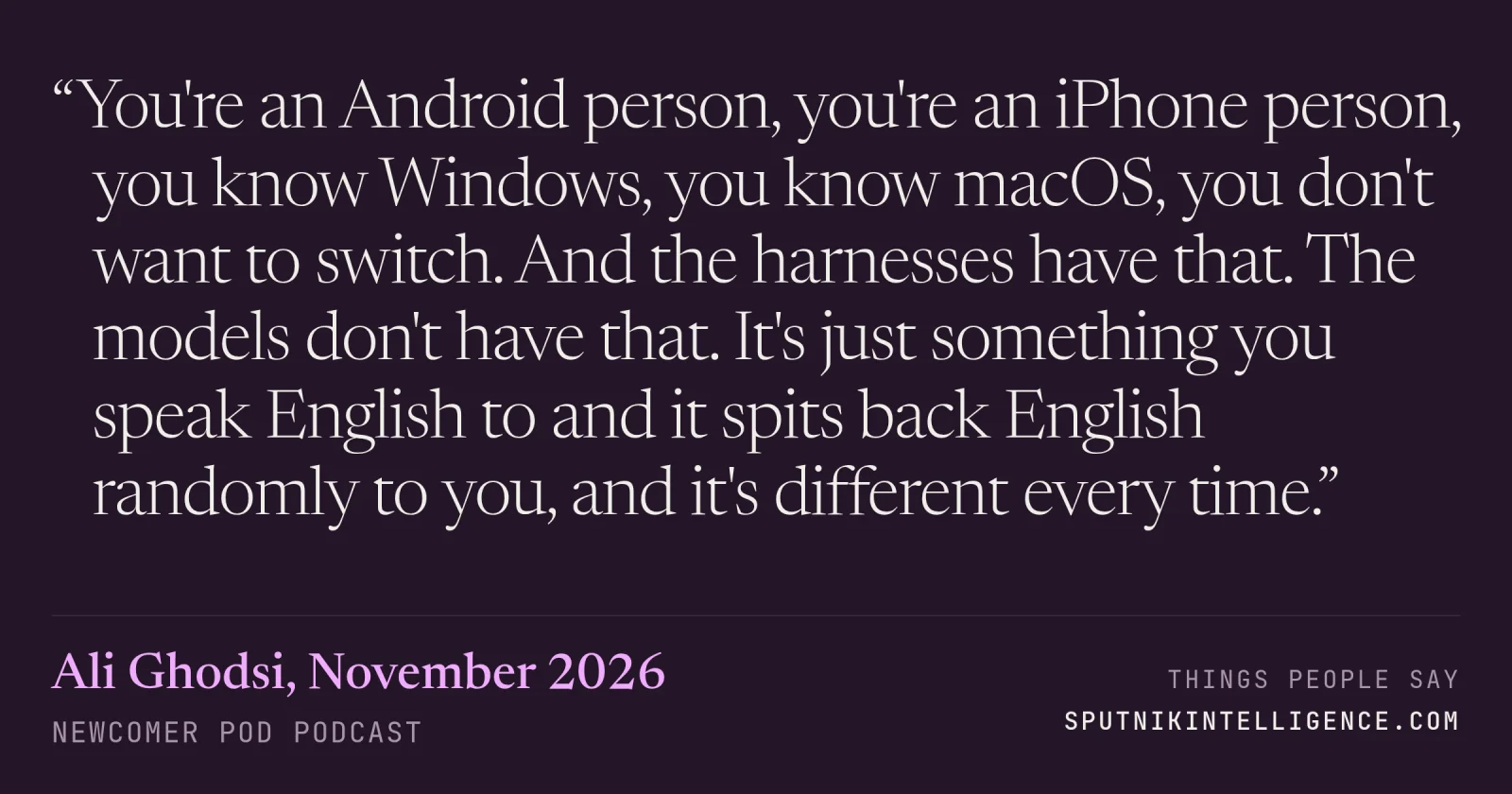
“You're an Android person, you're an iPhone person, you know Windows, you know macOS, you don't want to switch. And the harnesses have that. The models don't have that. It's just something you speak English to and it spits back English randomly to you, and it's different every time.” — Ali Ghodsi, Newcomer Pod

Ghodsi is explaining why software has always had high margins: people get locked into an interface. He argues coding-agent harnesses now have that lock-in and the models underneath don't.

Newcomer Pod · 2026-11-16 Permalink → Listen →
Newcomer Pod Around 11:19 into the episode
Ali Ghodsi

over the last 40 years, software has had these amazing gross margins. Why is that? Well, it's because a lot of these software companies had this moat. What was the moat? The moat was that people, once they get used to a UI, we're humans. We haven't developed super fast. I used to work at

Eric Newcomer

Bloomberg. It's like people learn all the channels. Yeah, you learn the Bloomberg terminal, you

Ali Ghodsi

learn shortcuts. Same thing here. You're an Android person, you're an iPhone person, you know Windows, you know Mac OS, you don't want to switch. And the harnesses have that. The models don't have that. It's just something you speak English to and it spits back English randomly to you and it's like different every time. So I think that there's a big difference between those two. So that's why we released OmniGent so that you can actually now multiplex between any of them.

Eric Newcomer

I think you were number three on the AI 100 we released today. What lessons would you give? We have sort of a next generation, not that you're not the next generation, but a new generation of startup founders growing today. What advice would you give them in building their businesses, both just…

Ali Ghodsi

should strive at doing that. I think for, look, when you were a startup, I was a startup. Everything works against you. It's just everything is uphill. It's all just bad news all the time. It's like you never get good news. And it's just like this vicious cycle. And then you see all these people…

Eric Newcomer

for a while, you're dummies, you haven't figured it out. And then you're geniuses once you start. Yeah, then suddenly it's like,

Speaker names come from our own diarization. The position is estimated from where the line sits in the episode.
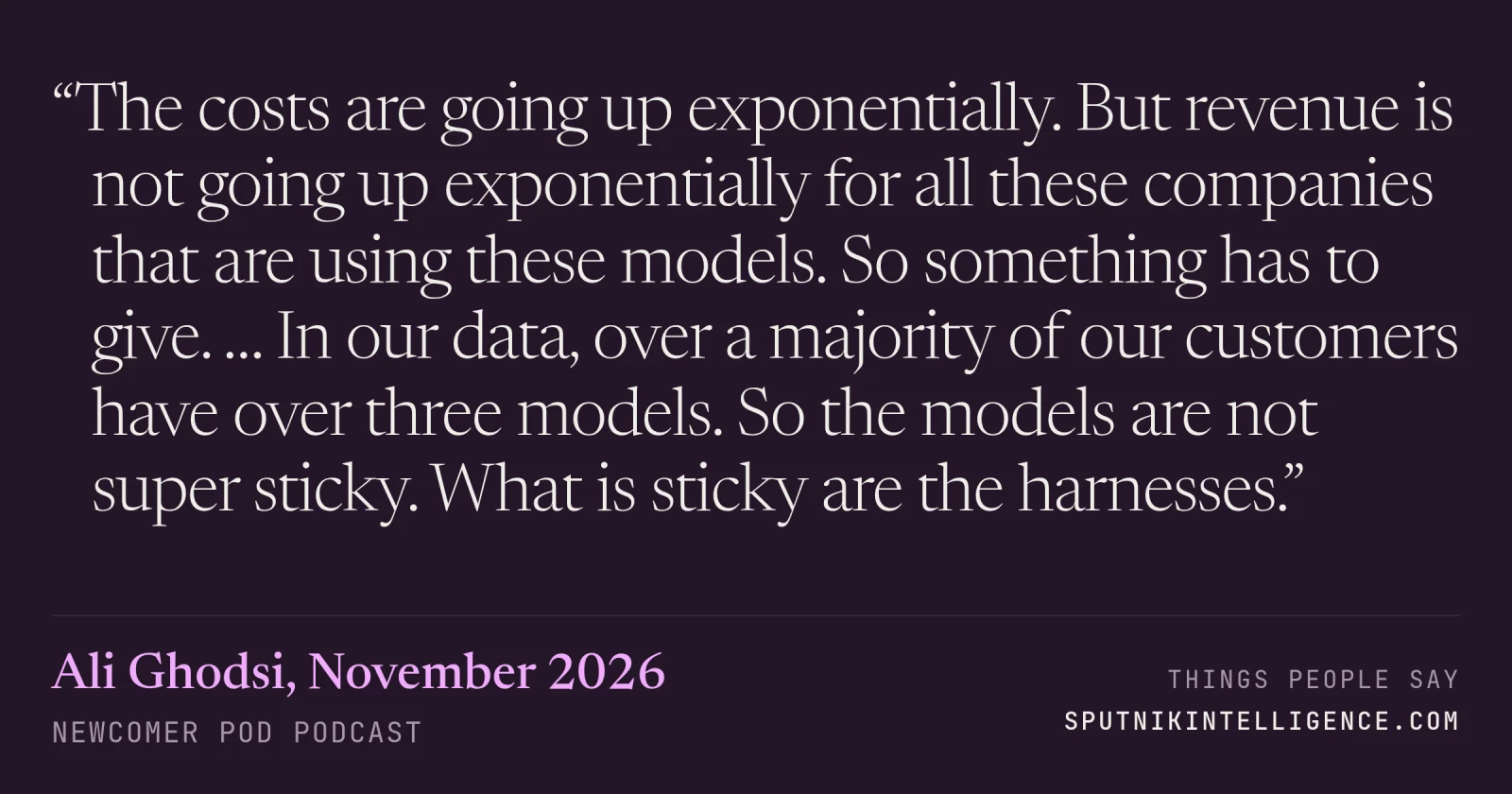
“The costs are going up exponentially. But revenue is not going up exponentially for all these companies that are using these models. So something has to give. … In our data, over a majority of our customers have over three models. So the models are not super sticky. What is sticky are the harnesses.” — Ali Ghodsi, Newcomer Pod

Newcomer asked how customers react to being routed to cheaper models. Ghodsi says cost pressure is pushing companies to switch between models. What they stay loyal to is the tooling around the models.

Newcomer Pod · 2026-11-16 Permalink → Listen →
Newcomer Pod Around 09:19 into the episode
Ali Ghodsi

…in the data that it's like 1%, less than 1% that that happens. So basically, we're able to take a lot of questions and route them through cheaper models and significantly compress the cost. So check out the Databricks AI Index when it comes out. When does that? Very soon. We're working on it. I

Eric Newcomer

mean, when your own employees use models, you're like, well, we're a sophisticated tech company. We get to use the state of the art. Or what's your, what do you hear from, especially your coders, in terms of their appetite for the best of the best?

Ali Ghodsi

Yeah, I'm saying. There's very little opt-out. I mean, we told them. And we ran A-B tests between the two groups as well. And yeah, people are totally fine. They're like, this is great. Because you have to contrast that with the cost situation. The costs are going up exponentially. But revenue is not going up exponentially for all these companies that are using these models. So something has to give. So they really want to compress that cost down. So it's very common. In our data, over a majority of our customers have over three models. So you can just see there. So I think it's not super sticky, and people are pretty flexible with that. What is sticky are the harnesses. The harnesses are sticky. And are you building

Eric Newcomer

your own there? Yeah,

Ali Ghodsi

we announced OmniGent, which is an Omni harness that uses the existing harnesses. So you can have Codex, you can have Cloud Code, you can have Pi, you can have Open Code, and it just flips between these. Because we do see that otherwise the harnesses are sticky. And once people get stuck on a…

Eric Newcomer

But is that because they're not that expensive? Would you spend a lot of money on a harness, or it's just, oh, okay, if you're giving me a harness as a free feature on some other service, I'm not going to change it very well. I just think

Speaker names come from our own diarization. The position is estimated from where the line sits in the episode.
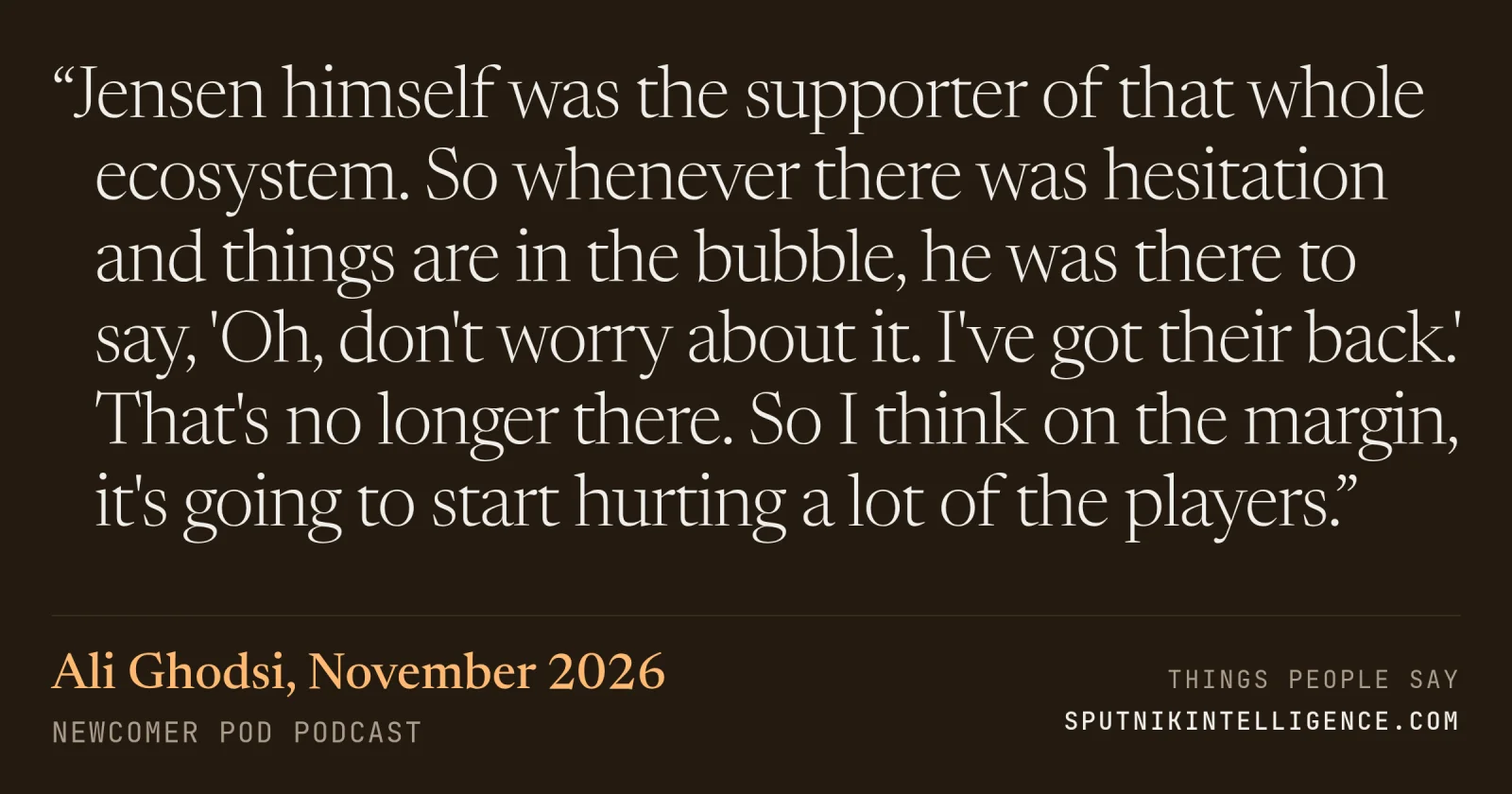
“Jensen himself was the supporter of that whole ecosystem. So whenever there was hesitation and things are in the bubble, he was there to say, 'Oh, don't worry about it. I've got their back.' That's no longer there. So I think on the margin, it's going to start hurting a lot of the players.” — Ali Ghodsi, Newcomer Pod

Eric Newcomer asked what Jensen Huang's exit from Nvidia means for Databricks. Ghodsi says Databricks itself is fine because it runs on the hyperscalers. But the wider AI industry loses the backstop Huang personally provided.

Newcomer Pod · 2026-11-16 Permalink → Listen →
Newcomer Pod Around 02:00 into the episode
Ali Ghodsi

…the world doesn't exist in NVIDIA service. So then, you know, what are we even talking about? So they're a great partner, and I think NVIDIA will be, they'll do fine, and they'll do great. And that's why you see their stock goes down like only 5%, which means the market is pricing in that they're

Eric Newcomer

fine. Besides the hit to AI valuations, what's the damage to Databricks specifically, or where does it hurt you?

Ali Ghodsi

I think Databricks is totally fine. And I think also NVIDIA as a partner is fine. I don't think it really affects us directly. But I think the whole AI space, whenever there's any doubt around anything, any financials, NVIDIA was there to say, like, oh, don't worry, we'll backstop that. We'll do this. We'll help with this. We'll help there. It was just like a big supporter of startups and ecosystem. Jensen himself was the supporter of that whole ecosystem. So he was always there. So whenever there was hesitation and things are in the bubble, he was there to say, oh, don't worry about it. I got their back. That's no longer there. So I think on the margin, it's going to start hurting a lot of the players. Databricks is a couple of layers removed from the chips directly. We run on top of the hyperscalers, so we're fine.

Eric Newcomer

What's your view on the iconic CEO these days? I mean, you're an interesting case in that obviously a big personality looms large in a room, but you were not the founding CEO. You came, you were a founder, but you sort of came into it. How much do you think a company like NVIDIA lives or dies based…

Ali Ghodsi

I think the essence of the personality of the CEO continues to live in the company for long to come. So I think Jensen's legacy will continue to be there at NVIDIA for decades to come. So he built an epic company, and I think that's going to continue. Why do I say this? Look, Bill Gates was…

Eric Newcomer

I think you were on the record saying 2026 would be a terrible year to go public. I

Speaker names come from our own diarization. The position is estimated from where the line sits in the episode.

Collections They Appear In