Kharazian, an economist at Ramp who studies business card spending, on a frontier model that came with mandatory prompt monitoring. Most businesses chose a slightly weaker, cheaper competitor instead, which he says shows customers now have the negotiating power over model makers.
…driven by the top 1%, that is the latest crack that's starting to form, which is that the top 1% is starting to slow its pace of spend. And the products are getting pretty good, such that they allow businesses to outright cut their spend and optimize it with cheaper and cheaper models every month.
…response by Anthropic or OpenAI to strengthen their business in the face of all of this competition? That the frontier models are cutting their prices. There's more competition from Chinese open weight models, from domestic open weight models. What should they do? What do you think they will do?
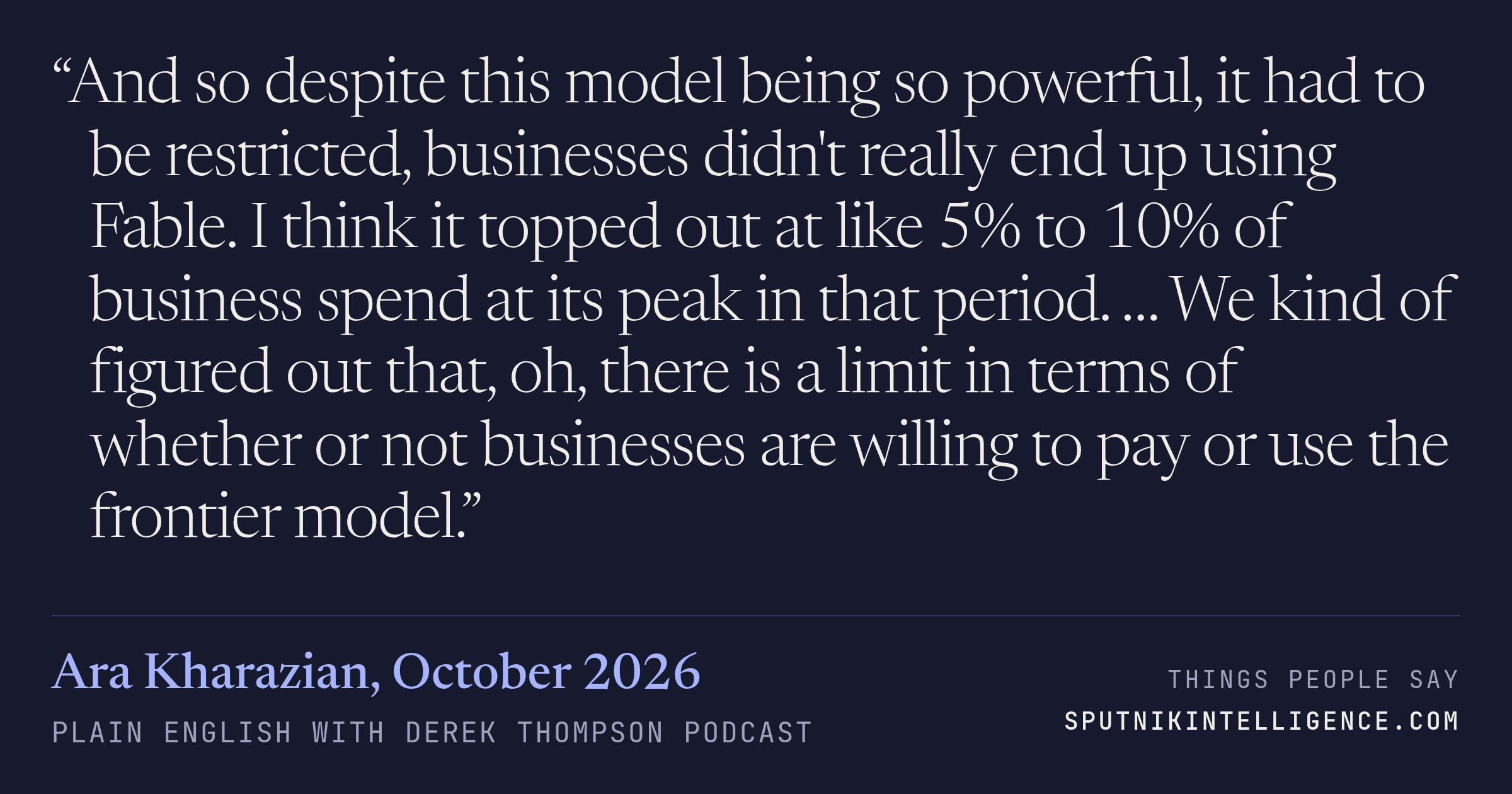
…responses was: okay, you can release the model, but you need to collect all the data from the model and do checks on everything that's being prompted in the model so that we know that no one's misusing it. That ended up being kind of a non-starter for most businesses, which have obligations to their customers about data retention and making sure that their software vendors don't store any data. And so despite this model being so powerful, it had to be restricted, businesses didn't really end up using Fable. I think it topped out at like 5% to 10% of business spend at its peak in that period. And why would they? Because it actually was it the best model on the market at the time? Yes. But there was also a really good other model available at the time, which was GPT Sol, OpenAI's competitor that had just come out. And so for a relatively low trade-off in performance, and actually a benefit in that Seoul was actually a little bit cheaper, businesses were able to still use a highly…
Eventually, somebody outside of the AI capital loop has to obtain enough value from AI Story pay the bill, right? Revenue right now is around $200 billion, $220 billion a year. It probably has to roughly double by next year and then roughly double from that in 2027. But several things are standing…
That's pretty much the case.
What's the strongest argument against it?