RP

Rebecca Patterson

Things Rebecca Says on Podcasts

Author of a book chapter on which countries gain most economically from AI, on The Spillover pushing back on the assumption that US AI leadership is settled.

Where to Find Them

Rebecca Patterson hosts The Spillover and hosts The President’s Inbox . They have also been a guest on Bloomberg Surveillance (39 times) , Wall Street Week (7 times) , Closing Bell (6 times) , Squawk on the Street (5 times) , RiskReversal Pod (4 times) , CNBC's "Fast Money" (2 times) , Bloomberg Intelligence (2 times) , Bloomberg Daybreak: US Edition , Masters in Business , The Compound and Friends , Exchanges and Irregular Warfare Podcast .

Recently: “The Pentagon’s $1.5 Trillion Ask + How to Build a Military for the Next War” on The Spillover (November 2026); “After the Blue Wave, What Do Voters Want From the Economy?” on The Spillover (November 2026); “Transactional U.S. Foreign Policy + Who Are America’s Friends Now?” on The Spillover (October 2026); “Brazil’s Runoff Election Is a Close Race Between Lula and Bolsonaro” on The Spillover (October 2026); “Lame Ducks, Black Swans, and the 2026 Midterm Elections” on The Spillover (October 2026); “What We Got Right (and Wrong) This Year” on The Spillover (October 2026).

What They Said

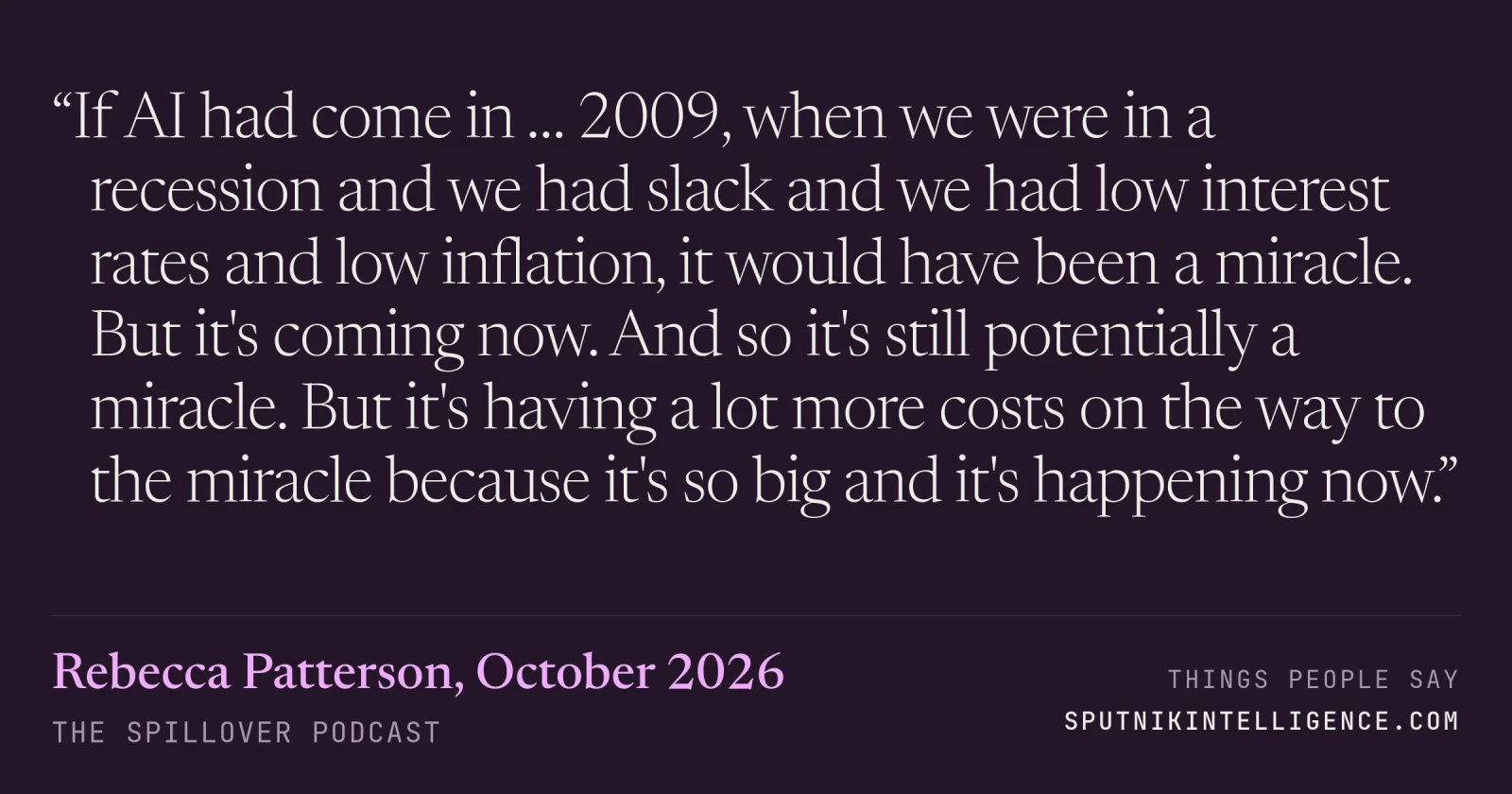
“If AI had come in … 2009, when we were in a recession and we had slack and we had low interest rates and low inflation, it would have been a miracle. But it's coming now. And so it's still potentially a miracle. But it's having a lot more costs on the way to the miracle because it's so big and it's happening now.” — Rebecca Patterson, The Spillover

Patterson is explaining a line she has been working on: "AI is too much of a good thing happening at the wrong time." She treats AI spending as an enormous fiscal stimulus landing on an economy with low unemployment and above-target inflation, where it crowds out other construction and other borrowers and pushes interest rates up while governments are already issuing heavily.

The Spillover · 2026-10-07 Permalink → Listen →
The Spillover Around 29:29 into the episode
Rebecca Patterson

…partly through all these conversations with you this year, Sebastian, I've been thinking more and more and more about the intersection of AI and the fragile four and the polarization around the world. And I think I've come up with a line: AI is too much of a good thing happening at the wrong time.

Sebastian Mallaby

Okay, explain that.

Rebecca Patterson

…we can play that story in France, UK, et cetera, et cetera, et cetera, it makes the fiscal crisis worse. And so this year, the U.S. is going to issue about $2 trillion of debt to fund the budget deficit. More and more of that's going to interest payments as rates go up, which adds to the debt. And then we have a slow-motion debt doom loop. And so that's the wrong time. If AI had come in 2020, 2009, when we were in a recession and we had slack and we had low interest rates and low inflation, it would have been a miracle. But it's coming now. And so it's still potentially a miracle. But it's having a lot more costs on the way to the miracle because it's so big and it's happening now. So that's my like thesis that's been gelling in my head. And I'm hoping to turn it into a proper research note to share with people soon.

Sebastian Mallaby

That's great. I mean, it's a good riff, and I take your point. It's a good

Rebecca Patterson

riff. I get a good riff. All right.

Sebastian Mallaby

What are you focusing on? Well, let me just react to it. I think it speaks to something that I've also thought about, which is that AI is not just an experiment and a gamble with a new technology. It's sort of testing other things as well, like the depth of our capital markets, the resilience and…
Speaker names come from our own diarization. The position is estimated from where the line sits in the episode.
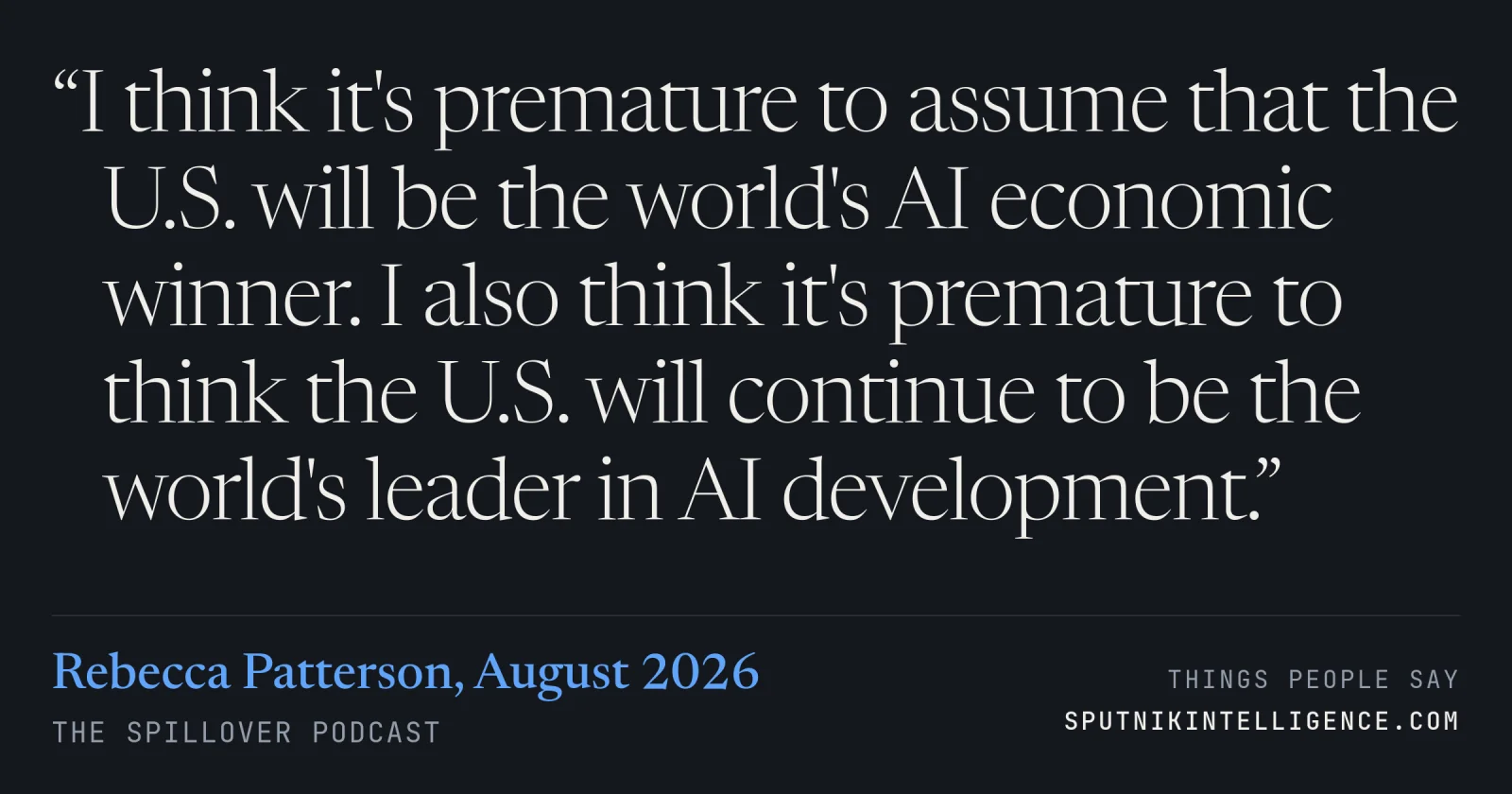
“I think it's premature to assume that the U.S. will be the world's AI economic winner. I also think it's premature to think the U.S. will continue to be the world's leader in AI development.” — Rebecca Patterson, The Spillover

Rebecca Patterson has just written a book chapter trying to identify which countries will come out ahead economically from AI. She opens with a deliberately contrarian stance against the assumption, common in US commentary, that American AI leadership is a settled fact.

The Spillover · 2026-08-18 Permalink → Listen →
The Spillover Around 06:57 into the episode
Rebecca Patterson

…as you and I both know, are changing so rapidly that to make a prediction like that would really be a fool's errand. But I still think you can look at all the inputs that are going into which economy can get economic benefits out of AI and create a framework that at least you can track and debate.

Sebastian Mallaby

Right, right. And so let's get right into it because I think you have an interesting position on one of the questions which will be front of mind for a lot of our listeners, which is, you know, do we think the U.S. will retain its current leadership in producing the AI?

Rebecca Patterson

Yes, it is a big question. And I do take a, I think, somewhat provocative stance. I think it's premature to assume that the U.S. will be the world's AI economic winner. I also think it's premature to think the U.S. will continue to be the world's leader in AI development. America's leading AI companies, obviously, they're incredibly powerful. They're so impressive. But when you step back and you think about the inputs required for them to continue to have this leadership role, it leaves me more open-minded. And let me just start with one of the inputs, which is talent. Building AI requires a lot of really smart people with the proper education and training. And…

Sebastian Mallaby

Yeah. And I mean, there's another stat in your book, which I think comes originally from an article in The Economist, which estimates that around 37% of the world's top AI researchers now work in Chinese organizations, compared to 32% for US ones. So China is ahead by quite a lot, by five…

Rebecca Patterson

Right. And we could get into lots of conversations about skilled immigration and, you know, are we getting the right people in the U.S. to looking ahead to maintain a lead? But there's so much to cover here. So let's move beyond talent and look at capital and infrastructure. Two other obvious…

Sebastian Mallaby

I mean, I think on the CapEx side, I mean, the way I've looked at the numbers at least suggests to me that the US does retain a pretty significant lead. So I think it's like $700, $800 billion of private companies spending in the US this year on AI CapEx. China's just over $150 billion. So you've…

Speaker names come from our own diarization. The position is estimated from where the line sits in the episode.

Collections They Appear In