JM

Jon McNeill

Things Jon Says on Podcasts

Where to Find Them

Jon McNeill has been a guest on Prof G Markets (3 times) , Closing Bell (3 times) , Newcomer Pod (2 times) , Brew Markets (2 times) , How to Be Awesome at Your Job , Equity , Prof G Media , Grit , The Information's TITV , Motley Fool Hidden Gems Investing , The Knowledge Project (Shane Parrish) , 3 Takeaways™ , The Founder Mindset with Reza Satchu , TBPN , The Home Service Expert Podcast , My First Million , Squawk on the Street , Bold Names , Second in Command: The Chief Behind the Chief with Cameron Herold and StrictlyVC Download .

Recently: “How Elon Musk Solves Problems | Jon McNeill” on The Knowledge Project (Shane Parrish) (November 2026); “Working With Elon Musk: How Jon McNeill Built Six Startups and Helped Scale Tesla” on The Founder Mindset with Reza Satchu (November 2026); “The Man Who Took Tesla From $2B To $20B Shares The Exact Formula | Jon McNeill” on The Home Service Expert Podcast (September 2026); “The Tesla Playbook for Success (ft. Former President Jon McNeill)” on Brew Markets (June 2026); “1157: How to Improve Processes, Remove Friction, and Accelerate Innovation with Jon McNeill” on How to Be Awesome at Your Job (June 2026); “Ex-Tesla President reveals EVERYTHING Elon does to win” on My First Million (April 2026).

What They Said

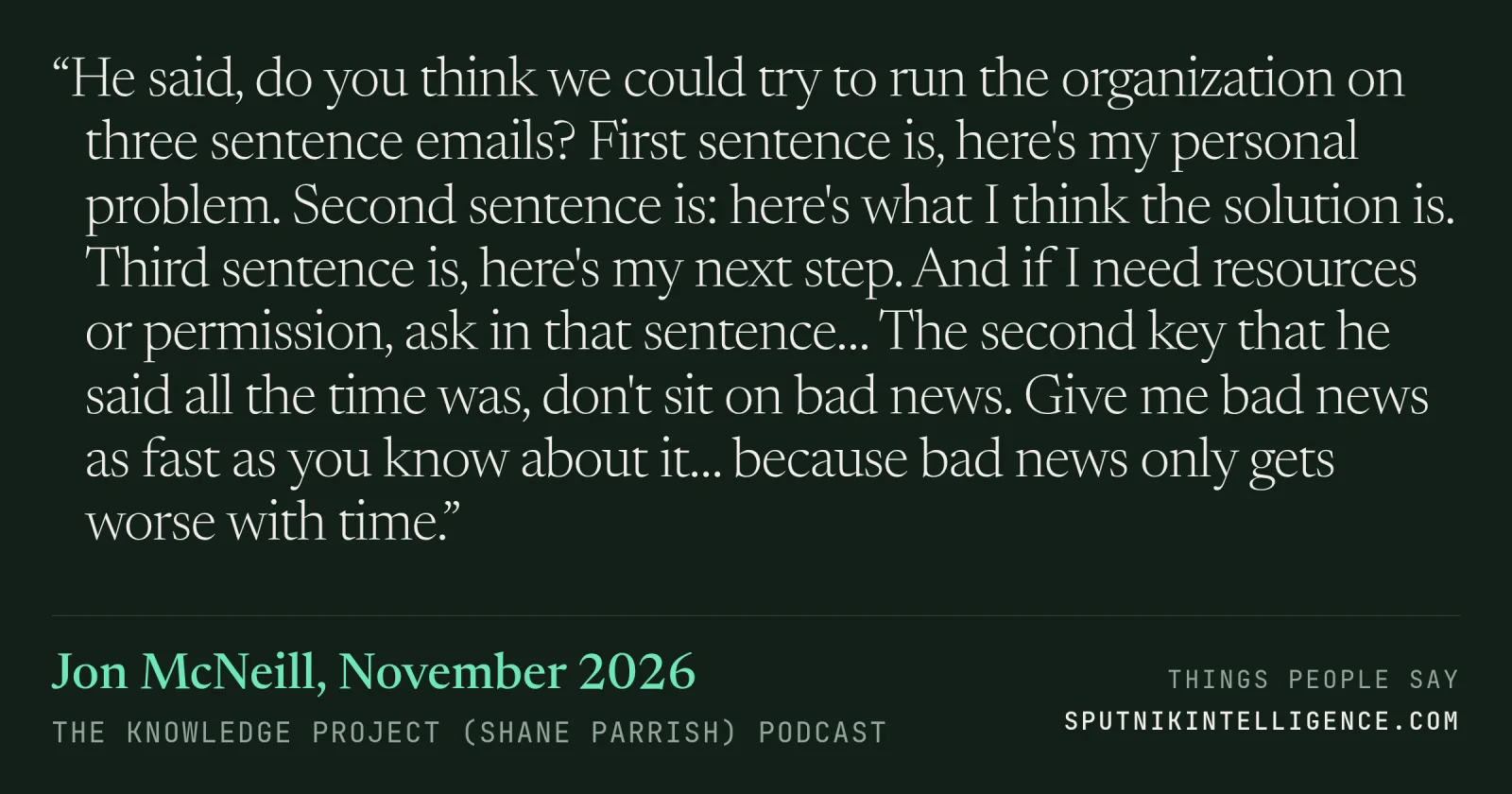
“He said, do you think we could try to run the organization on three sentence emails? First sentence is, here's my personal problem. Second sentence is: here's what I think the solution is. Third sentence is, here's my next step. And if I need resources or permission, ask in that sentence… The second key that he said all the time was, don't sit on bad news. Give me bad news as fast as you know about it… because bad news only gets worse with time.” — Jon McNeill, The Knowledge Project (Shane Parrish)

Asked what he learned about communicating with Elon Musk, Jon McNeill describes the format Musk proposed and says holding back bad news was the surest way to get on his bad side.

The Knowledge Project (Shane Parrish) · 2026-11-10 Permalink → Listen →
The Knowledge Project (Shane Parrish) Around 16:23 into the episode
Jon McNeill

Yeah. Yeah. It was super fun and still is because I still work with a number of those people today.

Shane Parrish

What did you learn about communicating with Elon that was different?

Jon McNeill

It has to be concise. And so we had this kind of fun. We had fun with our communication in the sense that we gave each other a challenge. I don't know who came up with it. And I think it was just his idea. He said, do you think we could try to run the organization on three sentence emails? First sentence is, here's my personal. Problem. Second sentence is: here's what I think the solution is. Third sentence is, here's my next step. And if I need resources or permission, ask in that sentence. And so we started to experiment with this. And it was really the key to communicating with him because he likes that sort of concise, get to the point. Have you super thought about the problem? Have you really thought about the solution? And you thought about the next steps. And that was kind of key to communicating with him. The second key that he said all the time was, don't sit on bad news. Give me bad news as fast as you know about it. And he said this to everybody because bad news only gets worse with time. So like, give me bad news fast. And the way that you could get on his bad side was saving bad news. And I watched that over time. And so those were the two keys to communication, like be concise and be rapid with bad news.

Shane Parrish

How did you guys handle disagreements?

Jon McNeill

We talked through them. Cheryl Sandberg introduced us. And so both of us quizzed Cheryl on how do you and Mark manage your relationship. And she said, okay, we meet once a week religiously for at least an hour. We open with, here are things you've done that have pissed me off, frustrated me…

Shane Parrish

A lot of people who don't avoid the conflict don't necessarily say that in the most receptive way to other people.

Speaker names come from our own diarization. The position is estimated from where the line sits in the episode.
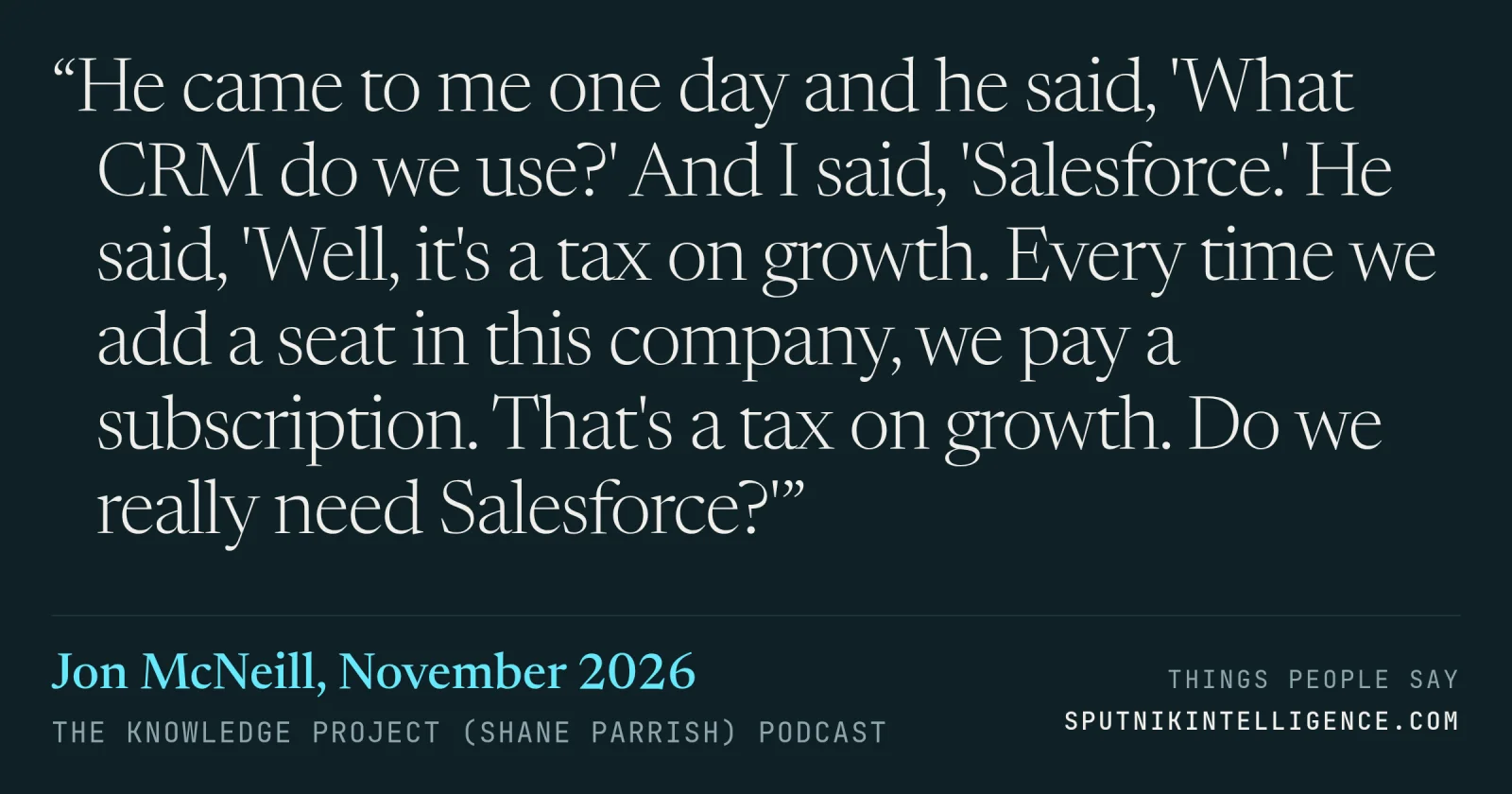
“He came to me one day and he said, 'What CRM do we use?' And I said, 'Salesforce.' He said, 'Well, it's a tax on growth. Every time we add a seat in this company, we pay a subscription. That's a tax on growth. Do we really need Salesforce?'” — Jon McNeill, The Knowledge Project (Shane Parrish)

Asked how often requirements turn out to be leftovers nobody remembers the reason for, Jon McNeill says Elon Musk wanted the 'weed whacker' out constantly on existing processes. The CRM question was his example of what he'd get asked weekly.

The Knowledge Project (Shane Parrish) · 2026-11-10 Permalink → Listen →
The Knowledge Project (Shane Parrish) Around 1:07:18 into the episode
Jon McNeill

…a problem: I start to take it apart, like my grandpa taught me to do. And then, and then once I'm now into it and see what the critical parts are, then you can start to say, does this really need to exist? Could this work differently? And you just start to pull the string on what could work.

Shane Parrish

What percentage of the time do you think when you dive into requirements that maybe they once were needed, but they're not needed, but nobody even knows why they're there anymore? You know,

Jon McNeill

I used to talk about this. Like we used to compare it to a garden. You plant a garden. And in business, like nobody goes out to weed these gardens. And so weeds just grow. It's a garden being a process. And so weeds just grow up and nobody's back there with the weed whacker whacking them out. And every once in a while, an executive will say, Well, this is totally broken. Let's go back there with the weed walker and whack it out. But that happens like once every five years, 10 years. And so he wanted to, and he wanted to build a culture where we had the weed whacker out a lot. Like we were looking at the current process and questioning why we're doing it. And so like he, an example of that is he came to me one day and he said, What CRM do we use? And I said, Salesforce. He said, Well, it's a tax on growth. Every time we add a seat in this company, we pay a subscription. That's a tax on growth. Do we really need Salesforce? And that was a typical question. The kind of question I would get from him on a weekly basis, where…

Shane Parrish

How did you know it was time to leave Tesla?

Jon McNeill

My family. They had a bit of an intervention with me. To his credit, Elon gave Walter permission to write about his mental health struggles in Isaacson's book on Elon. And I was right in the thick of that. And I'm okay in terms of my skill set of handling technical problems and handling…

Shane Parrish

Oh, like you're moody. You're.

Speaker names come from our own diarization. The position is estimated from where the line sits in the episode.
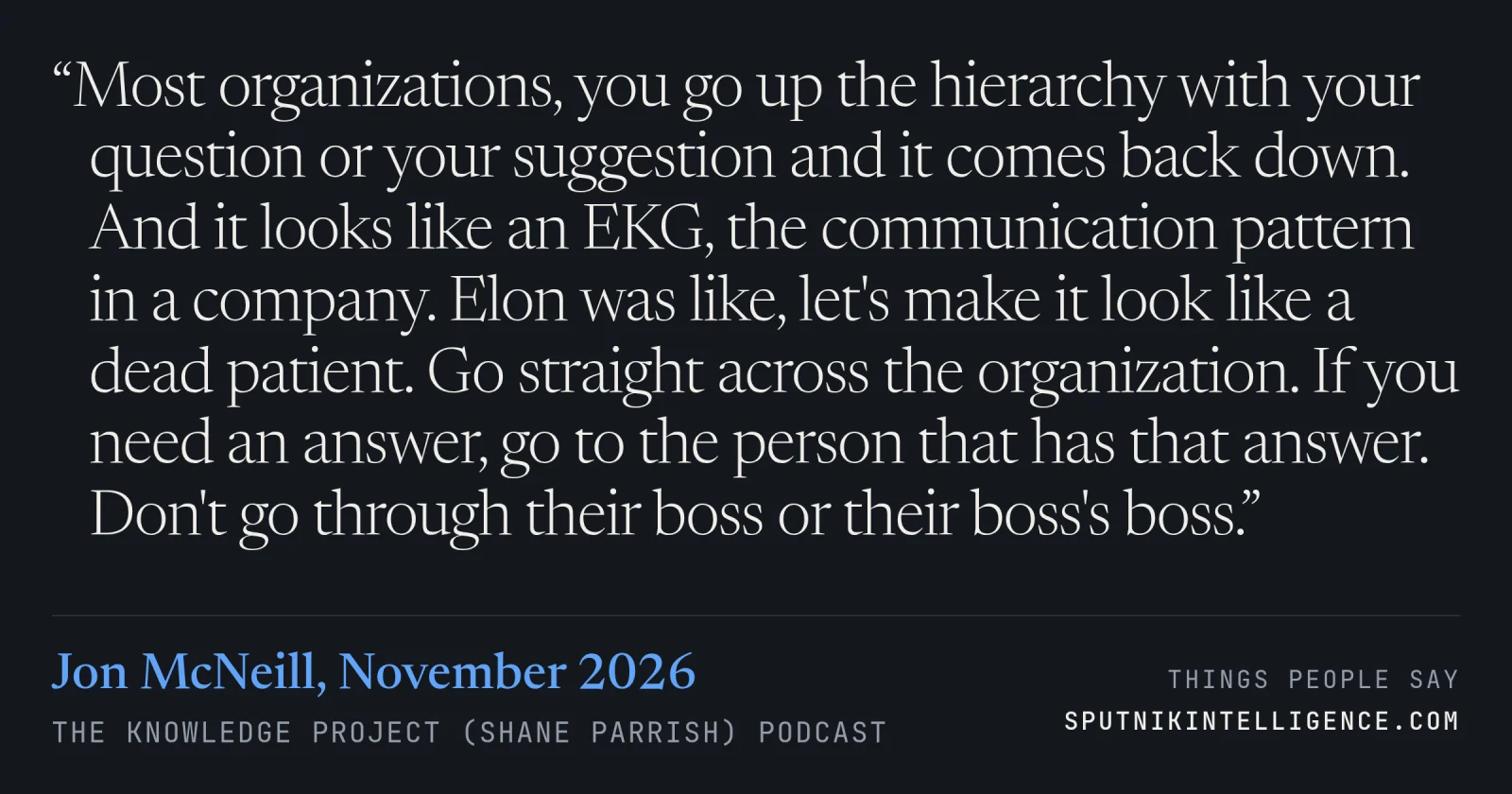
“Most organizations, you go up the hierarchy with your question or your suggestion and it comes back down. And it looks like an EKG, the communication pattern in a company. Elon was like, let's make it look like a dead patient. Go straight across the organization. If you need an answer, go to the person that has that answer. Don't go through their boss or their boss's boss.” — Jon McNeill, The Knowledge Project (Shane Parrish)

Asked how he helped build a winning culture at Tesla, former president Jon McNeill describes how Elon Musk wanted information to flow. The point, he says, was speed of decision-making.

The Knowledge Project (Shane Parrish) · 2026-11-10 Permalink → Listen →
The Knowledge Project (Shane Parrish) Around 14:03 into the episode
Jon McNeill

freaked me out a little bit too. Yeah.

Shane Parrish

How did you go about building a winning culture there?

Jon McNeill

I think all culture comes from founders and the culture was built. And the culture was a first principles culture. It was a culture of rapid communication. So you didn't have to, most organizations, you go up the hierarchy with your question or your suggestion and it comes back down. And it looks like an EKG, the communication pattern in a company. Elon was like, let's make it look like a dead patient. Go straight across the organization. If you need an answer, go to the person that has that answer. Don't go through their boss or their boss's boss. Go directly to them because that's going to help with speed of decision making. So that kind of culture was already set. What the business needed was a bunch of scaffolding. So I went about building a team and then building approach so that we could have a mechanism to essentially double the company every six to eight months, like super rapid growth. And in so doing, we kind of built a culture.…

Shane Parrish

What an incredible way to do that.

Jon McNeill

Yeah. Yeah. It was super fun and still is because I still work with a number of those people today.

Shane Parrish

What did you learn about communicating with Elon that was different?

Speaker names come from our own diarization. The position is estimated from where the line sits in the episode.

Collections They Appear In