
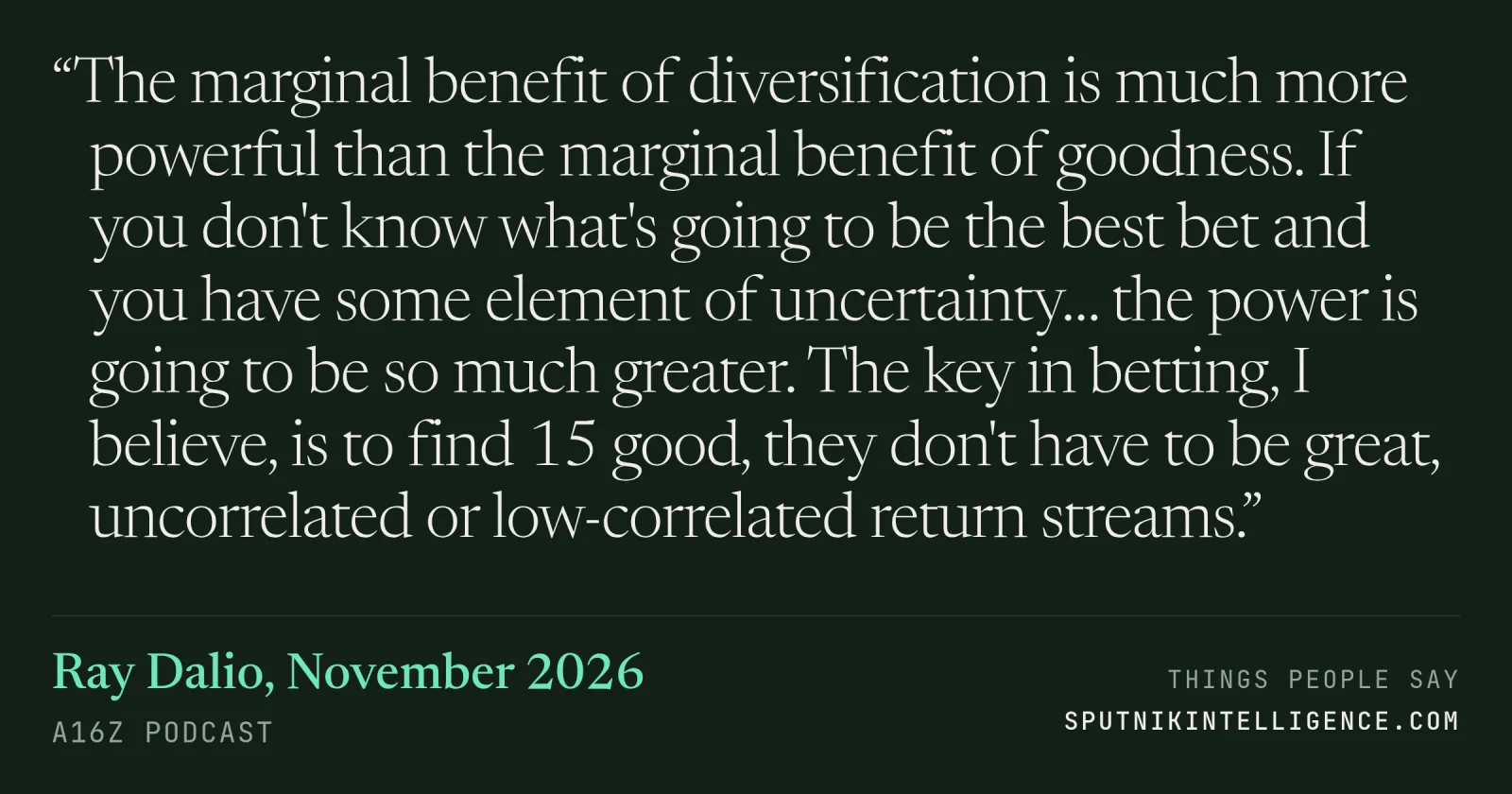
One host had argued for spreading a fund evenly rather than betting big on a single conviction. Dalio agrees and explains why uncorrelated bets improve the return-to-risk ratio. The episode is a 2019 conversation republished this week.
Well, the question is: what is the marginal benefit of diversification relative to the marginal benefit of goodness? It's
a better way of putting it.
And if you really look at that, the marginal benefit of diversification is much more powerful than the marginal benefit of goodness. If you don't know what's going to be the best bet and you have some element of uncertainty, so you're not typing in a number that has an uncertainty to it, you have a distribution of that number, and then you know that diversification works, the power is going to be so much greater. The key in betting, I believe, is to find 15 good, they don't have to be great, uncorrelated or low-correlated return streams. Because if you have, let's say, a 60% correlation between those items that…
So, one question I have, which I think is really great that you've done, is this decision to record errors versus flog the error makers.
Oh, I love that. You called it the error log, and then you changed it to the issue log.
And one thing that I also think is very interesting in terms of how organizations judge process versus output. And I was wondering if you could talk about this a little bit, because if you think about some of the hardest things, like if you want somebody to solve the hardest problem that perhaps…